| Jul 03, 2026 |
Single gold atoms toughen 2D oxides for space optoelectronicsInserting individual gold atoms into a layered oxide yields highly sensitive ultraviolet detectors that keep working through extreme cold, high heat and the intense radiation of space. |
| (Nanowerk Spotlight) Photodetectors for aerospace and deep-space missions must endure two of the harshest conditions: ionizing radiation and extreme thermal cycling. Over time, high-energy particles and repeated temperature swings degrade even the most resilient semiconductors. Van der Waals (vdW) crystals offer structural robustness, yet interfacial defects and operational instability still limit their practical use. |
| "In this context, we have developed a heteroatom-intercalation strategy for two-dimensional (2D) wide-bandgap potassium niobate (KNb₃O₈, KNO) which simultaneously passivates structural defects, induces interfacial polarization, and reconstructs the band structure," says Professor Ruiqing Cheng of the School of Physics and Technology, Wuhan University. "This approach significantly enhances the photodetection performance and enables solar-blind ultraviolet imaging." |
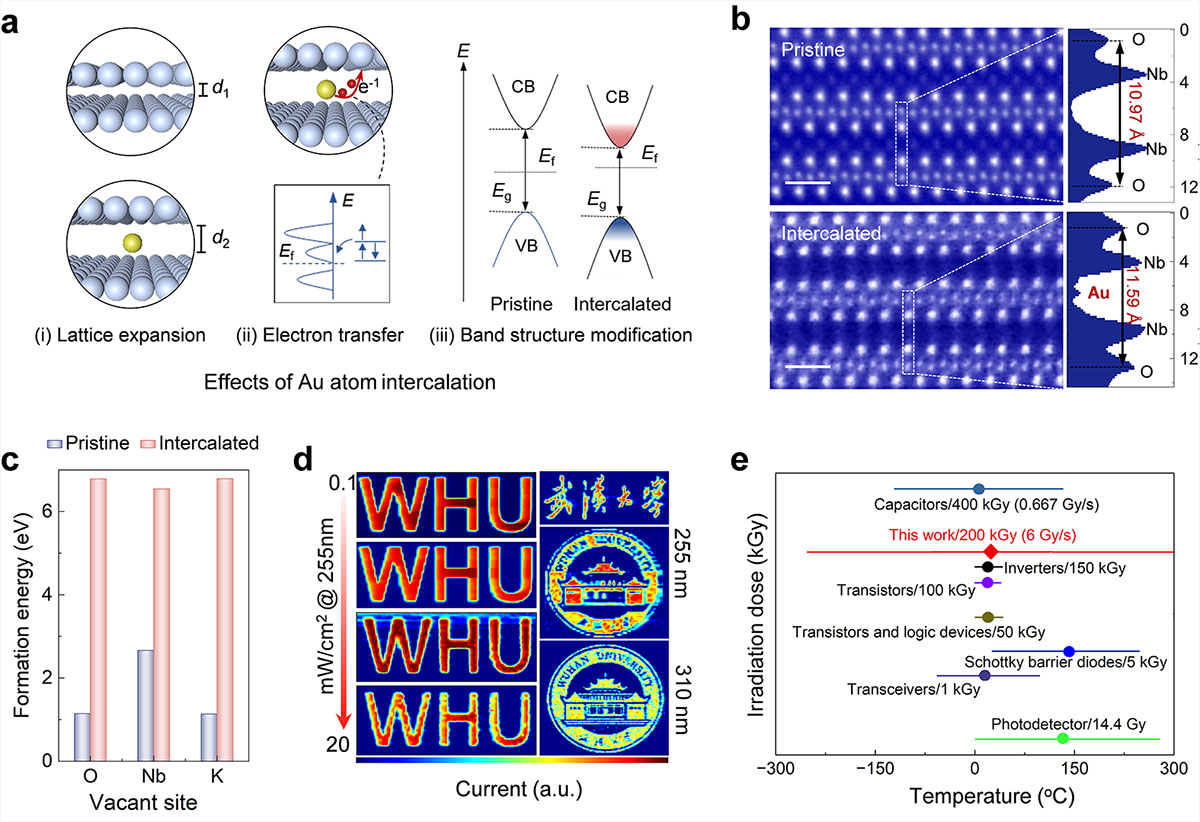 |
| Hetero-atoms interlayering technology achieves high-temperature and radiation-resistant vdW optoelectronic devices. (Image courtesy of the researchers). (click on image to enlarge) |
| 2D layered materials are attractive for optoelectronics, but most existing devices lose performance under radiation or temperature extremes, conditions common in space and aviation. The key challenge is achieving both high sensitivity and rugged environmental tolerance in one material system. |
| The team intercalated gold atoms into the vdW gaps of KNO — and, crucially, as isolated single atoms rather than clusters or nanoparticles, a precision that avoids the heavy-handed doping damage common to other modification strategies. |
| This fulfills three functions: neutralizing recombination-active defects, promoting charge separation via interface polarization, and tuning the electronic bands for optimal photoresponse. By widening the interlayer spacing and reshaping the electronic structure, the guest atoms also open efficient vertical pathways for charge transport between the layers. The engineered material thus overcomes the conventional trade-off between performance and durability. |
| The gains are substantial. Compared with the untreated material, the intercalated detector is markedly more sensitive — its peak responsivity reaches 181.2 A/W — with a far sharper separation between light and dark signals, a faster response, and stable operation over thousands of switching cycles. Together these are enough to capture crisp solar-blind ultraviolet images of fine microstructures. |
| The resulting photodetectors operate stably from −263.15 °C to 300 °C, covering deep-space cold, re-entry heat, and industrial highs. They also withstand γ-ray irradiation up to 200 kGy at 6 Gy/s, far outperforming silicon and other conventional counterparts — to put that in perspective, a dose of just 40 kGy already corresponds to the radiation a device would absorb over a decade in outer space. |
| The resilience traces back to the gold itself: by reinforcing the bonding within the lattice, the single atoms sharply raise the energy needed to displace host atoms, so the defects that radiation would normally create struggle to form in the first place. |
| Moreover, the intercalation not only reinforces environmental resilience but also enables solar-blind detection, which is essential for flame sensing, environmental monitoring, and secure space-borne communications where solar background rejection is critical. |
| This work demonstrates that direct chemical modification of the vdW gap offers a rational route to harsh-environment optoelectronics, avoiding the complexity of heterostructures or encapsulation layers. |
| The simplicity and effectiveness of this strategy, combined with the scalability of 2D oxides, position these devices as promising candidates for real-world aerospace and deep-space applications where traditional photodetectors consistently fail. |
| The study is published in Nature Communications ("Engineering temperature- and radiation-resistant van der Waals oxide optoelectronics via heteroatom-intercalation"). |
| (Source: Provided by Wuhan University as a Nanowerk exclusive) |

|

Become a Spotlight guest author! Join our large and growing group of guest contributors. Have you just published a scientific paper or have other exciting developments to share with the nanotechnology community? Here is how to publish on nanowerk.com. |


