

Biofilm: Definition, Formation, and Why Biofilms Resist Antibiotics
Definition: A biofilm is a community of microorganisms attached to a surface or to each other and embedded in a self-produced extracellular matrix. Biofilms are typically more tolerant of antibiotics, disinfectants, drying, and immune attack than free-floating microbial cells.
What Is a Biofilm?
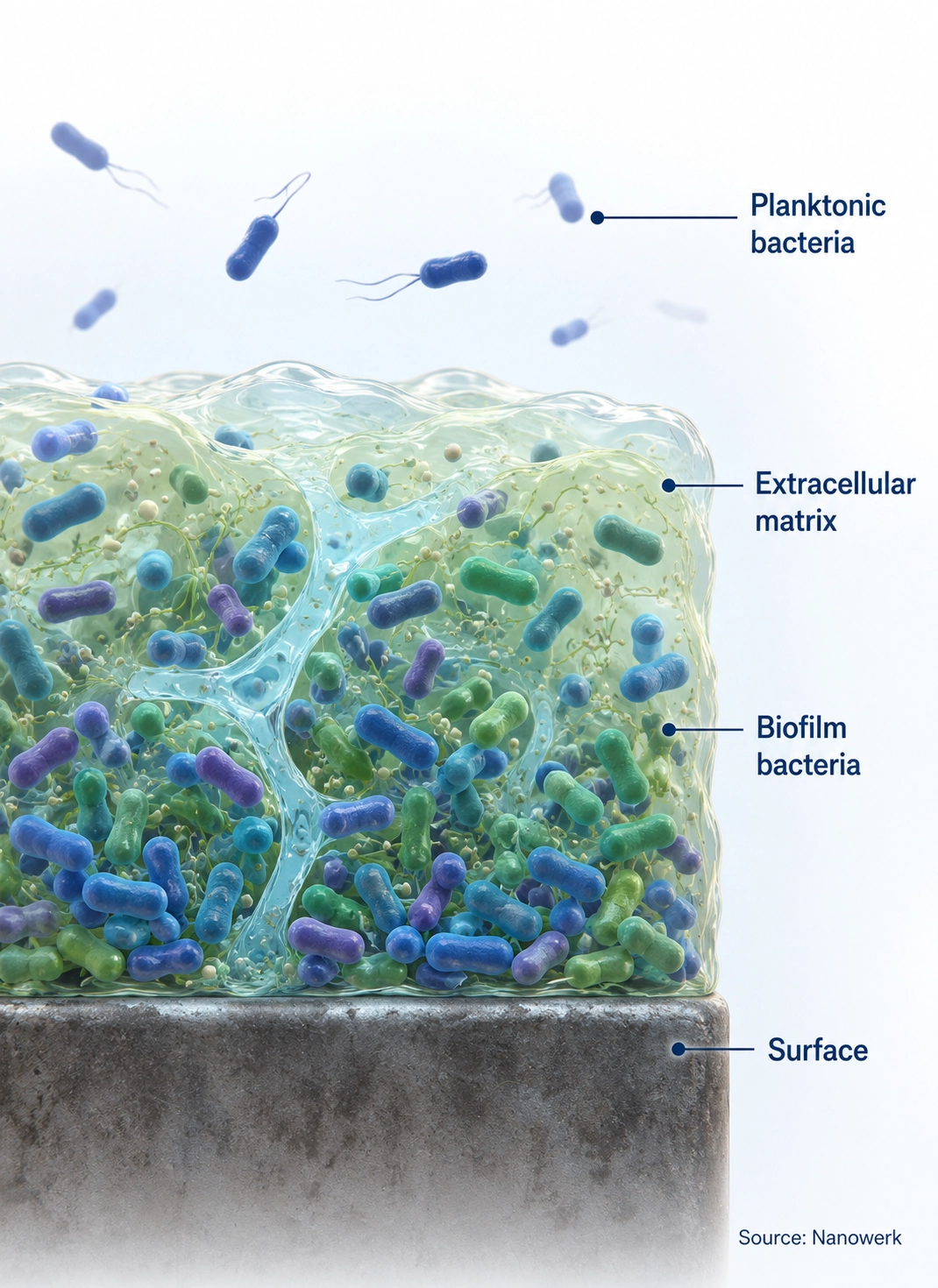
A biofilm is a structured community of microorganisms that live attached to a surface or to one another, embedded in a self-produced slime-like material called the extracellular matrix. The microorganisms involved are usually bacteria, but archaea, fungi, algae, and protozoa can all form or join biofilms, and most natural biofilms contain many different species living together. This way of life stands in contrast to the planktonic state, in which cells float and grow as independent individuals. Far from being an unusual exception, biofilm growth is one of the dominant forms of microbial life: many microorganisms, and probably a large fraction of bacteria in natural environments, live in biofilm-like communities rather than as isolated free-floating cells.
At a glance:
- Biofilm: surface- or aggregate-associated microbial community in a self-produced matrix
- Matrix material: extracellular polymeric substances (EPS) – polysaccharides, proteins, extracellular DNA, lipids
- Opposite state: planktonic (free-floating single cells)
- Life cycle: attachment → microcolony → maturation → dispersal
- Key trait: strong tolerance to antibiotics and host immune defenses
- Communication: quorum sensing coordinates group behavior
Biofilms are everywhere: on submerged rocks in a stream, on ship hulls, on teeth as dental plaque, inside water pipes, on food-processing equipment, and on virtually every kind of medical implant. They matter for human health because surface-attached microbial communities behave very differently from the same organisms growing in a test tube. Biofilms are widely implicated in persistent and device-associated infections; many reviews estimate that a large fraction of microbial infections, especially chronic infections, involve biofilm growth. Often-cited figures put this share in the range of roughly 65–80%, although the exact number depends on how “biofilm-associated” infection is defined. In a mature biofilm, the self-produced matrix — not the cells — can account for the majority of the dry mass.
Surface-attached microbial growth was first seen in the 1680s, when Antonie van Leeuwenhoek described the “animalcules” in scrapings from his own teeth, but the modern concept took shape only in the late twentieth century. The microbiologist J. William Costerton is widely credited with establishing the idea that biofilms are a distinct, regulated mode of microbial existence rather than incidental clumps of cells. That reframing — biofilm as a developmental state with its own gene expression program, architecture, and physiology — is the foundation of modern biofilm science and is increasingly important across biotechnology, medicine, and environmental engineering.
How Biofilms Form: The Biofilm Life Cycle
Biofilm formation is usually described as a cycle of five conceptual stages: reversible attachment, irreversible attachment, microcolony formation, maturation into a three-dimensional structure, and dispersal. The model is a simplification — real biofilms vary widely, and not every community follows every step in order — but it captures the essential progression from a free-living cell to an organized surface community and back again.
Attachment begins when planktonic cells encounter a surface. Most surfaces in natural and biological environments are quickly coated by a thin “conditioning film” of adsorbed proteins and other molecules that alters how cells stick. Initial contact is reversible and is mediated by weak physical forces and by appendages such as flagella and pili. If conditions are favorable, cells commit to the surface through specific adhesin proteins, and attachment becomes effectively irreversible as the cell begins to produce matrix material.
Once anchored, cells divide and recruit additional organisms to form microcolonies, and the community begins to secrete DNA, polysaccharides, and proteins that bind the population together. As the biofilm matures it develops a characteristic three-dimensional architecture — in many species, tower- or mushroom-shaped microcolonies separated by water-filled channels that help move nutrients in and waste products out. This developmental shift is accompanied by large-scale changes in gene regulation, and in many bacteria the intracellular signaling molecule cyclic di-GMP acts as a master switch that tips cells from the motile, planktonic lifestyle toward the sessile, matrix-producing biofilm state.
Dispersal completes the cycle. Cells can leave a biofilm passively, through erosion or shearing by fluid flow, or actively, through a programmed response in which the community produces enzymes that degrade its own matrix and releases cells that revert to the planktonic state. Active dispersal is biologically and clinically significant: it allows a biofilm to colonize new sites, and in an infected patient a dispersal event can seed a localized infection into the bloodstream.
The Extracellular Matrix: Structure and Composition
The defining feature of a biofilm is its matrix of extracellular polymeric substances, often abbreviated EPS. The matrix is a hydrated network composed mainly of polysaccharides, proteins, extracellular DNA, and lipids, and in many mature biofilms it makes up the bulk of the volume, with the cells themselves occupying a minor fraction. The matrix is not inert packaging. It provides mechanical stability, glues the community to surfaces and holds cells together, retains water and protects against drying, and concentrates secreted enzymes so that the biofilm functions, in effect, as an external digestive system that breaks down nutrients for the whole population.
The matrix is one of the main reasons biofilms are so resilient, especially when combined with slow growth, chemical gradients, stress responses, and dormant subpopulations. It acts as a diffusion barrier and chemical sponge, slowing and binding antimicrobial agents before they reach the cells, and it shields the community from desiccation, ultraviolet light, and immune attack. Because nutrients and oxygen are consumed faster than they can diffuse inward, a thick biofilm contains steep chemical gradients, creating distinct microenvironments. Cells in the same biofilm therefore experience very different conditions, producing a physiologically diverse population that includes slow-growing and dormant cells — a heterogeneity central to how biofilms survive stress.
Quorum Sensing and Coordinated Behavior
Many biofilm behaviors are coordinated through quorum sensing, a form of chemical communication that lets bacteria sense their own population density. Cells continuously release small diffusible signal molecules called autoinducers; as the population grows and the local signal concentration rises past a threshold, the molecules bind regulators inside the cells and trigger a coordinated change in gene expression across the group. Gram-negative bacteria typically use acyl-homoserine lactones, Gram-positive bacteria use modified peptides, and a signal called autoinducer-2 supports communication between species. Mechanistically, quorum sensing is a signal transduction system that converts a population-level cue into a cellular response.
In biofilms, quorum sensing helps regulate matrix production, the expression of virulence factors, and the timing of dispersal, allowing the community to act in a partially coordinated way rather than as isolated individuals. It is an important regulatory input but not the sole controller of biofilm development, which also depends on nutrients, surface properties, and signals such as cyclic di-GMP. Because quorum sensing influences how aggressive and cohesive a biofilm becomes, interfering with it — an approach called quorum quenching — is an actively studied strategy for weakening biofilms without trying to kill the bacteria outright.
Why Are Biofilms Hard to Kill?
Key takeaway: A biofilm is not just a pile of microbes. It is a surface-associated microbial community whose matrix, chemical gradients, and coordinated behavior make it more persistent than free-floating cells.
A central clinical fact about established biofilms is that they can be much harder to kill than the same bacteria growing planktonically, sometimes requiring antibiotic concentrations orders of magnitude higher to achieve the same effect in laboratory tests. It is important to distinguish tolerance from resistance. Resistance is a heritable genetic capacity to grow in the presence of a drug. Biofilm recalcitrance is largely tolerance: a reversible, community-level ability to survive exposure that does not depend on classical resistance genes. Several mechanisms act together — the matrix slows and sequesters drugs, slow growth and nutrient limitation make many antibiotics less effective, and a subpopulation of dormant “persister” cells survives treatment and can regrow once the drug is withdrawn.
The same features that frustrate antibiotics can also blunt the host immune response, so biofilm infections often become chronic or recurrent rather than resolving quickly. Biofilms underlie many persistent conditions, including infections of catheters, prosthetic joints and heart valves, the chronic lung infections of cystic fibrosis, non-healing wounds, endocarditis, and periodontitis. Biofilms also serve as hotspots for the horizontal exchange of genetic material between cells in close contact, which can accelerate the spread of genuine antibiotic-resistance genes through a microbial population — so a tolerant biofilm can additionally become a breeding ground for inherited resistance.
Biofilms in Medicine, Industry, and the Environment
In clinical and industrial settings biofilms are usually a problem. On medical devices they cause device-associated infections that often force removal of the implant; in the mouth they form dental plaque; on ship hulls, heat exchangers, and filtration membranes they cause biofouling that reduces performance and raises energy costs; and in pipelines and storage tanks they drive microbially influenced corrosion. In food processing and drinking-water systems, biofilms shelter pathogens from cleaning and disinfection, creating persistent contamination that is difficult to eradicate.
Biofilms are also indispensable to many natural and engineered processes. They are the engine of biogeochemical cycling in soils, sediments, and oceans, and the active component of biological wastewater treatment, where communities growing on supports or as granules degrade organic pollutants. In metagenomics-driven studies of environmental and host-associated microbiomes, biofilms are repeatedly found to be where much of the community's metabolic work happens, including in the gut and on plant roots, where root-associated biofilms support nutrient uptake and protect against pathogens.
Harnessing and Controlling Biofilms in Biotechnology
Biotechnology both exploits beneficial biofilms and fights harmful ones. On the constructive side, immobilized microbial communities are used in bioreactor systems for wastewater treatment and in industrial bioprocessing and fermentation, where cells held in a biofilm are more robust and easier to retain than suspended cultures. Biofilm electrodes are central to microbial fuel cells and bioelectrochemical systems, biofilms are used as the living catalyst in bioremediation, and they are being engineered as engineered living materials and as the sensing element in microbial biosensors. Tools from synthetic biology and genetic engineering increasingly allow researchers to program when and how matrix is made, turning the biofilm itself into a designable material.
Controlling unwanted biofilms is a parallel research effort, and because the matrix and dormant cells make established biofilms so tolerant, prevention and disruption are emphasized alongside killing. Strategies under investigation include anti-adhesive and antimicrobial surface coatings that block initial attachment, matrix-degrading enzymes such as DNase and dispersin B, agents that trigger dispersal, quorum-quenching molecules that disrupt cell-to-cell signaling, and bacteriophage therapy, often combined with conventional antibiotics rather than used alone. In medicine these approaches are paired with physical removal — debridement of infected tissue or replacement of a colonized device — because mechanical disruption remains one of the most reliable ways to clear a mature biofilm. Molecular biology studies of how biofilms assemble continue to supply new targets for both controlling and harnessing them.
Frequently Asked Questions
Is dental plaque a biofilm? Yes. Dental plaque is one of the most familiar and best-studied biofilms. It is a structured microbial community attached to the tooth surface within a self-produced matrix, and dental plaque was among the first microbial communities ever observed microscopically when Antonie van Leeuwenhoek examined tooth scrapings in the 1680s. Because plaque resists removal by saliva and rinsing, mechanical disruption by brushing and flossing remains the primary control measure.
What is the difference between planktonic bacteria and a biofilm? Planktonic bacteria are individual cells that live freely suspended in a liquid, while a biofilm is a surface-attached or aggregated community embedded in a shared matrix. The same strain can behave very differently in the two states: biofilm cells often switch on different genes, grow more slowly, cooperate metabolically, and become more tolerant of antibiotics and host defenses. The transition between planktonic and biofilm growth is reversible.
Are all biofilms harmful? No. Many biofilms are harmful in medical and industrial settings, but biofilms are also essential to natural and engineered processes. They drive nutrient cycling, support wastewater treatment, aid bioremediation and biocatalysis, and form beneficial associations with plant roots and animal guts. Whether a biofilm is a problem or an asset depends on where it grows and what it does there.
Can you see a biofilm with the naked eye? Sometimes. Individual microorganisms are microscopic, but a mature biofilm containing many cells and matrix can be visible as slime, film, or scum. Familiar examples include the slippery coating on river stones, slime inside a flower vase or drain, dental plaque, and film on a contact lens case. Many medically important biofilms, however, are too thin or hidden to see directly.
How are biofilm-related infections treated? Established biofilm infections are often difficult to clear with antibiotics alone because the matrix, slow growth, and dormant cells can make the community tolerant to drugs that would kill the same bacteria when free-floating. Clinical management may combine antibiotics with physical removal of the biofilm, such as surgical debridement or removal of an infected implant or catheter. Experimental approaches include matrix-degrading enzymes, dispersal agents, quorum-sensing inhibitors, and bacteriophage therapy used alongside conventional antibiotics.
Further Reading
Nature Reviews Microbiology, The Biofilm Matrix
Nature Reviews Microbiology, Biofilms: An Emergent Form of Bacterial Life
Nature Reviews Microbiology, The Biofilm Matrix: Multitasking in a Shared Space
Nature Reviews Microbiology, Tolerance and Resistance of Microbial Biofilms
npj Antimicrobials and Resistance, Mechanisms of Antimicrobial Resistance in Biofilms
