

Engineered Living Materials: Definition, Design, Applications, and Limitations
What Are Engineered Living Materials?
Engineered living materials (ELMs) are composites in which genetically programmed cells remain alive inside a polymer or mineral matrix, giving the material the ability to grow, sense, respond, and self-repair. The cells are not a passive additive; they are the active functional component, and the matrix is either secreted by the cells themselves or supplied as a synthetic scaffold that hosts them.
ELMs sit at the intersection of synthetic biology and materials science. Conventional biomaterials, even highly bioactive ones, are essentially static after fabrication. A living material continues to metabolize. It can divide, secrete proteins, precipitate minerals, change colour, switch on a sensor, or rebuild itself after damage. These behaviours emerge from the same genetic and biochemical processes that natural living tissues such as bone, wood, skin, and bacterial biofilms use to construct themselves – capabilities that biotechnology can now reproduce in engineered form.
The term took shape in the mid-2010s, partly through a U.S. Defense Advanced Research Projects Agency (DARPA) program that funded early exploration of biologically grown materials, and was consolidated by an influential 2018 review that framed ELMs as a class of advanced materials made by embedding programmable cells into bulk objects. Since then the field has expanded rapidly, with demonstrations ranging from self-healing concrete and bacterial bioplastics to bandages that release antibiotics on demand and structural blocks made from fungal mycelium and engineered bacteria. ELMs are sometimes called biological engineered living materials, living functional materials, or simply living materials, depending on author and discipline.
Not to be confused with: bioactive biomaterials such as collagen scaffolds or drug-eluting hydrogels, which interact with cells but do not contain living cells of their own; bioreactor cultures, which produce material as an output but do not assemble it into a usable structure; or unmodified natural materials such as wood or leather, which were once living but are not engineered.
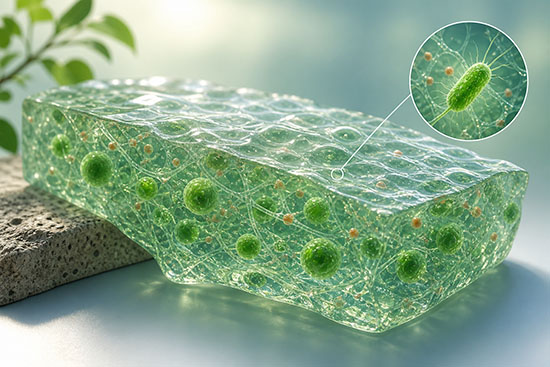
Engineered living materials combine living cells with a supportive matrix, creating biohybrid materials that can be designed to sense their environment, repair damage, grow, or produce useful molecules. (Image: Nanowerk)
How Engineered Living Materials Differ from Conventional Biomaterials
A conventional biomaterial such as a hydrogel, an absorbable suture, or a reinforced concrete is fabricated, then used. Its properties are set at the time of manufacture. An ELM keeps a living population inside the object, and that population executes a genetic program over the lifetime of the material. The result is a different category of behaviour: the material can adapt to inputs, replenish itself, and produce molecules in place rather than being loaded with them.
| Feature | Conventional biomaterial | Engineered living material |
|---|---|---|
| Active component | Polymer, ceramic, or fiber, sometimes with a bioactive coating | Living cells with engineered genes, embedded in a matrix |
| Properties over time | Static, may degrade | Dynamic, can grow, repair, or change function |
| Response to environment | Passive, defined by chemistry | Programmable through synthetic gene circuits |
| Manufacturing | Chemical or mechanical processing | Cell culture, fermentation, or microbial growth on feedstock |
| Typical strength | Often higher, well characterized | Generally lower, improving with mineralization or fiber engineering |
| Containment concern | Minimal | Significant if cells are genetically modified |
The trade-off is direct. ELMs gain functions that no inert material can provide, but they also inherit the constraints of biology: cells need water and nutrients, they have a finite lifespan unless dormant or sporulated, and genetically modified strains require careful biosafety design. The engineering challenge is to keep the living component productive long enough to be useful while building a matrix that meets real-world mechanical and regulatory requirements.
How ELMs Are Designed and Built
Building an ELM involves three coupled design problems: choosing a chassis organism, choosing or co-engineering a matrix, and writing the genetic program that links cellular behaviour to the desired material function. Each choice constrains the others. A bacterium that thrives at body temperature is not suitable for outdoor concrete, and a hydrogel that supports mammalian cells will not survive industrial fermentation conditions.
1. The chassis
Most ELMs use microbial chassis because genetic engineering tools for bacteria, yeasts, and fungi are well established. Escherichia coli and Bacillus subtilis are workhorses for laboratory ELMs because their genetics are deeply characterized. Komagataeibacter species are favoured for cellulose-producing materials. Cyanobacteria are used for photosynthetic, light-driven systems. Fungal mycelium provides naturally porous, structural networks. Yeasts such as Saccharomyces cerevisiae are used in food-adjacent ELMs and in symbiotic communities with bacteria. Mammalian cells are increasingly used for tissue-engineering oriented ELMs, where the matrix takes the form of an organoid or implant scaffold.
2. The matrix
Two strategies dominate. In exogenic ELMs, cells are encapsulated in an externally supplied matrix such as alginate, agarose, polyethylene glycol hydrogel, or silica. The matrix protects the cells, retains them at a defined location, and controls diffusion of nutrients and signals. In autogenic ELMs, the cells produce the matrix themselves. Bacterial cellulose, curli protein nanofibers in E. coli, biofilm exopolysaccharides, and bacterially induced calcium carbonate are all examples of cell-secreted matrices. Autogenic systems are more elegant because the matrix can grow, regenerate, and respond as part of the same biological program, but they are typically harder to engineer to high mechanical strength.
3. The genetic program
Inside the chassis, synthetic genetic circuits define what the material does. These circuits are built from standard parts – promoters, ribosome binding sites, coding sequences, and terminators – combined into devices that sense an input, process it, and drive an output. A simple ELM might use one inducible promoter to switch on production of an antimicrobial peptide. A more sophisticated one might combine quorum sensing for cell-cell communication, a logic gate that integrates two environmental signals through signal transduction, and a memory element that records past exposure. Genome editing tools, particularly CRISPR-Cas9, accelerate the assembly of these circuits and allow precise insertion of designed genetic constructs into the chassis.
4. Manufacturing
ELMs are produced by cell culture, microbial fermentation, or growth on solid feedstocks. Hydrogel-based ELMs are often cast or extruded with cells already mixed into the precursor, then crosslinked. 3D bioprinting deposits cell-laden bioinks layer by layer to produce shaped objects with controlled internal architecture. Spores of Bacillus subtilis can be printed and later germinated, allowing dry, shelf-stable ELM precursors. Fungal-bacterial biocomposites are typically grown on lignocellulosic waste in moulds and then dried, killed, or kept partly alive depending on the application.
Common Chassis Organisms and Their Roles
The choice of chassis organism is the most consequential design decision for an ELM. It determines which genetic tools are available, what molecules and structures the cell can produce, what temperatures and chemistries the material will tolerate, and how stringently the system must be contained. The chassis used in published work cluster into a small number of families with distinct strengths.
| Chassis | Why it is used | Typical ELM application | Main limitation |
|---|---|---|---|
| E. coli | Best-characterized genetics, fast growth, curli protein nanofibers | Hydrogel sensors, tunable plastics, gut-resident therapeutics | Public perception, biosafety in non-laboratory settings |
| Bacillus subtilis | Robust biofilm matrix, sporulation enables shelf stability | Programmable biofilms, resilient living devices | Lower expression yields than E. coli for some proteins |
| Komagataeibacter spp. | Secretes pure bacterial cellulose at high yield | Cellulose textiles, packaging, wound dressings | Slower growth, fewer modular genetic tools |
| Cyanobacteria | Photosynthetic, biomineralizing, low-input | Living building materials, carbon-capturing structures | Long doubling times, light dependence |
| Fungal mycelium | Forms strong porous networks from agricultural waste | Bricks, packaging foams, mycelium-bacteria composites | Genetic toolkits less mature than for bacteria |
| Mammalian cells | Compatible with human tissue, complex secretomes | Living implants, programmable organoids, tissue-engineered grafts | Demanding culture conditions, immunogenicity |
A trend in current work is to combine chassis rather than rely on a single strain. Fungal mycelium can serve as a porous scaffold for biomineralizing bacteria, cellulose-secreting bacteria can be co-cultured with yeasts that supply small molecules, and multistrain consortia can run multistep reactions that no single strain completes. Stable interspecies interactions, however, are an engineering problem in their own right, because cells that grow well in isolation may compete, signal, or destabilize when combined.
Applications of Engineered Living Materials
Sustainable construction and biomineralization
One of the most studied directions is the replacement or supplementation of cement, which is responsible for roughly 8% of global carbon dioxide emissions. Living building materials use bacteria such as Sporosarcina pasteurii or photosynthetic cyanobacteria to precipitate calcium carbonate inside a sand or gel scaffold, hardening it through a process called microbially induced calcium carbonate precipitation. In a 2020 study, photosynthetic cyanobacteria embedded in sand-gelatin scaffolds biomineralized the structure and could be regrown across multiple generations from a single parent block. More recent work has combined fungal mycelium scaffolds with biomineralizing bacteria to produce living, self-repairing composites whose cells remain metabolically active for at least a month, opening the way to materials that close cracks autonomously rather than degrading.
Biomedical applications and living therapeutics
In medicine, ELMs are being developed as living bandages, ingestible therapeutics, and bioactive implants. Engineered E. coli Nissle has been built into hydrogels that secrete therapeutic proteins inside the gut, where the bacteria adhere to the mucosa and deliver matrix-tethered domains for treating inflammatory bowel disease. Bacterial spores have been printed into resilient, shelf-stable patches that activate when rehydrated, allowing wound dressings that release antimicrobials only in response to infection. Mammalian-cell ELMs blur the line between materials and tissue engineering, creating implantable constructs that integrate with host tissue and could support regenerative medicine for damaged organs.
Biosensing and bioremediation
Because cells already sense their environment with high sensitivity, ELMs make natural biosensors. Engineered bacteria embedded in hydrogels or paper-like substrates can be programmed to fluoresce, change colour, or release a reporter enzyme in the presence of heavy metals, pathogens, or specific small molecules. The same logic supports bioremediation, where engineered microbial communities trapped in a matrix degrade contaminants such as organophosphates or capture heavy metals from water without releasing the cells into the environment. Multistrain consortia can perform multistep reactions that single-strain systems cannot complete.
Sustainable packaging and consumer materials
A growing branch of the field aims to replace petrochemical plastics with cell-grown alternatives. Bacterial cellulose from Komagataeibacter is already used in textile prototypes and food packaging. In 2024, researchers reported a flushable, compostable plastic made from cultured bacterial biomass containing engineered curli protein nanofibers, with mechanical properties tunable across more than two orders of magnitude and full biodegradation within 15 to 75 days. Such materials offer a route to packaging that performs like plastic during use but composts like paper at end of life.
Limitations and Biosafety Considerations
Several practical and ethical constraints shape what ELMs can become. Mechanical performance is the most obvious. Even the strongest demonstrated living concretes and mycelium composites are weaker than conventional Portland cement or fibre-reinforced polymers, and most laboratory ELMs lose function as cells die or starve. Manufacturing throughput is another bottleneck: scaling from gram-level laboratory yields to industrial output requires reliable cell culture or fermentation infrastructure that does not yet exist for most chassis-matrix combinations.
Biosafety is the most serious societal question. Many ELMs use genetically modified organisms, and any deployment outside a contained laboratory raises concerns about horizontal gene transfer, unintended persistence, and ecological effects. Common containment strategies include physical barriers such as multilayer hydrogels, auxotrophy that makes the cells dependent on a synthetic nutrient unavailable in the environment, and engineered kill switches that trigger cell death outside defined conditions. Each strategy has limitations, and regulators in different jurisdictions treat ELMs differently depending on whether they are classified as devices, drugs, contained-use organisms, or environmental releases.
Reproducibility is also non-trivial. Living systems vary across batches in ways that polymers do not. Two ELM blocks made from the same genetic design and the same starter culture can perform differently if temperature, humidity, or feedstock composition shift even slightly. The field is developing standards for reporting cell viability, genetic stability across generations, and material-property variance, but these are not yet uniform.
Future Directions
Several trends are visible in current literature. One is the move toward multistrain ELMs, where two or more engineered species cooperate to perform tasks no single strain can complete – a fungus providing a structural scaffold, for example, while a bacterium biomineralizes it. Another is the integration of ELMs with electronics and information-processing layers to create living devices that combine biological sensing with digital readout. A third is the cautious extension of ELMs into mammalian systems, where genetically programmed cells are assembled into therapeutic implants that integrate with the recipient's tissue.
The most fundamental shift, however, is conceptual. Treating a material as a living, programmable system rather than a fixed object reframes what materials can do. Instead of asking how to make a stronger or lighter polymer, designers can ask what behaviour the material should exhibit over its lifetime: when it should grow, when it should sense, when it should repair, and when it should die. ELMs are early demonstrations of that idea, and the engineering problem of the next decade is to make them robust, scalable, and safe enough to act on it outside the laboratory.
Frequently Asked Questions
What is the difference between an engineered living material and a conventional biomaterial? Conventional biomaterials are inert or only passively bioactive. An engineered living material contains genetically programmed cells that remain alive inside the matrix, so the material can grow, divide, sense its environment, and produce new molecules on demand. The cells are the active component, not just a coating or additive.
Are engineered living materials the same as synthetic biology? They are closely related but not identical. Synthetic biology designs and rewires genetic circuits inside cells. Engineered living materials apply those circuits at the scale of bulk materials, embedding programmed cells in matrices so the engineered behavior is expressed in a usable physical object such as a hydrogel, fiber, or building block.
Can engineered living materials replace concrete or plastic? Not yet at scale. Living concrete and bacterial bioplastics have been demonstrated in laboratory and prototype settings, with self-healing and biodegradability as key advantages. Strength, manufacturing throughput, regulatory approval, and cost still limit broad commercial replacement of conventional materials.
Are engineered living materials safe to release into the environment? Most current designs are not intended for environmental release. Researchers use containment strategies such as physical encapsulation, auxotrophy, and engineered kill switches to prevent genetically modified cells from escaping or persisting. Each application requires its own biosafety and regulatory assessment.
Which organisms are most commonly used in engineered living materials? Bacteria such as Escherichia coli, Bacillus subtilis, and Komagataeibacter are the most common chassis. Yeasts, photosynthetic cyanobacteria, fungal mycelium, and increasingly mammalian cells are also used. The choice depends on the function needed: strong genetic tools, fast growth, biomineralization, structural fiber production, or compatibility with the human body.
Can engineered living materials self-heal? Yes, this is one of their defining features. Because the cells inside the material remain metabolically active, they can grow into cracks, regenerate damaged regions, or precipitate new mineral or polymer to restore mechanical integrity. Demonstrated examples include living concrete and mycelium-bacteria composites that close cracks autonomously.
Selected References
Advanced Materials, Engineered Living Materials: Prospects and Challenges for Using Biological Systems to Direct the Assembly of Smart Materials
Nature Reviews Materials, Engineered Living Biomaterials
Chemical Reviews, Engineered Living Materials for Sustainability
Nature Communications, Mechanically Tunable, Compostable, Healable and Scalable Engineered Living Materials
Cell Reports Physical Science, Mycelium as a Scaffold for Biomineralized Engineered Living Materials
