

Biosensors: Analytical Devices that Detect Biological and Chemical Targets
What are Biosensors?
A biosensor is an analytical device that couples a biological recognition element with a physical transducer to detect a specific chemical or biological target, converting a molecular binding event into a measurable signal. The recognition element – typically an enzyme, antibody, aptamer, nucleic acid, or whole cell – provides molecular selectivity, while the transducer converts the recognition event into an electrical, optical, or mechanical output that can be quantified.
Biosensors bridge the worlds of biotechnology, analytical chemistry, and microelectronics. They have become essential tools in clinical diagnostics, food safety, environmental monitoring, and research, with the glucose test strip used by people with diabetes widely cited as the most commercially successful example. The integration of nanomaterials into biosensor design has substantially improved sensitivity, selectivity, and miniaturization, giving rise to a class of devices often referred to as nanobiosensors.
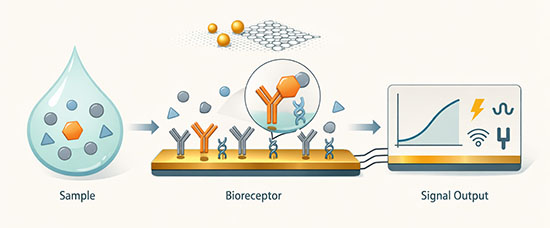
How Biosensors Work
The home blood glucose meter illustrates the generic biosensor workflow well. A drop of blood is applied to a disposable strip coated with the enzyme glucose oxidase. The enzyme selectively binds glucose and catalyzes its oxidation to gluconolactone, producing hydrogen peroxide (H2O2) as a byproduct. The H2O2 is then oxidized at an electrode in the strip, releasing electrons that generate a small current. The current is proportional to the glucose concentration in the sample, and the meter converts it into a numerical readout in a few seconds.
This example captures the two-stage principle shared by all biosensors. First, the bioreceptor selectively binds the target analyte in a complex sample matrix that contains many chemically similar interfering species. This biorecognition event produces a localized physical or chemical change – a shift in mass, charge, refractive index, or the release of a reaction product – at the transducer interface. Second, the transducer converts this change into a proportional electrical signal that can be amplified, digitized, and interpreted.
The quality of a biosensor is defined by several intertwined parameters: sensitivity (the smallest analyte concentration that produces a detectable signal), selectivity (the ability to distinguish the target from interferents), response time, dynamic range, reproducibility, and operational stability. Achieving low detection limits in real biological samples such as blood, sweat, or saliva is particularly challenging because these fluids contain thousands of molecules at concentrations spanning many orders of magnitude.
Classification by Recognition Element
Biosensors are commonly categorized by the type of biological recognition element they employ, as the receptor dictates the specificity, affinity, and operational conditions of the device.
Enzymatic Biosensors
Enzymatic biosensors, like the glucose sensor described above, use immobilized enzymes to catalyze a reaction with the target analyte, generating a detectable product such as hydrogen peroxide, protons, or a change in oxygen consumption. Enzymes offer powerful catalytic amplification because each enzyme molecule turns over many substrate molecules per second, effectively multiplying the signal per binding event. The trade-off is that enzymes can denature over time and are sensitive to pH, temperature, and inhibitors in the sample, which limits shelf life and complicates use in harsh matrices.
Immunosensors
Immunosensors exploit the highly specific binding between antibodies and their cognate antigens. Because antibodies can be raised against virtually any target – from small molecules to whole pathogens – immunosensors are extremely versatile. They underpin many point-of-care diagnostics, including pregnancy tests and rapid antigen tests for infectious diseases, and can detect targets at picomolar or lower concentrations when paired with amplification strategies.
Nucleic Acid Biosensors
Nucleic acid biosensors (also called genosensors) use single-stranded DNA or RNA probes – including short oligonucleotides – to detect complementary target sequences through hybridization. Aptamers, which are synthetic nucleic acids selected for high-affinity binding to non-nucleic acid targets, combine the specificity of antibodies with the chemical stability of DNA. Nucleic acid biosensors play an important role in pathogen identification, genetic testing, and biomarker detection.
Whole-Cell and Tissue Biosensors
Some biosensors use intact microbial cells, mammalian cells, or tissue slices as the recognition element. These systems respond to toxins, pollutants, or signaling molecules through changes in metabolism, viability, or gene expression, often read out via fluorescence, luminescence, or ATP-based assays. Whole-cell biosensors excel at assessing the overall biological impact of a sample, such as its toxicity, rather than identifying individual molecules.
Classification by Transduction Mechanism
An equally important classification distinguishes biosensors by how the recognition event is converted into a readable signal. The choice of transducer determines portability, cost, and the type of information that can be extracted from the sample.
Electrochemical Biosensors
Electrochemical biosensors measure changes in current, potential, or impedance at an electrode surface as the analyte interacts with an immobilized recognition layer. Amperometric, potentiometric, and impedimetric modes are all widely used. These devices dominate the commercial biosensor market because they are inexpensive, compatible with disposable screen-printed electrodes, and readily miniaturized for portable readers.
Optical Biosensors
Optical biosensors detect changes in light absorption, fluorescence, chemiluminescence, or refractive index upon analyte binding. Surface plasmon resonance (SPR) instruments rely on the collective oscillation of conduction electrons at a thin gold film, whose resonance condition is acutely sensitive to the refractive index of the medium just above the surface – so much so that the binding of molecules to an immobilized receptor can be tracked in real time and without labels. A closely related phenomenon in metal nanoparticles, called localized surface plasmon resonance, underlies many colorimetric assays. Fluorescence-based assays and surface-enhanced Raman scattering (SERS) platforms provide complementary optical readouts, with some SERS configurations approaching single-molecule sensitivity.
Piezoelectric and Mechanical Biosensors
Mass-sensitive devices such as quartz crystal microbalances and microcantilevers register the mass added to a functionalized surface when analytes bind, producing shifts in resonance frequency or cantilever deflection. These label-free approaches can monitor binding kinetics in real time and are useful in fundamental studies of biomolecular interactions, although they tend to be less portable than electrochemical systems.
Thermal and Calorimetric Biosensors
Calorimetric biosensors detect the small amounts of heat released or absorbed during enzymatic reactions. Although less common than electrochemical or optical devices, thermal biosensors have the advantage of being label-free and insensitive to the optical or electrical properties of the sample, making them useful for turbid or colored solutions that defeat other transducers.
Role of Nanomaterials in Biosensors
The incorporation of nanoscale materials has reshaped biosensor performance across every transduction mode. Nanoparticles, nanowires, graphene, and other nanostructures offer very high surface-to-volume ratios, which increase the number of bioreceptors that can be immobilized per unit area, as well as tunable electronic and optical properties that can amplify the signal generated by each binding event. For example, electrochemical immunosensors for cardiac troponin built on gold nanoparticle or graphene electrodes have reported detection limits in the picomolar to femtomolar range, well below the thresholds needed for early diagnosis of heart attack.
Different nanomaterials contribute in different ways. Gold nanoparticles serve as both signal labels and plasmonic amplifiers, and their optical extinction shifts upon analyte-induced aggregation form the basis of many colorimetric assays – most visibly the red-to-blue color change used in some lateral-flow tests. Carbon nanotubes and graphene provide high electrical conductivity and are used as electrode modifiers in electrochemical biosensors. Quantum dots offer bright, photostable fluorescence with narrow emission peaks, enabling multiplexed optical detection. Magnetic nanoparticles allow analytes to be concentrated and separated from complex samples before detection.
Surface functionalization is central to nanomaterial-enabled biosensing. Bioreceptors must be attached to the nanostructure in a manner that preserves their activity and orients them for target binding. Strategies such as self-assembled monolayers, covalent coupling through carbodiimide chemistry, and streptavidin–biotin bridges are routinely employed. Advances in functionalization have been a major driver of improved selectivity in complex matrices.
Key Applications
Clinical Diagnostics
Clinical diagnostics is the largest application area for biosensors. Beyond blood glucose monitoring, biosensors are used to detect cardiac markers such as troponin, cancer markers including prostate-specific antigen, infectious disease agents, and drug metabolites. Point-of-care immunosensors compress laboratory-scale assays into handheld devices, enabling rapid decisions in emergency rooms, primary-care settings, and remote areas. Biosensor-enabled personalized medicine aims to match therapies to individual molecular profiles.
Wearable and Continuous Monitoring
Wearable biosensors integrated into patches, wristbands, electronic skin, and contact lenses provide continuous, real-time readings of analytes in sweat, tears, saliva, or interstitial fluid. Continuous glucose monitors have already changed diabetes management, and devices that track lactate, cortisol, electrolytes, or amino acids are under active development for fitness, mental health, and chronic disease management. Wearable biosensors increasingly incorporate flexible electronics, microfluidic sampling, and wireless data transmission.
Food Safety and Environmental Monitoring
Biosensors are used to detect pathogens, toxins, pesticides, and allergens in food, often replacing slower and more costly laboratory methods. In environmental monitoring, they detect heavy metals, industrial pollutants, and pharmaceutical residues in water and soil at levels far below regulatory thresholds. Many of these applications benefit from lab-on-a-chip integration, which consolidates sampling, processing, and detection into a portable device.
Drug Discovery and Bioprocessing
In the pharmaceutical industry, biosensors accelerate drug discovery by enabling high-throughput screening of candidate molecules against disease-relevant targets. They are also used to monitor the production of biopharmaceuticals in a bioreactor, tracking nutrients, metabolic byproducts, and product quality in real time. This feedback supports tighter control over bioprocessing and improves yields of recombinant proteins and cell-based products.
Biosensors in the Biohacking and Self-Tracking Space
Wearable biosensors have become central tools in the biohacking and quantified-self community, with continuous glucose monitors (CGMs) leading the way. Devices from Abbott (Libre) and Dexcom (G7) use nanoscale-structured electrodes coated with glucose oxidase to measure interstitial glucose every few minutes, and the 2024 FDA clearance of the first over-the-counter CGM opened access to non-diabetic users interested in tracking dietary and lifestyle responses. A growing number of athletes and longevity enthusiasts now use CGMs for self-experimentation, though the interpretive frameworks for non-diabetic glucose data are still developing and should not replace professional guidance. Beyond glucose, next-generation microneedle-based patches that simultaneously monitor multiple analytes – including uric acid, cholesterol, and electrolytes – are approaching early commercial pilots, driven by advances in functionalized nanomaterials and flexible electronics. A detailed assessment of CGMs, emerging multiplexed biosensors, and practical guidance for non-diabetic users can be found in our guide to nanotechnology in biohacking.
Challenges and Future Perspectives
Despite decades of progress, several obstacles continue to limit the widespread adoption of biosensors. Long-term stability of the bioreceptor layer remains a persistent issue, particularly for enzymes and antibodies that can denature or lose activity over time. Reproducibility between batches of sensors and between different laboratories is another challenge, especially for nanomaterial-based devices whose performance depends sensitively on nanoscale morphology and surface chemistry.
Biofouling – the non-specific adsorption of proteins and cells onto the sensor surface – degrades performance in complex fluids such as whole blood and must be mitigated with antifouling coatings or integrated sample preparation. For implantable and wearable devices, biocompatibility, power supply, and secure wireless transmission of sensitive health data add further layers of complexity. Regulatory approval for clinical use requires extensive validation against established laboratory methods.
Future directions include the integration of biosensors with microfluidic sample preparation, organ-on-a-chip platforms, and machine-learning algorithms that can extract meaningful patterns from multiplexed sensor arrays. Ongoing work on bioinspired nanomaterials, bioelectronics, and CRISPR-based detection schemes is expected to broaden the range of accessible targets. As biosensor technology continues to mature, it will play an increasingly central role in nanobiotechnology and in the delivery of precise, real-time biological information for health and the environment.
Further Reading
Nature Biotechnology, Wearable biosensors for healthcare monitoring
Chemical Society Reviews, SERS-based microdevices for use as in vitro diagnostic biosensors
Immunosensors exploit the highly specific binding between antibodies and their cognate antigens. Because antibodies can be raised against virtually any target – from small molecules to whole pathogens – immunosensors are extremely versatile. They underpin many point-of-care diagnostics, including pregnancy tests and rapid antigen tests for infectious diseases, and can detect targets at picomolar or lower concentrations when paired with amplification strategies.
Nucleic Acid Biosensors
Nucleic acid biosensors (also called genosensors) use single-stranded DNA or RNA probes – including short oligonucleotides – to detect complementary target sequences through hybridization. Aptamers, which are synthetic nucleic acids selected for high-affinity binding to non-nucleic acid targets, combine the specificity of antibodies with the chemical stability of DNA. Nucleic acid biosensors play an important role in pathogen identification, genetic testing, and biomarker detection.
Whole-Cell and Tissue Biosensors
Some biosensors use intact microbial cells, mammalian cells, or tissue slices as the recognition element. These systems respond to toxins, pollutants, or signaling molecules through changes in metabolism, viability, or gene expression, often read out via fluorescence, luminescence, or ATP-based assays. Whole-cell biosensors excel at assessing the overall biological impact of a sample, such as its toxicity, rather than identifying individual molecules.
Classification by Transduction Mechanism
An equally important classification distinguishes biosensors by how the recognition event is converted into a readable signal. The choice of transducer determines portability, cost, and the type of information that can be extracted from the sample.
Electrochemical Biosensors
Electrochemical biosensors measure changes in current, potential, or impedance at an electrode surface as the analyte interacts with an immobilized recognition layer. Amperometric, potentiometric, and impedimetric modes are all widely used. These devices dominate the commercial biosensor market because they are inexpensive, compatible with disposable screen-printed electrodes, and readily miniaturized for portable readers.
Optical Biosensors
Optical biosensors detect changes in light absorption, fluorescence, chemiluminescence, or refractive index upon analyte binding. Surface plasmon resonance (SPR) instruments rely on the collective oscillation of conduction electrons at a thin gold film, whose resonance condition is acutely sensitive to the refractive index of the medium just above the surface – so much so that the binding of molecules to an immobilized receptor can be tracked in real time and without labels. A closely related phenomenon in metal nanoparticles, called localized surface plasmon resonance, underlies many colorimetric assays. Fluorescence-based assays and surface-enhanced Raman scattering (SERS) platforms provide complementary optical readouts, with some SERS configurations approaching single-molecule sensitivity.
Piezoelectric and Mechanical Biosensors
Mass-sensitive devices such as quartz crystal microbalances and microcantilevers register the mass added to a functionalized surface when analytes bind, producing shifts in resonance frequency or cantilever deflection. These label-free approaches can monitor binding kinetics in real time and are useful in fundamental studies of biomolecular interactions, although they tend to be less portable than electrochemical systems.
Thermal and Calorimetric Biosensors
Calorimetric biosensors detect the small amounts of heat released or absorbed during enzymatic reactions. Although less common than electrochemical or optical devices, thermal biosensors have the advantage of being label-free and insensitive to the optical or electrical properties of the sample, making them useful for turbid or colored solutions that defeat other transducers.
Role of Nanomaterials in Biosensors
The incorporation of nanoscale materials has reshaped biosensor performance across every transduction mode. Nanoparticles, nanowires, graphene, and other nanostructures offer very high surface-to-volume ratios, which increase the number of bioreceptors that can be immobilized per unit area, as well as tunable electronic and optical properties that can amplify the signal generated by each binding event. For example, electrochemical immunosensors for cardiac troponin built on gold nanoparticle or graphene electrodes have reported detection limits in the picomolar to femtomolar range, well below the thresholds needed for early diagnosis of heart attack.
Different nanomaterials contribute in different ways. Gold nanoparticles serve as both signal labels and plasmonic amplifiers, and their optical extinction shifts upon analyte-induced aggregation form the basis of many colorimetric assays – most visibly the red-to-blue color change used in some lateral-flow tests. Carbon nanotubes and graphene provide high electrical conductivity and are used as electrode modifiers in electrochemical biosensors. Quantum dots offer bright, photostable fluorescence with narrow emission peaks, enabling multiplexed optical detection. Magnetic nanoparticles allow analytes to be concentrated and separated from complex samples before detection.
Surface functionalization is central to nanomaterial-enabled biosensing. Bioreceptors must be attached to the nanostructure in a manner that preserves their activity and orients them for target binding. Strategies such as self-assembled monolayers, covalent coupling through carbodiimide chemistry, and streptavidin–biotin bridges are routinely employed. Advances in functionalization have been a major driver of improved selectivity in complex matrices.
Key Applications
Clinical Diagnostics
Clinical diagnostics is the largest application area for biosensors. Beyond blood glucose monitoring, biosensors are used to detect cardiac markers such as troponin, cancer markers including prostate-specific antigen, infectious disease agents, and drug metabolites. Point-of-care immunosensors compress laboratory-scale assays into handheld devices, enabling rapid decisions in emergency rooms, primary-care settings, and remote areas. Biosensor-enabled personalized medicine aims to match therapies to individual molecular profiles.
Wearable and Continuous Monitoring
Wearable biosensors integrated into patches, wristbands, electronic skin, and contact lenses provide continuous, real-time readings of analytes in sweat, tears, saliva, or interstitial fluid. Continuous glucose monitors have already changed diabetes management, and devices that track lactate, cortisol, electrolytes, or amino acids are under active development for fitness, mental health, and chronic disease management. Wearable biosensors increasingly incorporate flexible electronics, microfluidic sampling, and wireless data transmission.
Food Safety and Environmental Monitoring
Biosensors are used to detect pathogens, toxins, pesticides, and allergens in food, often replacing slower and more costly laboratory methods. In environmental monitoring, they detect heavy metals, industrial pollutants, and pharmaceutical residues in water and soil at levels far below regulatory thresholds. Many of these applications benefit from lab-on-a-chip integration, which consolidates sampling, processing, and detection into a portable device.
Drug Discovery and Bioprocessing
In the pharmaceutical industry, biosensors accelerate drug discovery by enabling high-throughput screening of candidate molecules against disease-relevant targets. They are also used to monitor the production of biopharmaceuticals in a bioreactor, tracking nutrients, metabolic byproducts, and product quality in real time. This feedback supports tighter control over bioprocessing and improves yields of recombinant proteins and cell-based products.
Biosensors in the Biohacking and Self-Tracking Space
Wearable biosensors have become central tools in the biohacking and quantified-self community, with continuous glucose monitors (CGMs) leading the way. Devices from Abbott (Libre) and Dexcom (G7) use nanoscale-structured electrodes coated with glucose oxidase to measure interstitial glucose every few minutes, and the 2024 FDA clearance of the first over-the-counter CGM opened access to non-diabetic users interested in tracking dietary and lifestyle responses. A growing number of athletes and longevity enthusiasts now use CGMs for self-experimentation, though the interpretive frameworks for non-diabetic glucose data are still developing and should not replace professional guidance. Beyond glucose, next-generation microneedle-based patches that simultaneously monitor multiple analytes – including uric acid, cholesterol, and electrolytes – are approaching early commercial pilots, driven by advances in functionalized nanomaterials and flexible electronics. A detailed assessment of CGMs, emerging multiplexed biosensors, and practical guidance for non-diabetic users can be found in our guide to nanotechnology in biohacking.
Challenges and Future Perspectives
Despite decades of progress, several obstacles continue to limit the widespread adoption of biosensors. Long-term stability of the bioreceptor layer remains a persistent issue, particularly for enzymes and antibodies that can denature or lose activity over time. Reproducibility between batches of sensors and between different laboratories is another challenge, especially for nanomaterial-based devices whose performance depends sensitively on nanoscale morphology and surface chemistry.
Biofouling – the non-specific adsorption of proteins and cells onto the sensor surface – degrades performance in complex fluids such as whole blood and must be mitigated with antifouling coatings or integrated sample preparation. For implantable and wearable devices, biocompatibility, power supply, and secure wireless transmission of sensitive health data add further layers of complexity. Regulatory approval for clinical use requires extensive validation against established laboratory methods.
Future directions include the integration of biosensors with microfluidic sample preparation, organ-on-a-chip platforms, and machine-learning algorithms that can extract meaningful patterns from multiplexed sensor arrays. Ongoing work on bioinspired nanomaterials, bioelectronics, and CRISPR-based detection schemes is expected to broaden the range of accessible targets. As biosensor technology continues to mature, it will play an increasingly central role in nanobiotechnology and in the delivery of precise, real-time biological information for health and the environment.
Further Reading
Nature Biotechnology, Wearable biosensors for healthcare monitoring
Chemical Society Reviews, SERS-based microdevices for use as in vitro diagnostic biosensors
Some biosensors use intact microbial cells, mammalian cells, or tissue slices as the recognition element. These systems respond to toxins, pollutants, or signaling molecules through changes in metabolism, viability, or gene expression, often read out via fluorescence, luminescence, or ATP-based assays. Whole-cell biosensors excel at assessing the overall biological impact of a sample, such as its toxicity, rather than identifying individual molecules.
Classification by Transduction Mechanism
An equally important classification distinguishes biosensors by how the recognition event is converted into a readable signal. The choice of transducer determines portability, cost, and the type of information that can be extracted from the sample.
Electrochemical Biosensors
Electrochemical biosensors measure changes in current, potential, or impedance at an electrode surface as the analyte interacts with an immobilized recognition layer. Amperometric, potentiometric, and impedimetric modes are all widely used. These devices dominate the commercial biosensor market because they are inexpensive, compatible with disposable screen-printed electrodes, and readily miniaturized for portable readers.
Optical Biosensors
Optical biosensors detect changes in light absorption, fluorescence, chemiluminescence, or refractive index upon analyte binding. Surface plasmon resonance (SPR) instruments rely on the collective oscillation of conduction electrons at a thin gold film, whose resonance condition is acutely sensitive to the refractive index of the medium just above the surface – so much so that the binding of molecules to an immobilized receptor can be tracked in real time and without labels. A closely related phenomenon in metal nanoparticles, called localized surface plasmon resonance, underlies many colorimetric assays. Fluorescence-based assays and surface-enhanced Raman scattering (SERS) platforms provide complementary optical readouts, with some SERS configurations approaching single-molecule sensitivity.
Piezoelectric and Mechanical Biosensors
Mass-sensitive devices such as quartz crystal microbalances and microcantilevers register the mass added to a functionalized surface when analytes bind, producing shifts in resonance frequency or cantilever deflection. These label-free approaches can monitor binding kinetics in real time and are useful in fundamental studies of biomolecular interactions, although they tend to be less portable than electrochemical systems.
Thermal and Calorimetric Biosensors
Calorimetric biosensors detect the small amounts of heat released or absorbed during enzymatic reactions. Although less common than electrochemical or optical devices, thermal biosensors have the advantage of being label-free and insensitive to the optical or electrical properties of the sample, making them useful for turbid or colored solutions that defeat other transducers.
Role of Nanomaterials in Biosensors
The incorporation of nanoscale materials has reshaped biosensor performance across every transduction mode. Nanoparticles, nanowires, graphene, and other nanostructures offer very high surface-to-volume ratios, which increase the number of bioreceptors that can be immobilized per unit area, as well as tunable electronic and optical properties that can amplify the signal generated by each binding event. For example, electrochemical immunosensors for cardiac troponin built on gold nanoparticle or graphene electrodes have reported detection limits in the picomolar to femtomolar range, well below the thresholds needed for early diagnosis of heart attack.
Different nanomaterials contribute in different ways. Gold nanoparticles serve as both signal labels and plasmonic amplifiers, and their optical extinction shifts upon analyte-induced aggregation form the basis of many colorimetric assays – most visibly the red-to-blue color change used in some lateral-flow tests. Carbon nanotubes and graphene provide high electrical conductivity and are used as electrode modifiers in electrochemical biosensors. Quantum dots offer bright, photostable fluorescence with narrow emission peaks, enabling multiplexed optical detection. Magnetic nanoparticles allow analytes to be concentrated and separated from complex samples before detection.
Surface functionalization is central to nanomaterial-enabled biosensing. Bioreceptors must be attached to the nanostructure in a manner that preserves their activity and orients them for target binding. Strategies such as self-assembled monolayers, covalent coupling through carbodiimide chemistry, and streptavidin–biotin bridges are routinely employed. Advances in functionalization have been a major driver of improved selectivity in complex matrices.
Key Applications
Clinical Diagnostics
Clinical diagnostics is the largest application area for biosensors. Beyond blood glucose monitoring, biosensors are used to detect cardiac markers such as troponin, cancer markers including prostate-specific antigen, infectious disease agents, and drug metabolites. Point-of-care immunosensors compress laboratory-scale assays into handheld devices, enabling rapid decisions in emergency rooms, primary-care settings, and remote areas. Biosensor-enabled personalized medicine aims to match therapies to individual molecular profiles.
Wearable and Continuous Monitoring
Wearable biosensors integrated into patches, wristbands, electronic skin, and contact lenses provide continuous, real-time readings of analytes in sweat, tears, saliva, or interstitial fluid. Continuous glucose monitors have already changed diabetes management, and devices that track lactate, cortisol, electrolytes, or amino acids are under active development for fitness, mental health, and chronic disease management. Wearable biosensors increasingly incorporate flexible electronics, microfluidic sampling, and wireless data transmission.
Food Safety and Environmental Monitoring
Biosensors are used to detect pathogens, toxins, pesticides, and allergens in food, often replacing slower and more costly laboratory methods. In environmental monitoring, they detect heavy metals, industrial pollutants, and pharmaceutical residues in water and soil at levels far below regulatory thresholds. Many of these applications benefit from lab-on-a-chip integration, which consolidates sampling, processing, and detection into a portable device.
Drug Discovery and Bioprocessing
In the pharmaceutical industry, biosensors accelerate drug discovery by enabling high-throughput screening of candidate molecules against disease-relevant targets. They are also used to monitor the production of biopharmaceuticals in a bioreactor, tracking nutrients, metabolic byproducts, and product quality in real time. This feedback supports tighter control over bioprocessing and improves yields of recombinant proteins and cell-based products.
Biosensors in the Biohacking and Self-Tracking Space
Wearable biosensors have become central tools in the biohacking and quantified-self community, with continuous glucose monitors (CGMs) leading the way. Devices from Abbott (Libre) and Dexcom (G7) use nanoscale-structured electrodes coated with glucose oxidase to measure interstitial glucose every few minutes, and the 2024 FDA clearance of the first over-the-counter CGM opened access to non-diabetic users interested in tracking dietary and lifestyle responses. A growing number of athletes and longevity enthusiasts now use CGMs for self-experimentation, though the interpretive frameworks for non-diabetic glucose data are still developing and should not replace professional guidance. Beyond glucose, next-generation microneedle-based patches that simultaneously monitor multiple analytes – including uric acid, cholesterol, and electrolytes – are approaching early commercial pilots, driven by advances in functionalized nanomaterials and flexible electronics. A detailed assessment of CGMs, emerging multiplexed biosensors, and practical guidance for non-diabetic users can be found in our guide to nanotechnology in biohacking.
Challenges and Future Perspectives
Despite decades of progress, several obstacles continue to limit the widespread adoption of biosensors. Long-term stability of the bioreceptor layer remains a persistent issue, particularly for enzymes and antibodies that can denature or lose activity over time. Reproducibility between batches of sensors and between different laboratories is another challenge, especially for nanomaterial-based devices whose performance depends sensitively on nanoscale morphology and surface chemistry.
Biofouling – the non-specific adsorption of proteins and cells onto the sensor surface – degrades performance in complex fluids such as whole blood and must be mitigated with antifouling coatings or integrated sample preparation. For implantable and wearable devices, biocompatibility, power supply, and secure wireless transmission of sensitive health data add further layers of complexity. Regulatory approval for clinical use requires extensive validation against established laboratory methods.
Future directions include the integration of biosensors with microfluidic sample preparation, organ-on-a-chip platforms, and machine-learning algorithms that can extract meaningful patterns from multiplexed sensor arrays. Ongoing work on bioinspired nanomaterials, bioelectronics, and CRISPR-based detection schemes is expected to broaden the range of accessible targets. As biosensor technology continues to mature, it will play an increasingly central role in nanobiotechnology and in the delivery of precise, real-time biological information for health and the environment.
Further Reading
Nature Biotechnology, Wearable biosensors for healthcare monitoring
Chemical Society Reviews, SERS-based microdevices for use as in vitro diagnostic biosensors
Optical biosensors detect changes in light absorption, fluorescence, chemiluminescence, or refractive index upon analyte binding. Surface plasmon resonance (SPR) instruments rely on the collective oscillation of conduction electrons at a thin gold film, whose resonance condition is acutely sensitive to the refractive index of the medium just above the surface – so much so that the binding of molecules to an immobilized receptor can be tracked in real time and without labels. A closely related phenomenon in metal nanoparticles, called localized surface plasmon resonance, underlies many colorimetric assays. Fluorescence-based assays and surface-enhanced Raman scattering (SERS) platforms provide complementary optical readouts, with some SERS configurations approaching single-molecule sensitivity.
Piezoelectric and Mechanical Biosensors
Mass-sensitive devices such as quartz crystal microbalances and microcantilevers register the mass added to a functionalized surface when analytes bind, producing shifts in resonance frequency or cantilever deflection. These label-free approaches can monitor binding kinetics in real time and are useful in fundamental studies of biomolecular interactions, although they tend to be less portable than electrochemical systems.
Thermal and Calorimetric Biosensors
Calorimetric biosensors detect the small amounts of heat released or absorbed during enzymatic reactions. Although less common than electrochemical or optical devices, thermal biosensors have the advantage of being label-free and insensitive to the optical or electrical properties of the sample, making them useful for turbid or colored solutions that defeat other transducers.
Role of Nanomaterials in Biosensors
The incorporation of nanoscale materials has reshaped biosensor performance across every transduction mode. Nanoparticles, nanowires, graphene, and other nanostructures offer very high surface-to-volume ratios, which increase the number of bioreceptors that can be immobilized per unit area, as well as tunable electronic and optical properties that can amplify the signal generated by each binding event. For example, electrochemical immunosensors for cardiac troponin built on gold nanoparticle or graphene electrodes have reported detection limits in the picomolar to femtomolar range, well below the thresholds needed for early diagnosis of heart attack.
Different nanomaterials contribute in different ways. Gold nanoparticles serve as both signal labels and plasmonic amplifiers, and their optical extinction shifts upon analyte-induced aggregation form the basis of many colorimetric assays – most visibly the red-to-blue color change used in some lateral-flow tests. Carbon nanotubes and graphene provide high electrical conductivity and are used as electrode modifiers in electrochemical biosensors. Quantum dots offer bright, photostable fluorescence with narrow emission peaks, enabling multiplexed optical detection. Magnetic nanoparticles allow analytes to be concentrated and separated from complex samples before detection.
Surface functionalization is central to nanomaterial-enabled biosensing. Bioreceptors must be attached to the nanostructure in a manner that preserves their activity and orients them for target binding. Strategies such as self-assembled monolayers, covalent coupling through carbodiimide chemistry, and streptavidin–biotin bridges are routinely employed. Advances in functionalization have been a major driver of improved selectivity in complex matrices.
Key Applications
Clinical Diagnostics
Clinical diagnostics is the largest application area for biosensors. Beyond blood glucose monitoring, biosensors are used to detect cardiac markers such as troponin, cancer markers including prostate-specific antigen, infectious disease agents, and drug metabolites. Point-of-care immunosensors compress laboratory-scale assays into handheld devices, enabling rapid decisions in emergency rooms, primary-care settings, and remote areas. Biosensor-enabled personalized medicine aims to match therapies to individual molecular profiles.
Wearable and Continuous Monitoring
Wearable biosensors integrated into patches, wristbands, electronic skin, and contact lenses provide continuous, real-time readings of analytes in sweat, tears, saliva, or interstitial fluid. Continuous glucose monitors have already changed diabetes management, and devices that track lactate, cortisol, electrolytes, or amino acids are under active development for fitness, mental health, and chronic disease management. Wearable biosensors increasingly incorporate flexible electronics, microfluidic sampling, and wireless data transmission.
Food Safety and Environmental Monitoring
Biosensors are used to detect pathogens, toxins, pesticides, and allergens in food, often replacing slower and more costly laboratory methods. In environmental monitoring, they detect heavy metals, industrial pollutants, and pharmaceutical residues in water and soil at levels far below regulatory thresholds. Many of these applications benefit from lab-on-a-chip integration, which consolidates sampling, processing, and detection into a portable device.
Drug Discovery and Bioprocessing
In the pharmaceutical industry, biosensors accelerate drug discovery by enabling high-throughput screening of candidate molecules against disease-relevant targets. They are also used to monitor the production of biopharmaceuticals in a bioreactor, tracking nutrients, metabolic byproducts, and product quality in real time. This feedback supports tighter control over bioprocessing and improves yields of recombinant proteins and cell-based products.
Biosensors in the Biohacking and Self-Tracking Space
Wearable biosensors have become central tools in the biohacking and quantified-self community, with continuous glucose monitors (CGMs) leading the way. Devices from Abbott (Libre) and Dexcom (G7) use nanoscale-structured electrodes coated with glucose oxidase to measure interstitial glucose every few minutes, and the 2024 FDA clearance of the first over-the-counter CGM opened access to non-diabetic users interested in tracking dietary and lifestyle responses. A growing number of athletes and longevity enthusiasts now use CGMs for self-experimentation, though the interpretive frameworks for non-diabetic glucose data are still developing and should not replace professional guidance. Beyond glucose, next-generation microneedle-based patches that simultaneously monitor multiple analytes – including uric acid, cholesterol, and electrolytes – are approaching early commercial pilots, driven by advances in functionalized nanomaterials and flexible electronics. A detailed assessment of CGMs, emerging multiplexed biosensors, and practical guidance for non-diabetic users can be found in our guide to nanotechnology in biohacking.
Challenges and Future Perspectives
Despite decades of progress, several obstacles continue to limit the widespread adoption of biosensors. Long-term stability of the bioreceptor layer remains a persistent issue, particularly for enzymes and antibodies that can denature or lose activity over time. Reproducibility between batches of sensors and between different laboratories is another challenge, especially for nanomaterial-based devices whose performance depends sensitively on nanoscale morphology and surface chemistry.
Biofouling – the non-specific adsorption of proteins and cells onto the sensor surface – degrades performance in complex fluids such as whole blood and must be mitigated with antifouling coatings or integrated sample preparation. For implantable and wearable devices, biocompatibility, power supply, and secure wireless transmission of sensitive health data add further layers of complexity. Regulatory approval for clinical use requires extensive validation against established laboratory methods.
Future directions include the integration of biosensors with microfluidic sample preparation, organ-on-a-chip platforms, and machine-learning algorithms that can extract meaningful patterns from multiplexed sensor arrays. Ongoing work on bioinspired nanomaterials, bioelectronics, and CRISPR-based detection schemes is expected to broaden the range of accessible targets. As biosensor technology continues to mature, it will play an increasingly central role in nanobiotechnology and in the delivery of precise, real-time biological information for health and the environment.
Further Reading
Nature Biotechnology, Wearable biosensors for healthcare monitoring
Chemical Society Reviews, SERS-based microdevices for use as in vitro diagnostic biosensors
Calorimetric biosensors detect the small amounts of heat released or absorbed during enzymatic reactions. Although less common than electrochemical or optical devices, thermal biosensors have the advantage of being label-free and insensitive to the optical or electrical properties of the sample, making them useful for turbid or colored solutions that defeat other transducers.
Role of Nanomaterials in Biosensors
The incorporation of nanoscale materials has reshaped biosensor performance across every transduction mode. Nanoparticles, nanowires, graphene, and other nanostructures offer very high surface-to-volume ratios, which increase the number of bioreceptors that can be immobilized per unit area, as well as tunable electronic and optical properties that can amplify the signal generated by each binding event. For example, electrochemical immunosensors for cardiac troponin built on gold nanoparticle or graphene electrodes have reported detection limits in the picomolar to femtomolar range, well below the thresholds needed for early diagnosis of heart attack.
Different nanomaterials contribute in different ways. Gold nanoparticles serve as both signal labels and plasmonic amplifiers, and their optical extinction shifts upon analyte-induced aggregation form the basis of many colorimetric assays – most visibly the red-to-blue color change used in some lateral-flow tests. Carbon nanotubes and graphene provide high electrical conductivity and are used as electrode modifiers in electrochemical biosensors. Quantum dots offer bright, photostable fluorescence with narrow emission peaks, enabling multiplexed optical detection. Magnetic nanoparticles allow analytes to be concentrated and separated from complex samples before detection.
Surface functionalization is central to nanomaterial-enabled biosensing. Bioreceptors must be attached to the nanostructure in a manner that preserves their activity and orients them for target binding. Strategies such as self-assembled monolayers, covalent coupling through carbodiimide chemistry, and streptavidin–biotin bridges are routinely employed. Advances in functionalization have been a major driver of improved selectivity in complex matrices.
Key Applications
Clinical Diagnostics
Clinical diagnostics is the largest application area for biosensors. Beyond blood glucose monitoring, biosensors are used to detect cardiac markers such as troponin, cancer markers including prostate-specific antigen, infectious disease agents, and drug metabolites. Point-of-care immunosensors compress laboratory-scale assays into handheld devices, enabling rapid decisions in emergency rooms, primary-care settings, and remote areas. Biosensor-enabled personalized medicine aims to match therapies to individual molecular profiles.
Wearable and Continuous Monitoring
Wearable biosensors integrated into patches, wristbands, electronic skin, and contact lenses provide continuous, real-time readings of analytes in sweat, tears, saliva, or interstitial fluid. Continuous glucose monitors have already changed diabetes management, and devices that track lactate, cortisol, electrolytes, or amino acids are under active development for fitness, mental health, and chronic disease management. Wearable biosensors increasingly incorporate flexible electronics, microfluidic sampling, and wireless data transmission.
Food Safety and Environmental Monitoring
Biosensors are used to detect pathogens, toxins, pesticides, and allergens in food, often replacing slower and more costly laboratory methods. In environmental monitoring, they detect heavy metals, industrial pollutants, and pharmaceutical residues in water and soil at levels far below regulatory thresholds. Many of these applications benefit from lab-on-a-chip integration, which consolidates sampling, processing, and detection into a portable device.
Drug Discovery and Bioprocessing
In the pharmaceutical industry, biosensors accelerate drug discovery by enabling high-throughput screening of candidate molecules against disease-relevant targets. They are also used to monitor the production of biopharmaceuticals in a bioreactor, tracking nutrients, metabolic byproducts, and product quality in real time. This feedback supports tighter control over bioprocessing and improves yields of recombinant proteins and cell-based products.
Biosensors in the Biohacking and Self-Tracking Space
Wearable biosensors have become central tools in the biohacking and quantified-self community, with continuous glucose monitors (CGMs) leading the way. Devices from Abbott (Libre) and Dexcom (G7) use nanoscale-structured electrodes coated with glucose oxidase to measure interstitial glucose every few minutes, and the 2024 FDA clearance of the first over-the-counter CGM opened access to non-diabetic users interested in tracking dietary and lifestyle responses. A growing number of athletes and longevity enthusiasts now use CGMs for self-experimentation, though the interpretive frameworks for non-diabetic glucose data are still developing and should not replace professional guidance. Beyond glucose, next-generation microneedle-based patches that simultaneously monitor multiple analytes – including uric acid, cholesterol, and electrolytes – are approaching early commercial pilots, driven by advances in functionalized nanomaterials and flexible electronics. A detailed assessment of CGMs, emerging multiplexed biosensors, and practical guidance for non-diabetic users can be found in our guide to nanotechnology in biohacking.
Challenges and Future Perspectives
Despite decades of progress, several obstacles continue to limit the widespread adoption of biosensors. Long-term stability of the bioreceptor layer remains a persistent issue, particularly for enzymes and antibodies that can denature or lose activity over time. Reproducibility between batches of sensors and between different laboratories is another challenge, especially for nanomaterial-based devices whose performance depends sensitively on nanoscale morphology and surface chemistry.
Biofouling – the non-specific adsorption of proteins and cells onto the sensor surface – degrades performance in complex fluids such as whole blood and must be mitigated with antifouling coatings or integrated sample preparation. For implantable and wearable devices, biocompatibility, power supply, and secure wireless transmission of sensitive health data add further layers of complexity. Regulatory approval for clinical use requires extensive validation against established laboratory methods.
Future directions include the integration of biosensors with microfluidic sample preparation, organ-on-a-chip platforms, and machine-learning algorithms that can extract meaningful patterns from multiplexed sensor arrays. Ongoing work on bioinspired nanomaterials, bioelectronics, and CRISPR-based detection schemes is expected to broaden the range of accessible targets. As biosensor technology continues to mature, it will play an increasingly central role in nanobiotechnology and in the delivery of precise, real-time biological information for health and the environment.
Further Reading
Nature Biotechnology, Wearable biosensors for healthcare monitoring
Chemical Society Reviews, SERS-based microdevices for use as in vitro diagnostic biosensors
Wearable biosensors integrated into patches, wristbands, electronic skin, and contact lenses provide continuous, real-time readings of analytes in sweat, tears, saliva, or interstitial fluid. Continuous glucose monitors have already changed diabetes management, and devices that track lactate, cortisol, electrolytes, or amino acids are under active development for fitness, mental health, and chronic disease management. Wearable biosensors increasingly incorporate flexible electronics, microfluidic sampling, and wireless data transmission.
Food Safety and Environmental Monitoring
Biosensors are used to detect pathogens, toxins, pesticides, and allergens in food, often replacing slower and more costly laboratory methods. In environmental monitoring, they detect heavy metals, industrial pollutants, and pharmaceutical residues in water and soil at levels far below regulatory thresholds. Many of these applications benefit from lab-on-a-chip integration, which consolidates sampling, processing, and detection into a portable device.
Drug Discovery and Bioprocessing
In the pharmaceutical industry, biosensors accelerate drug discovery by enabling high-throughput screening of candidate molecules against disease-relevant targets. They are also used to monitor the production of biopharmaceuticals in a bioreactor, tracking nutrients, metabolic byproducts, and product quality in real time. This feedback supports tighter control over bioprocessing and improves yields of recombinant proteins and cell-based products.
Biosensors in the Biohacking and Self-Tracking Space
Wearable biosensors have become central tools in the biohacking and quantified-self community, with continuous glucose monitors (CGMs) leading the way. Devices from Abbott (Libre) and Dexcom (G7) use nanoscale-structured electrodes coated with glucose oxidase to measure interstitial glucose every few minutes, and the 2024 FDA clearance of the first over-the-counter CGM opened access to non-diabetic users interested in tracking dietary and lifestyle responses. A growing number of athletes and longevity enthusiasts now use CGMs for self-experimentation, though the interpretive frameworks for non-diabetic glucose data are still developing and should not replace professional guidance. Beyond glucose, next-generation microneedle-based patches that simultaneously monitor multiple analytes – including uric acid, cholesterol, and electrolytes – are approaching early commercial pilots, driven by advances in functionalized nanomaterials and flexible electronics. A detailed assessment of CGMs, emerging multiplexed biosensors, and practical guidance for non-diabetic users can be found in our guide to nanotechnology in biohacking.
Challenges and Future Perspectives
Despite decades of progress, several obstacles continue to limit the widespread adoption of biosensors. Long-term stability of the bioreceptor layer remains a persistent issue, particularly for enzymes and antibodies that can denature or lose activity over time. Reproducibility between batches of sensors and between different laboratories is another challenge, especially for nanomaterial-based devices whose performance depends sensitively on nanoscale morphology and surface chemistry.
Biofouling – the non-specific adsorption of proteins and cells onto the sensor surface – degrades performance in complex fluids such as whole blood and must be mitigated with antifouling coatings or integrated sample preparation. For implantable and wearable devices, biocompatibility, power supply, and secure wireless transmission of sensitive health data add further layers of complexity. Regulatory approval for clinical use requires extensive validation against established laboratory methods.
Future directions include the integration of biosensors with microfluidic sample preparation, organ-on-a-chip platforms, and machine-learning algorithms that can extract meaningful patterns from multiplexed sensor arrays. Ongoing work on bioinspired nanomaterials, bioelectronics, and CRISPR-based detection schemes is expected to broaden the range of accessible targets. As biosensor technology continues to mature, it will play an increasingly central role in nanobiotechnology and in the delivery of precise, real-time biological information for health and the environment.
Further Reading
Nature Biotechnology, Wearable biosensors for healthcare monitoring
Chemical Society Reviews, SERS-based microdevices for use as in vitro diagnostic biosensors
In the pharmaceutical industry, biosensors accelerate drug discovery by enabling high-throughput screening of candidate molecules against disease-relevant targets. They are also used to monitor the production of biopharmaceuticals in a bioreactor, tracking nutrients, metabolic byproducts, and product quality in real time. This feedback supports tighter control over bioprocessing and improves yields of recombinant proteins and cell-based products.
Biosensors in the Biohacking and Self-Tracking Space
Wearable biosensors have become central tools in the biohacking and quantified-self community, with continuous glucose monitors (CGMs) leading the way. Devices from Abbott (Libre) and Dexcom (G7) use nanoscale-structured electrodes coated with glucose oxidase to measure interstitial glucose every few minutes, and the 2024 FDA clearance of the first over-the-counter CGM opened access to non-diabetic users interested in tracking dietary and lifestyle responses. A growing number of athletes and longevity enthusiasts now use CGMs for self-experimentation, though the interpretive frameworks for non-diabetic glucose data are still developing and should not replace professional guidance. Beyond glucose, next-generation microneedle-based patches that simultaneously monitor multiple analytes – including uric acid, cholesterol, and electrolytes – are approaching early commercial pilots, driven by advances in functionalized nanomaterials and flexible electronics. A detailed assessment of CGMs, emerging multiplexed biosensors, and practical guidance for non-diabetic users can be found in our guide to nanotechnology in biohacking.
Challenges and Future Perspectives
Despite decades of progress, several obstacles continue to limit the widespread adoption of biosensors. Long-term stability of the bioreceptor layer remains a persistent issue, particularly for enzymes and antibodies that can denature or lose activity over time. Reproducibility between batches of sensors and between different laboratories is another challenge, especially for nanomaterial-based devices whose performance depends sensitively on nanoscale morphology and surface chemistry.
Biofouling – the non-specific adsorption of proteins and cells onto the sensor surface – degrades performance in complex fluids such as whole blood and must be mitigated with antifouling coatings or integrated sample preparation. For implantable and wearable devices, biocompatibility, power supply, and secure wireless transmission of sensitive health data add further layers of complexity. Regulatory approval for clinical use requires extensive validation against established laboratory methods.
Future directions include the integration of biosensors with microfluidic sample preparation, organ-on-a-chip platforms, and machine-learning algorithms that can extract meaningful patterns from multiplexed sensor arrays. Ongoing work on bioinspired nanomaterials, bioelectronics, and CRISPR-based detection schemes is expected to broaden the range of accessible targets. As biosensor technology continues to mature, it will play an increasingly central role in nanobiotechnology and in the delivery of precise, real-time biological information for health and the environment.
Further Reading
Nature Biotechnology, Wearable biosensors for healthcare monitoring
Chemical Society Reviews, SERS-based microdevices for use as in vitro diagnostic biosensors
