| Jul 09, 2026 |
Controlled micro-explosions from oil-coated liquid metal rapidly clear blood clotsSilicone oil controls liquid metal reactions that produce micro-explosions, rapidly clearing clots in preclinical artery models with heat, bubbles, and chemistry. |
| (Nanowerk Spotlight) Clearing a blockage from inside a blood vessel is a problem of controlled destruction. The blockage has to be broken apart quickly enough to restore flow, while the vessel wall remains intact. Heat, chemical attack, and mechanical force can all help dismantle a blockage. Each can also damage the vessel wall or surrounding blood if it escapes the target. |
| Blood clots make that problem especially difficult because they are made from the body’s own clotting machinery. The same fibrin mesh and trapped blood cells that block flow also belong to the body’s normal wound-sealing system. A treatment that dissolves a clot too broadly can interfere with the coagulation processes that prevent bleeding elsewhere. |
| Current thrombolytic drugs address the problem through biochemistry. Agents such as urokinase and tissue plasminogen activator activate fibrin breakdown, which can reopen blocked vessels but may also increase bleeding risk. Catheter-based procedures move treatment closer to the clot and improve local control, but they add equipment, procedural complexity, and time. A useful alternative would need fast local disruption without exposing the whole circulation to clot breakdown. |
| New work in Advanced Science ("Thermochemical Micro‐Explosion for Prompt Thrombolysis via Proximal Injection of Liquid Alkali Metal") approaches that challenge through controlled reactivity. |
| The researchers use liquid sodium-potassium alloy, a material whose reaction with water releases heat, hydrogen gas, and alkaline products. Bare alloy reacts too violently for direct vascular use. Dispersing it in dimethylsilicone oil slows contact with water, converting a hazardous reaction into an injectable, localized mechanism for breaking down thrombus tissue. |
| The oil coating gives the alloy a narrow path between inactivity and injury. Direct contact between bare liquid alkali metal and aqueous solution produced sparks, smoke, and extreme heating. In oil, the alloy broke into dispersed droplets that still reacted with water, but more slowly. Heat, gas, and hydroxide release shifted from an uncontrolled burst toward a confined reaction at the wet clot surface. |
| That confined reaction uses the thrombus environment against itself. Clots contain water trapped within a dense matrix of fibrin and blood cells. When coated droplets reach that matrix, water reaches the alloy through the oil interface. Hydrogen bubbles form close to the clot, then collapse and disturb the fibrin network. Heat and alkaline products add thermal and chemical stress to the same weakened structure. |
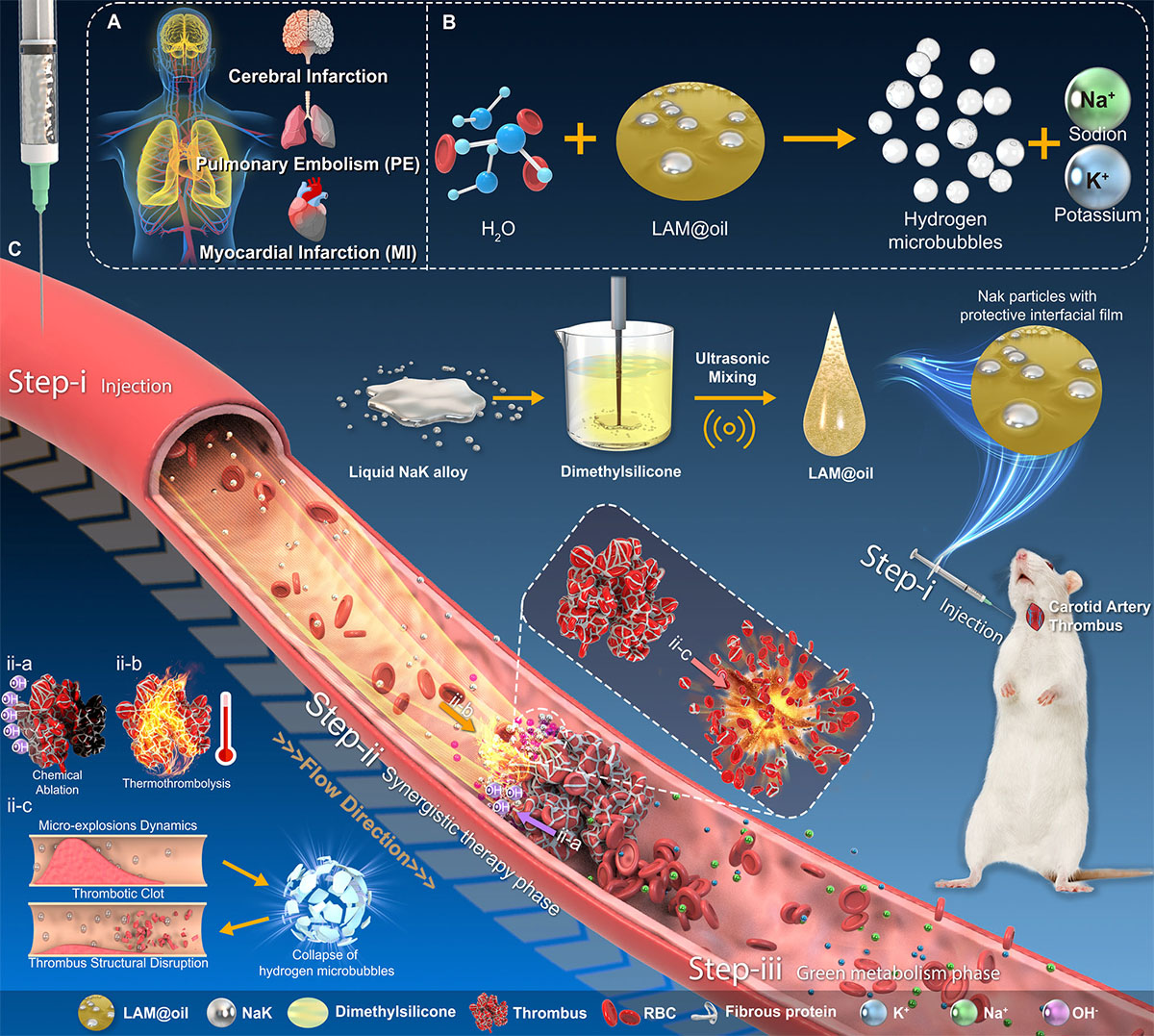 |
| Principle of liquid alkali metal (LAM) enabled micro-explosive thermochemical thrombolysis (METCT) strategy. (A) Typical thrombotic diseases: cerebral infarction, pulmonary embolism (PE), myocardial infarction (MI). (B) Mechanism of LAM@oil mediated METCT therapy. (C) Schematic illustration of the fabrication, biosafety, therapeutic mechanism, and applications of the LAM@oil thrombolytic strategy. Step-i: Intracarotid administration in a rat thrombus model: The LAM@oil mixture, generated by ultrasonication-mediated emulsification of dimethylsilicone and LAM, was injected at the proximal site of the thrombus. Step-ii: Synergistic therapy phase: Accompanying therapeutic reactions include ii-a) Chemical ablation (OH− as a transient therapeutic agent), ii-b) Thermothrombolysis, and ii-c) Micro-explosion (hydrogen microbubble collapse) effect. Step-iii: Green metabolism phase: Thrombus dissolution with the release of biocompatible byproducts (Na+ and K+). (Image: Reproduced with permission from Wiley-VCH Verlag) (click on image to enlarge) |
| The authors describe the process as micro-explosive thermochemical thrombolysis. In practical terms, the formulation creates a small reaction zone rather than acting like a circulating clot drug. The evidence does not isolate each force perfectly in living vessels, but treated clots showed the combined traces expected from bubble collapse, heat, and alkaline chemistry: fragmentation, dark ablation marks, and loss of mass. |
| Flow makes the problem harder than a still vial. Moving fluid can dilute reactive products, shift droplets, and carry fragments away before the reaction finishes. In a dynamic vascular model, the formulation still dismantled thrombus material. Clots treated with 20 µL of LAM@oil fell to 29.8 % of their original mass, while control clots mainly changed through ordinary flow-induced erosion. |
| In blocked rat carotid arteries, the controlled reaction translated into rapid flow recovery. After injection near the thrombus, blood-flow signals began returning within seconds. One reported treatment sequence reached recanalization within 81 s, and the authors describe pronounced thrombolysis within 90 s. At the end of the comparison period, LAM@oil left about 11 % residual thrombus area, compared with about 81 % after urokinase. |
| Those numbers come from a controlled preclinical model, not a clinical trial. They show that a localized thermochemical event can clear a clot quickly under the study conditions. They do not show how the approach would perform against human thrombi with varied age, density, composition, vessel diameter, and blood-flow patterns. The speed matters because it sharpens the next question: whether control can scale with potency. |
| Safety depended on whether the reaction stayed local after the artery reopened. The treated rat arteries remained open during a 14 day follow-up, and the authors reported no obvious restenosis in the monitored vessels. Blood chemistry, blood counts, and tissue analysis of major organs did not show clear toxicity at the tested dose. They also did not observe a bleeding signal under these experimental conditions. |
| Sodium and potassium ions are familiar to physiology, but dose and location still govern safety. Hydroxide ions are different because their benefit comes from caustic local chemistry. Hydrogen gas adds a physical risk if bubbles accumulate in vessels. The authors report limited hydrogen formation at the therapeutic dose and note that higher-dose use would require attention to embolism risk. |
| A rabbit femoral artery model moved the reaction into a larger vessel, where flow and access begin to test the same control problem at a different scale. After LAM@oil treatment, the artery showed restored continuous blood flow. The result extends the proof of concept beyond a small rodent carotid artery, while leaving open how precisely the formulation can be placed and contained in more complex vascular anatomy. |
| The reported results make spatial control the central issue for this approach. LAM@oil worked because silicone oil slowed water contact enough for the alloy to react near the thrombus rather than as a destructive burst. In the tested artery models, that confined reaction reopened blocked vessels quickly and avoided the extreme behavior of bare liquid metal. |
| The harder test is whether the same confinement holds when clots differ in size, age, density, and location. The chemistry must be strong enough to dismantle the blockage, but it cannot drift, accumulate, or continue reacting after leaving the target. That boundary between useful damage and vascular injury will determine whether micro-explosive thrombolysis can move beyond preclinical proof of concept. |
 By
Michael
Berger
– Michael is author of four books by the Royal Society of Chemistry:
Nano-Society: Pushing the Boundaries of Technology (2009),
Nanotechnology: The Future is Tiny (2016),
Nanoengineering: The Skills and Tools Making Technology Invisible (2019), and
Waste not! How Nanotechnologies Can Increase Efficiencies Throughout Society (2025)
Copyright ©
Nanowerk LLC
By
Michael
Berger
– Michael is author of four books by the Royal Society of Chemistry:
Nano-Society: Pushing the Boundaries of Technology (2009),
Nanotechnology: The Future is Tiny (2016),
Nanoengineering: The Skills and Tools Making Technology Invisible (2019), and
Waste not! How Nanotechnologies Can Increase Efficiencies Throughout Society (2025)
Copyright ©
Nanowerk LLC
|

ORCID information
|
Become a Spotlight guest author! Join our large and growing group of guest contributors. Have you just published a scientific paper or have other exciting developments to share with the nanotechnology community? Here is how to publish on nanowerk.com. |


