| Jul 10, 2026 | |
A nitrogen nanofoam that conducts heat like a metalA nitrogen-based nanofoam could enable more efficient, water-free geothermal heat extraction while reducing pumping needs and easing some operational constraints. |
|
| (Nanowerk Spotlight) Enhanced geothermal systems have long faced a materials problem as much as a drilling problem. To extract heat from deep hot rock, operators need a working fluid that can move through engineered fractures, carry heat efficiently to the surface, and remain stable under high pressure and temperature. Water is effective at transporting heat, but water-based geothermal stimulation can also raise site-specific concerns around fluid loss, scaling, freshwater demand, and induced-seismicity scrutiny. | |
| Nitrogen gas offers a different profile: it is dry, inert, and recoverable. Its drawback is thermal. Ordinary nitrogen conducts heat poorly, with a native thermal conductivity around 0.026 W/m·K, which has kept it outside serious consideration as a primary geothermal working fluid. | |
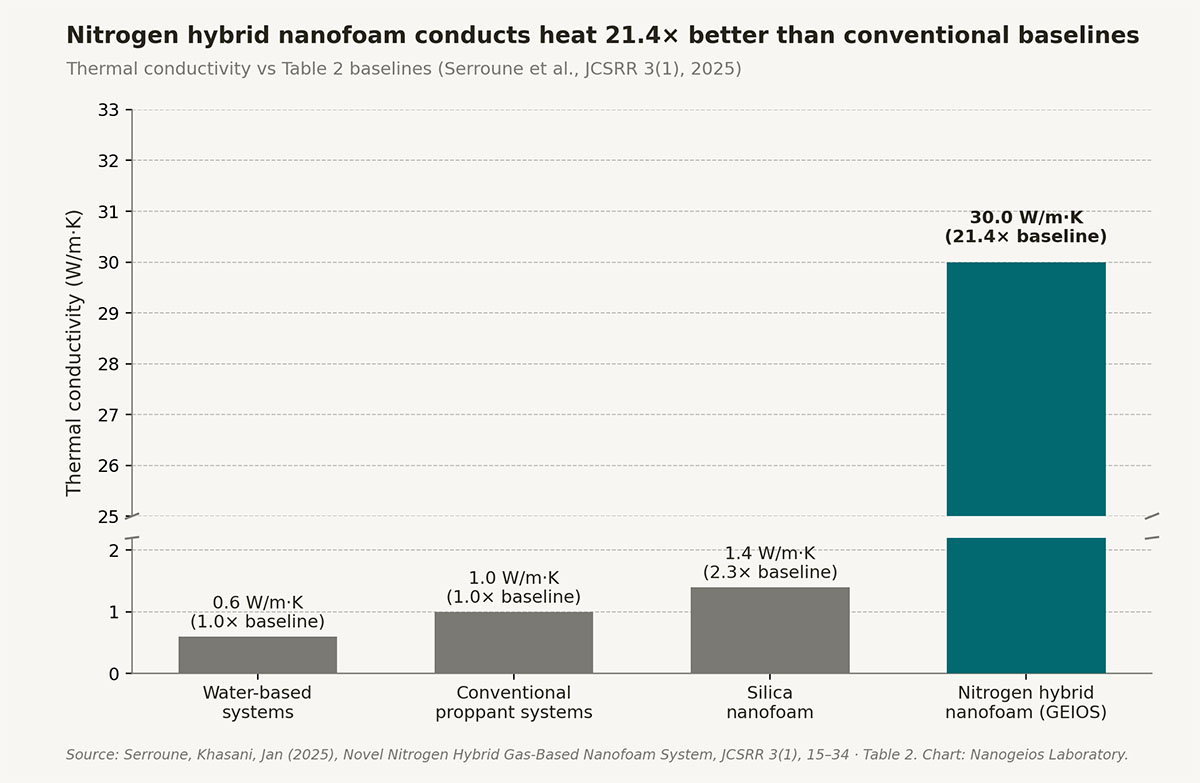
| Researchers at Nanogeios Laboratory, in collaboration with academic partners in Indonesia, have reported a nitrogen-based nanofoam with an effective thermal conductivity of 30.0 W/m·K under laboratory geothermal test conditions. That is up to 21.4× higher than the conventional geothermal materials benchmark cited in the paper, using silica nanofoam at 1.4 W/m·K as the reference point. | |
| The findings are reported in Journal of Current Science and Research Review ("Novel Nitrogen Hybrid Gas-Based Nanofoam System for Enhanced Geothermal Applications: Nanogeios and GEIOS Geothermal EQG Laboratory Validation Study"). The peer-reviewed paper is available open access through the Zenodo mirror record. | |
| The material is a gas-phase nanofoam: 95% nitrogen by volume, with aluminum oxide nanoparticles (Al₂O₃, 50–100 nm, 0.6–0.8% volume fraction) and a smaller loading of silica nanoparticles (SiO₂, 20–50 nm, 0.3–0.5% volume fraction) dispersed through the gas matrix. What makes the system unusual is not only the ingredients but the geometry. | |
| The Al₂O₃ particles are spaced 40–70 nm apart, close enough for the authors to describe coherent acoustic-vibration, or phonon, transport from one particle to the next rather than random scattering through the gas. In this architecture, the particles act as nanoscale stepping stones for heat. | |
 |
|
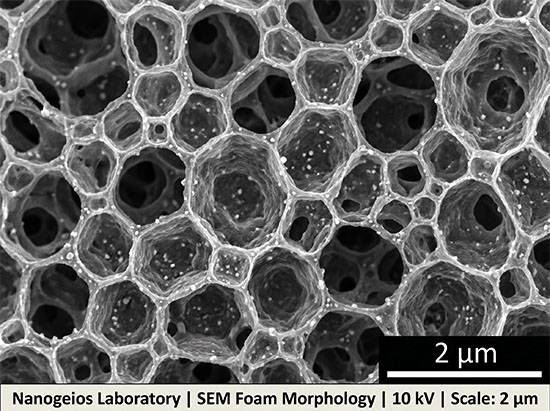
| Figure 1. SEM foam morphology of the nitrogen nanofoam. Field-emission SEM at 10 kV, secondary-electron mode, scale bar 2 μm. The open, polyhedral-cell architecture is the result of a nitrogen-rich gas-phase foam stabilised by sub-100 nm nanoparticles, imaged after controlled depressurisation. (Image: Nanogeios Laboratory) | |
| The work was led by Abdelmoumen Shad Serroune of Nanogeios Biotech and Nanotechnology, with Professor Khasani of the Nanogeios Nanogeothermal Division and Professor Jan of the Nanogeios Geological Nanotech Division. The team reports an eight-month laboratory validation program, conducted between March and November 2024, using a laboratory-scale geothermal loop at 80–140 MPa and temperatures up to 240 °C. These conditions were selected to approximate the operating envelope of a planned 200 MW commercial deployment rather than a low-pressure bench demonstration. | |
| “The bottleneck in enhanced geothermal has never been the rock. It has been the fluid we ask to carry heat out of the rock,” Serroune explains. “We wanted to know whether it was possible to engineer a gas that behaves thermally like a metal, without introducing water into the system. The eight-month validation program tells us the answer is yes.” | |
How the phonon corridors work |
|
| In a normal gas, heat transfer is dominated by molecular collision, a slow and disordered process. In the Nanogeios nanofoam, the Al₂O₃ nanoparticles are surface-modified through vapor-phase deposition of organosilane compounds. The team reports that this treatment lowers thermal boundary resistance at the particle–gas interface to approximately 2.3 × 10⁻⁸ m²K/W, described as about an order of magnitude below conventional nanofluid interfaces. | |
| That interface treatment is intended to let acoustic phonons pass into and out of the particles with reduced loss, allowing heat to propagate across nanoparticle networks over distances beyond 100 nm. | |
| The SiO₂ particles play a secondary structural role. At 0.3–0.5% volume fraction, they are described as a scaffold that helps preserve particle spacing and foam structure without disrupting the Al₂O₃ transport network. | |
What the eight-month validation showed |
|
| The team reports three headline measurements. First, fracture apertures started at 3.00 mm and remained at 2.64 mm after 15 weeks of continuous operation at 240 °C and 80–140 MPa. That corresponds to linear degradation of about 0.8% per week. Second, thermal conductivity held at 30 ± 1.2 W/m·K across the full 15-week test. Third, flow stability was maintained with Reynolds numbers above 1.2 × 10⁴ and Weber numbers above 50, while coalescence rates remained below 0.1% per hour. | |
| Uniform particle distribution, with a coefficient of variation below 15%, was tracked through a laser diffraction analyzer with a high-temperature sample cell. Pressure was held within ±0.1 MPa across the operating band, and the system re-equilibrated within 800 ms after imposed pressure perturbations. | |
 |
|
| Figure 2. Thermal conductivity of the Nanogeios nitrogen nanofoam (30.0 W/m·K) against the conventional-systems comparison reported in the paper’s Table 2: conventional proppant systems (0.6–1.4 W/m·K), water-based systems (0.6 W/m·K), and silica nanofoam (1.4 W/m·K). The reported enhancement factor is 21.4× versus the highest listed conventional comparator, silica nanofoam at 1.4 W/m·K. Insert schematic shows Al₂O₃ nanoparticles, 50–100 nm, at 40–70 nm spacing, forming coherent phonon transport pathways within the nitrogen matrix. (Image: Nanogeios Laboratory) | |
Implications for enhanced geothermal |
|
| According to the paper’s process-scale calculations, a working fluid with 30 W/m·K effective thermal conductivity could reduce required surface heat-exchanger area by 30–40% and lower pumping energy by roughly 20%. These are deployment projections, not field-demonstrated outcomes, and would need to be tested in a single-well or multi-well field demonstration. | |
| The absence of water also changes the development case. A recoverable nitrogen-based working fluid could reduce freshwater demand and simplify some water-management issues that affect conventional geothermal stimulation. The authors argue that sustained fracture apertures without conventional proppants may also reduce some of the permitting concerns associated with fracture maintenance and induced-seismicity risk, although these claims remain site-specific and would require field validation. | |
| “What we are describing is more than a simple bench measurement,” Serroune concludes. “It is 15 weeks of continuous laboratory operation at commercial-scale pressure and temperature targets, with baseline-paired measurements against conventional working-fluid materials. The next step is a single-well field demonstration at commercial temperature.” | |
| The peer-reviewed paper is available open access through the Zenodo mirror record. Underlying validation data, including pressure-flow curves, particle-distribution histograms, and thermal cycling records, are held by Nanogeios Laboratory and are available on request. | |
| Source: Sponsored article provided by Nanogeios Laboratory | |

|
|

Become a Spotlight guest author! Join our large and growing group of guest contributors. Have you just published a scientific paper or have other exciting developments to share with the nanotechnology community? Here is how to publish on nanowerk.com. |
|


