| Jul 12, 2026 |
Transparent ceramic enables rewritable 3D optical writing |
| (Nanowerk Spotlight) Optical discs store data as microscopic marks spread across a thin recording layer. That is essentially two-dimensional storage. Writing similar marks at many depths inside a transparent solid would turn the whole volume into usable recording space, potentially increasing capacity. The laser, however, must reach each point without being scattered or absorbed along the way. |
| Glass is well suited to this kind of three-dimensional writing because it can be made highly transparent. It already supports high-density laser writing across multiple depths and optical dimensions. Ceramics are more resistant to heat, chemicals, and physical damage, which makes them attractive for durable storage. Their drawback is that the crystal defects needed to produce a strong optical mark can also block or scatter the writing beam. |
| A study in Advanced Functional Materials ("Designing Photochromic Transparent Ceramics With Large Photochromic Contrast and High Transmission for Rewritable Information Displays and 3D Optical Information Storage") reports a calcium-doped yttrium oxide ceramic designed around that conflict. Calcium helps the crystal hold large numbers of hydroxyl groups, simple units made from oxygen and hydrogen, without strongly reducing transparency. Ultraviolet light converts these groups into oxygen vacancies that trap electrons and turn the written regions deep red. The surrounding ceramic remains clear, and light or heat can erase the pattern for reuse. |
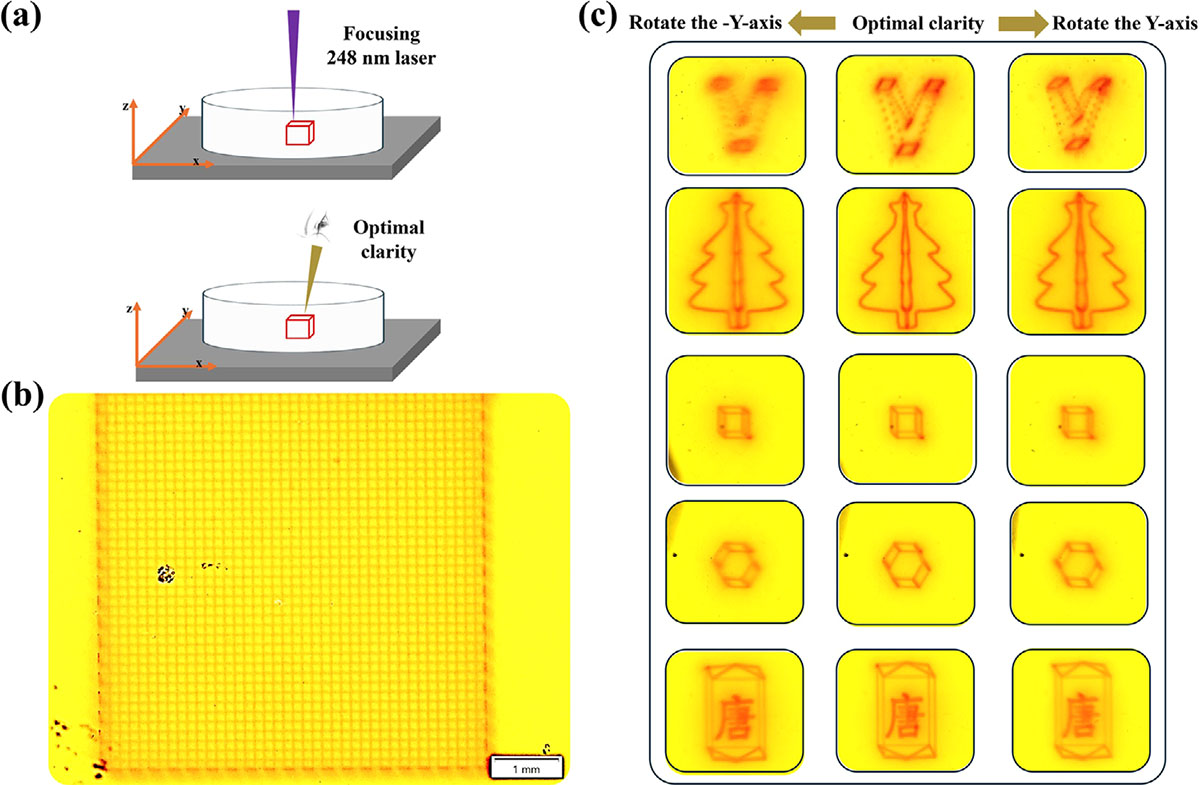 |
| A focused ultraviolet laser writes red photochromic patterns at different depths inside the transparent ceramic. The structures appear differently when viewed from different angles, confirming their three-dimensional form. (Image: Reproduced with permission from Wiley-VCH Verlag) (click on image to enlarge) |
| The ceramic contained only 0.02 at% calcium. Before writing, its transmission exceeded 80% at 600 nm. Ultraviolet exposure then produced a color contrast above 90%, while undoped Y₂O₃ changed only weakly. Adding more calcium strengthened the coloration further but reduced transparency. The selected composition preserved enough clarity for light to reach the interior while still producing a sharply distinguishable mark. |
| Color appeared quickly enough for a focused laser to draw visible letters without a prepatterned mask. The ceramic developed 60.6% of its maximum response within 1 s. A second beam operating at 365 nm bleached selected letters while leaving the rest of the pattern intact, allowing corrections within the written image. Heating cleared the complete sample and prepared it for another round of writing. |
| The ultraviolet beam could also focus below the surface. By moving that focal point through the ceramic, the researchers inscribed cubes, prisms, and other structures whose appearance changed with the viewing angle. Lines approximately 50 µm wide remained distinguishable at different depths. The demonstration extended photochromic ceramic recording from a flat image into the material’s volume, although it did not measure how much digital information that volume could hold. |
| A ceramic filled with permanent oxygen vacancies would have darkened before writing began, undermining the transparency needed to reach deeper layers. Calcium produced a different starting point. It allowed the yttrium oxide lattice to hold parts of the crystal containing oxygen-and-hydrogen groups that absorbed little visible light but could later rearrange into color-producing defects. Calculations comparing several additives indicated that calcium made these sites easier to form and transform. |
| Before irradiation, the calcium-doped samples contained almost none of the unpaired electrons associated with visible coloration. Strong signals appeared only after ultraviolet exposure, when the material turned red. The researchers attributed them to F⁺ centers, which form when an empty oxygen site traps a single electron. Undoped yttrium oxide produced far fewer of these centers and showed a correspondingly weak color change. |
| The number of hydroxyl groups changed at the same time. Calcium-doped ceramics began with far more of them than pure Y₂O₃, but their abundance fell during ultraviolet exposure as the measured concentration of oxygen vacancies rose. The crystal lattice also contracted, while atomic-resolution images contained local features consistent with missing oxygen atoms. These coordinated changes support a conversion between hydroxyl-bearing sites and oxygen vacancies rather than a fixed defect population introduced during manufacturing. |
| Ultraviolet light drives that conversion by exciting electrons and leaving positively charged holes behind. The proposed reaction begins when those holes interact with hydroxyl groups already held in the lattice. Oxygen and hydrogen then rearrange, creating water that remains confined within the ceramic and leaving vacant oxygen sites. Those sites capture excited electrons and become F⁺ centers, producing the visible absorption that turns each written region red. |
| By keeping the excited electrons separated from the holes, the vacancies allow those holes to continue reacting with nearby hydroxyl groups. More vacancies can then form and trap more electrons, amplifying the initial response. Calcium does not color the ceramic directly. It gives the lattice a supply of inactive chemical precursors that ultraviolet light can convert into absorbing centers at selected locations. |
| Erasure sends the material back toward its original state. Light at 365 nm bleaches selected regions, while heating provides a more complete reset. The ceramic recovered its initial transmission after 3 min at 450 °C, and the number of hydroxyl groups increased again. That recovery supports the proposed reconstruction of hydroxyl groups from water retained inside the material, although the measurements do not resolve every molecular step. |
| The optical response changed little over 10 rounds of ultraviolet writing and thermal erasure. That limited test confirms repeatable switching, not the endurance expected from a working memory device. The high reset temperature also exposes a practical compromise. Deep traps help the written color persist, but releasing their electrons requires considerable heat. Selective optical bleaching avoids heating the whole sample, though its effectiveness across many buried layers remains unknown. |
| Other volumetric writing methods reach much finer scales by permanently altering glass or crystals. Laser-created nanostructures in silica can encode information through several optical properties, while three-dimensional color voxels inside transparent crystals can produce detailed internal images with submicrometer features. The new ceramic offers coarser resolution, but its color comes from reversible chemistry, allowing selected marks to be edited and the full material to be reused. |
| The present patterns are still coarse, and the study does not show that many closely spaced layers can be written and read without interference. Lower-temperature erasure, faster writing, reliable readout, and far more switching cycles will also be necessary. But the ceramic solves the first materials problem: it remains clear while light travels through it, then creates strong color only at the chosen depth. That separation could turn ceramic optical recording from surface marking into information stored throughout a durable solid. |
 By
Michael
Berger
– Michael is author of four books by the Royal Society of Chemistry:
Nano-Society: Pushing the Boundaries of Technology (2009),
Nanotechnology: The Future is Tiny (2016),
Nanoengineering: The Skills and Tools Making Technology Invisible (2019), and
Waste not! How Nanotechnologies Can Increase Efficiencies Throughout Society (2025)
Copyright ©
Nanowerk LLC
By
Michael
Berger
– Michael is author of four books by the Royal Society of Chemistry:
Nano-Society: Pushing the Boundaries of Technology (2009),
Nanotechnology: The Future is Tiny (2016),
Nanoengineering: The Skills and Tools Making Technology Invisible (2019), and
Waste not! How Nanotechnologies Can Increase Efficiencies Throughout Society (2025)
Copyright ©
Nanowerk LLC
|

ORCID information
|

Become a Spotlight guest author! Join our large and growing group of guest contributors. Have you just published a scientific paper or have other exciting developments to share with the nanotechnology community? Here is how to publish on nanowerk.com. |


