

Nanotechnology News – Latest Headlines
NanoArt 2008 international nanotechnology art competition deadline nearing
Submission deadline for NanoArt 2008 is January 15, 2009.
December 16, 2008 Read more
Alfred P. Sloan Foundation supports Hastings Center work on ethical issues in synthetic biology
The Hastings Center, long at the forefront of interdisciplinary research into ethical issues in emerging technology, has received a $500,000 grant from the Alfred P. Sloan Foundation for a two-year project to examine the issues surrounding new developments in synthetic biology.
December 16, 2008 Read more
Super-resolution microscope technique can resolve cell features down to 20-30 nanometers
Thanks to a new 'super-resolution' fluorescence microscopy technique, Harvard University researchers have succeeded in resolving the features of cells as miniscule as 20-30 nanometers, an order of magnitude smaller than conventional fluorescence light microscopy images.
December 16, 2008 Read more
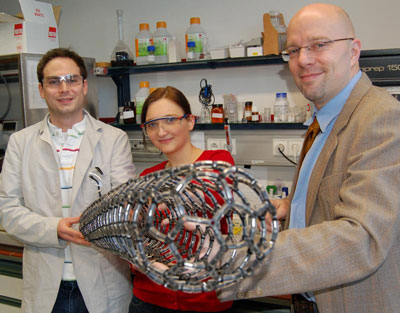
Nanotubes: Wie die Energie fliesst
Neue Erkenntnisse ueber den Energiefluss in carbon nanotubes beschreiben Forscher in der Zeitschrift Nature Physics. Ihnen ist es weltweit erstmals gelungen, die Groesse von Exzitonen zu messen.
December 16, 2008 Read more
Researchers create 5-inch transparent, flexible nanotube transistor plastic disk
It's a clear, colorless disk about 5 inches in diameter that bends and twists like a playing card, with a lattice of more than 20,000 nanotube transistors capable of high-performance electronics printed upon it using a potentially inexpensive low-temperature process.
December 16, 2008 Read more
European Union funds EUR 3 million nanotechnology risk research
Dr Andrew Nelson, a chemist at the University of Leeds, will lead the project which has been awarded EUR 3 million by the European Union and brings together experts from the UK, the Netherlands, Belgium, Italy and Spain to assess how nanotechnology impacts on our environment.
December 16, 2008 Read more
Iron nanoparticles released from melting icebergs could slow global warming
Melting icebergs are doing their own bit to halt the onward march of global warming. By releasing iron into the Southern Oceans, melting icebergs are fuelling the growth of plankton - which help to remove a substantial amount of CO2 from the atmosphere.
December 16, 2008 Read more
Nanotechnology researchers create nontoxic clean-up method for potentially toxic nanomaterials
University of Pittsburgh researchers have developed the first natural, nontoxic method for biodegrading carbon nanotubes, a finding that could help diminish the environmental and health concerns that mar the otherwise bright prospects of the super-strong materials commonly used in products, from electronics to plastics.
December 16, 2008 Read more
Nanotechnology conference: Theoretical assessment of the biological effects of nanomaterials
The Nordic Institute for Theoretical Physics announced the Nordita research program and symposium on 'Theoretical Assessment of the Biological Effects of Nanomaterials'. The event will take place from March 6-28, 2009, in Stockholm, Sweden.
December 16, 2008 Read more
Feynman Prizes in Nanotechnology go to James Tour and George Schatz
The 2008 Foresight Institute Feynman Prizes, named in honor of pioneer physicist Richard Feynman, are given in two categories, one for experimental work and the other for theory in advances in nanotechnology.
December 16, 2008 Read more
NanoKTN and The Wellcome Trust collaborate on Nano 4 Life conference
The Nanotechnology Knowledge Transfer Network (NanoKTN), one of the UK's primary knowledge-based networks for Micro and Nanotechnologies, has announced that their first Nano 4 Life event will take place on Wednesday 11th February hosted by The Wellcome Trust in London.
December 16, 2008 Read more
Green Energy Summit 2009 program now available
The summit is a highly efficient forum for varied stakeholders from solar, wind, biomass, IT, transport, construction, aviation, nanotechnology and biotechnology to bring together the business and science of the most important and relevant Green Energy and Clean technologies.
December 16, 2008 Read more
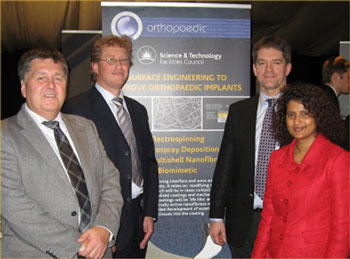
Biological nanocoating technology improves surgical implants
The technology involves a unique surface engineering process that adds micro and nano sized hair like structures to the surface which creates a ?living interface? between artificial implants and bone. The addition of a multilayer coating containing biological substances, such as growth factors and antibiotics, could improve bony integration, arterial and venous proliferation and reduce infection.
December 15, 2008 Read more
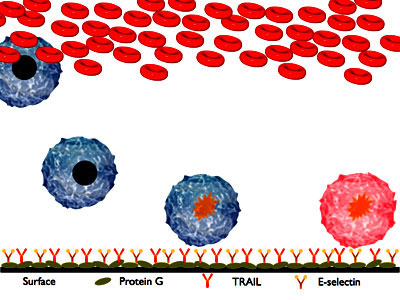
Lethal 'lint brush' captures and kills cancer cells in the bloodstream
In a new tactic in the fight against cancer, Cornell researcher Michael King has developed what he calls a lethal 'lint brush' for the blood - a tiny, implantable device that captures and kills cancer cells in the bloodstream before they spread through the body.
December 15, 2008 Read more
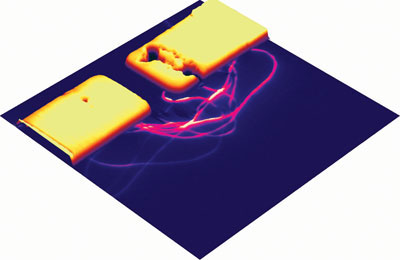
Efficient method to measure conductance of individual carbon nanotubes in batches
A team of Cornell researchers has invented an efficient, inexpensive method to electrically characterize individual carbon nanotubes, even when they are of slightly different shapes and sizes and are networked together.
December 15, 2008 Read more
Electric nanotechnology yarn enables smart textiles to detect blood
A carbon nanotube-coated 'smart yarn' that conducts electricity could be woven into soft fabrics that detect blood and monitor health.
December 15, 2008 Read more
 Subscribe to our Nanotechnology News feed