

Nanotechnology News – Latest Headlines
Nanowire structures for batteries built with viruses
MIT scientists have harnessed the construction talents of tiny viruses to build ultra-small nanowire structures for use in very thin lithium-ion batteries.
April 6, 2006 Read more

Scientists develop new way to explore and control atom-scale magnetism
IBM scientists have developed a powerful new technique for exploring and controlling magnetism at its fundamental atomic level.
April 6, 2006 Read more
Fullerenes show promise in reducing radiation side effects
Using transparent zebrafish embryos, researchers at Jefferson Medical College in Philadelphia have shown that fullerenes can help fend off damage to normal tissue from radiation.
April 6, 2006 Read more
Government officials in Germany recall nanotech product
Officials in Germany have issued what appears to be the first health-related recall of a nanotechnology product.
April 5, 2006 Read more
Nanodots boost superconductivity
Oak Ridge National Laboratory (ORNL) researchers have demonstrated a way to sustain high supercurrents in wires in the presence of a large applied magnetic field ? a step which could greatly expand practical applications of superconductors.
April 4, 2006 Read more
Researchers develop new procedure to synthesize quantum dots
Indiana University-Purdue University Indianapolis researchers have developed a new procedure for the synthesis of quantum dots.
April 4, 2006 Read more
Nanoparticles may pose threat to liver cells, say scientists
University of Edinburgh scientists will assess whether nanoparticles can cause damage to the cells of the liver.
April 4, 2006 Read more
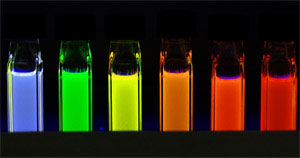
Ultra-sensitive detection of trace amounts of proteins using fluorescent nanoparticles
AIST in Japan has succeeded in the synthesis of unique high quality fluorescent quantum dots, and the development of nano-biohybrid materials for protein and DNA/RNA measurements using quantum dots.
April 4, 2006 Read more
Successful development of a desktop apparatus enabling nanometer-scale fabrication
AIST in Japan has succeeded in the development of a nano-fabrication technique utilizing a thermal lithography method resulting from the combination of visible-light lithography using a semi-conductor laser with a thermally nonlinear material.
April 4, 2006 Read more
New record set for smallest X-ray nano-spot
An award-winning device developed at Argonne National Laboratory has set a world record for tiny spot size with a hard X-ray beam.
April 3, 2006 Read more
Scientists to tackle illness with silver nanoparticles
Research to be carried out at the University of Leicester will develop silver nanoparticles, in a form which can play a significant role to play in combating MRSA, Cystic Fibrosis and AIDS, as well as the treatment of wounds.
March 31, 2006 Read more
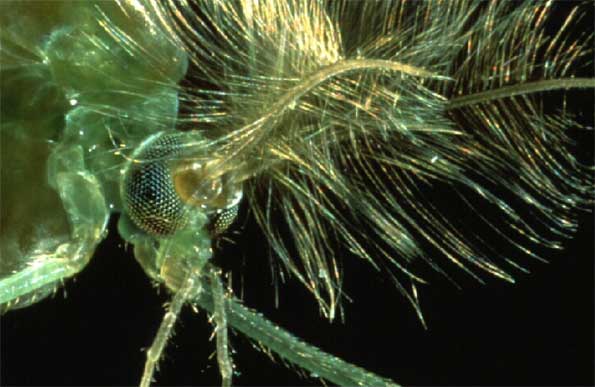
How the eardrum of a locust could lead to tiny microphones
Being able to hear the smallest of noises is a matter of life or death for many insects, but for the scientists studying their hearing systems understanding how insect ears can be so sensitive could lead to new microphones able to capture and analyse extremely faint sounds.
March 30, 2006 Read more
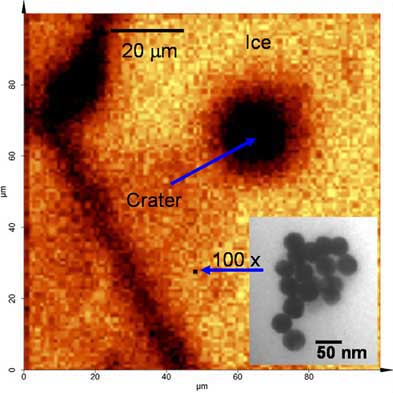
Gold nanoparticles emit intense heat, study finds
Nanoparticles of gold can act as tiny, precise and powerful heaters, which potentially could be used in biomedical applications, according to a new study.
March 30, 2006 Read more
Magnetism shepherds microlenses to excavate nanocavities
A Duke University engineer is herding tiny lenses with magnetic ferrofluids, precisely aligning them so that they focus bursts of light to excavate patterns of cavities on surfaces.
March 30, 2006 Read more
Engineers building erasible detectors, nanobrushes and DNA highrises
A Duke University engineering group is doing pioneering work at very diminutive dimensions. Their basic studies could lead to genetically engineered proteins that can form e.g. erasable chemical detectors.
March 30, 2006 Read more
Quantum dot method rapidly identifies bacteria
A rapid method for detecting and identifying very small numbers of diverse bacteria, from anthrax to E. coli, has been developed by scientists from the National Cancer Institute (NCI) and National Institute of Standards and Technology (NIST).
March 30, 2006 Read more
 Subscribe to our Nanotechnology News feed