

Nanotechnology News – Latest Headlines
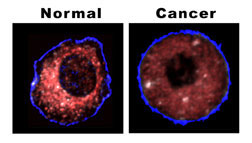
Ultrafast nanolaser flow device for detecting cancer in single cells
A lightning-fast laser technique, led by Sandia National Laboratories researcher Paul Gourley, has provided laboratory demonstrations of accurate, real-time, high-throughput identification of liver tumor cells at their earliest stages, and without invasive chemical reagents.
January 24, 2006 Read more
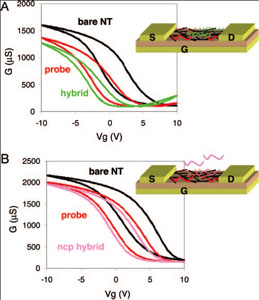
Label-free detection of DNA hybridization using carbon nanotube network field-effect transistors
University of Pittsburgh researcher Alexander Star and colleagues at a California-based company, Nanomix, Inc., have developed devices made of carbon nanotubes that can find mutations in genes causing hereditary diseases, they report in the Jan. 24, 2006 issue of the journal Proceedings of the National Academy of Science.
January 24, 2006 Read more
Study reports controlled growth of metal oxide nanoparticles
Central Michigan University reports on the controlled growth of metal oxide nanoparticles using a dendrimer architecture will provide unprecedented opportunities for industrial applications.
January 24, 2006 Read more
Laser beams build and hold nanoscale structures
A form of matter held together by nothing more substantial than light has been created by physicists in the UK. The method, known as "optical binding", was used to glue together about 100 polystyrene beads ? each 400-nanometres in diameter ? in a flat two-dimensional structure.
January 24, 2006 Read more

The closest look ever at the cell's machines
Researchers in Germany announce they have finished the first complete analysis of the molecular machines in yeast
January 24, 2006 Read more
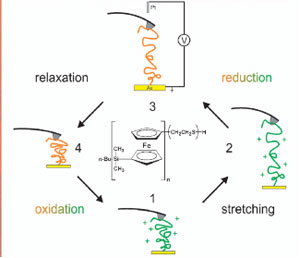
A single molecule working as the nano scale version of the steam engine
A single molecule working as the nano scale version of the steam engine: that is the molecular motor developed by a group of UT scientists led by prof. Julius Vancso of the MESA+ Institute for Nanotechnology. Natural motor molecules, capable of converting chemical energy into movement, have been the source of inspiration for this new synthetic version: a polymer molecule that stretches and shrinks caused by redox reactions.
January 23, 2006 Read more
Leading experts worldwide to help guide research on nanotechnology's social impact
The Nanoethics Group today announced appointing a distinguished list of members to its Advisory Board, as public interest grows concerning the impact of nanotechnology on ethics and society.
January 23, 2006 Read more
Successful development of an upright-type double-gate MOS transistor capable of ultra-large scale in(...)
The National Institute for Advanced Industrial Science and Technology (AIST) and Tohoku University have succeeded in manufacturing a high-performance upright-type double gate MOS transistor capable of ultra-large scale integration using neutral beams which cannot damage silicon substrates.
January 23, 2006 Read more
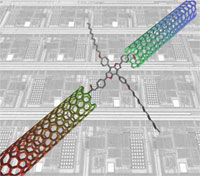
Towards molecular electronics: New way of making molecular transistors
Researchers at Columbia University's Nanoscience Center are on the verge of solving one of the most vexing barriers facing advances in molecular electronics: incorporating individual molecules into functional nanoscale devices and exploiting their electrical and chemical properties.
January 20, 2006 Read more
A new database compiles information about safety and risk research of nanotechnology
The Swiss Innovation Society Ltd. has launched a database with relevant information about safety and risk research of nanotechnology. This database will be updated regularly with scientific and policy information.
January 20, 2006 Read more
The Technical University of Denmark to receive the most powerful microscope in the world
The 180 researchers and 50 companies co-operating at the Center for Nanotechnology at DTU (NANO-DTU) will have the most advanced microscope in the world at their disposal a so-called Environmental Transmission Electron Microscope.
January 19, 2006 Read more
Toward a quantum computer, one dot at a time
Researchers at the University of Pittsburgh have developed a way to create semiconductor islands smaller than 10 nanometers in scale, known as quantum dots. The islands, made from germanium and placed on the surface of silicon with two-nanometer precision, are capable of confining single electrons.
January 19, 2006 Read more
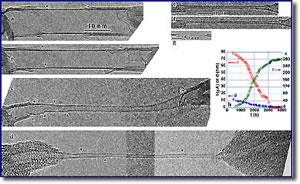
Superheated nanotubes gain strength as they stretch, researchers find
A single-walled carbon nanotube heated to more than 3,600 degrees Fahrenheit became nearly 280 percent stronger than it was in its original form, and its diameter shrunk by 15 times. The discovery has implications in strengthening ceramic and other nanocomposites at high temperatures and is useful in tuning electronics.
January 19, 2006 Read more
New theory explains electronic and thermal behavior of nanotubes
Researchers have made an important theoretical breakthrough in the understanding of energy dissipation and thermal breakdown in metallic carbon nanotubes. Their discovery will help move nanotube wires from laboratory to marketplace.
January 19, 2006 Read more
Microwave-accelerated silver nanoparticle-enhanced fluorescence leads to ultrafast and ultrabright assays
Researchers from the University of Maryland describe an exciting assay platform technology that promises to fundamentally address two underlying physical constraints of modern assays and immunoassays, namely, assay sensitivity and rapidity.
January 18, 2006 Read more
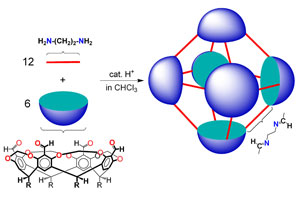
Researchers create nanocontainers 3.2 nm wide
Research could promote safe delivery of drugs and pesticides, filter toxins from wastewater and improve chemical production.
January 18, 2006 Read more
 Subscribe to our Nanotechnology News feed