

Space Exploration News – Latest Headlines
 Subscribe to our Space Exploration News feed
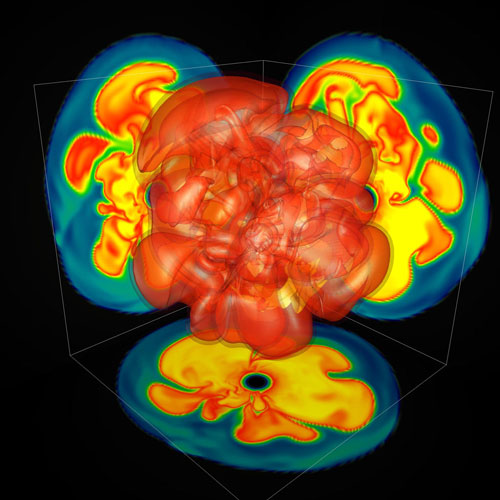
Scaling the universe
Some of the most intractable scientific problems involve natural and physical processes that span many scales and disciplines, from atoms to organs, and from quarks to galaxies. Developing coherent theories that can describe these fundamental phenomena will be crucial to understanding the origins of the Universe and life on Earth. Researchers are inventing solutions to link the vast with the tiny.
October 23, 2015 Read more
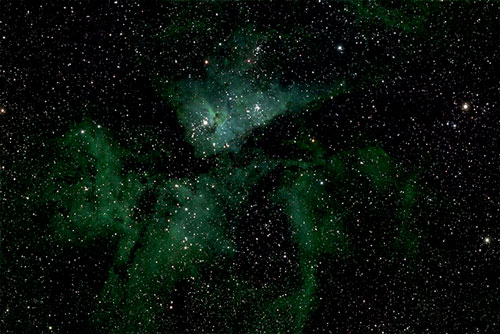
Milky Way photo with 46 billion pixels
Astronomers compile the largest astronomical image of all time. In order to view it, researchers have provided an online tool. The image contains data gathered in astronomical observations over a period of five years.
October 21, 2015 Read more
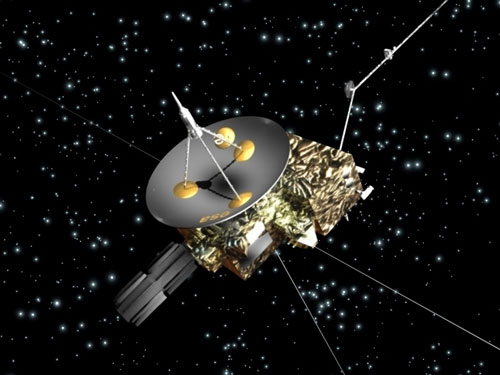
Dust particles from outer space
Researchers have analyzed the Ulysses interstellar dust measurements.
October 21, 2015 Read more
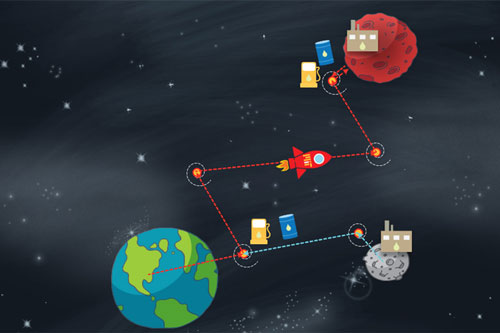
To save on weight, a detour to the moon is the best route to Mars
For a piloted mission to Mars, fueling up on the moon could streamline cargo by 68 percent.
October 15, 2015 Read more
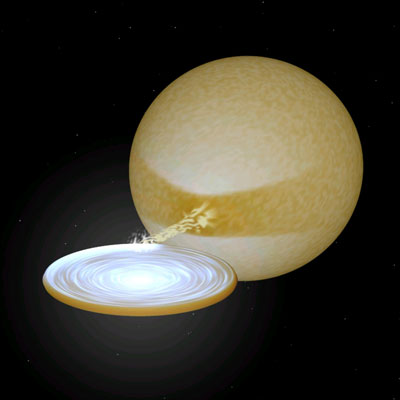
Young stars' flickering light reveals remarkable link with matter-eating black holes
An international team of astronomers has discovered a previously unknown link between the way young stars grow and the way black holes and other exotic space objects feed from their surroundings.
October 13, 2015 Read more
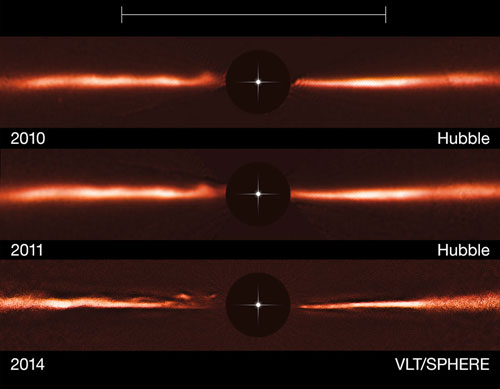
Mysterious ripples found racing through planet-forming disk
Astronomers have discovered never-before-seen structures within a dusty disc surrounding a nearby star. The fast-moving wave-like features in the disc of the star AU Microscopii are unlike anything ever observed, or even predicted, before now. The origin and nature of these features present a new mystery for astronomers to explore.
October 7, 2015 Read more
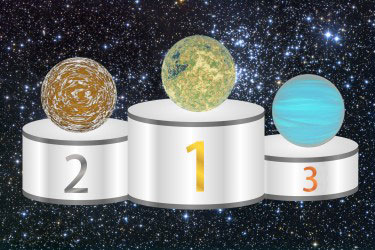
Where to look for life? Astronomers devise 'habitability index' to guide future search
Astronomers have created a way to compare and rank exoplanets to help prioritize which of the thousands discovered warrant close inspection in the search for life beyond Earth.
October 6, 2015 Read more
Researchers find a new way to weigh a star
Researchers have developed a new method for measuring the mass of pulsars - highly magnetised rotating neutron stars formed from the remains of massive stars after they explode into supernovae.
October 5, 2015 Read more
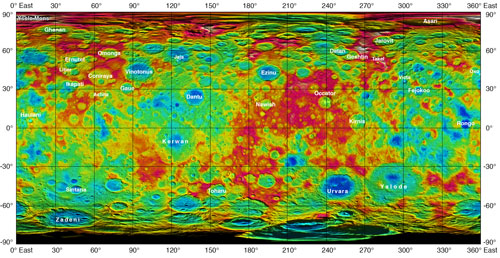
Dwarf planet Ceres - new name, new maps, new questions
Ceres continues to fascinate researchers; in particular, the dwarf planet's surface repeatedly raises new questions.
October 1, 2015 Read more
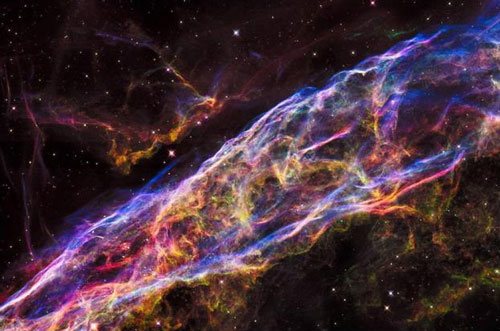
Hubble zooms in on shrapnel from an exploded star
NASA's Hubble Space Telescope has unveiled in stunning detail a small section of the expanding remains of a massive star that exploded about 8,000 years ago.
September 24, 2015 Read more

New theory of stealth dark matter may explain universe's missing mass
Scientists have come up with a new theory that may identify why dark matter has evaded direct detection in Earth-based experiments.
September 24, 2015 Read more
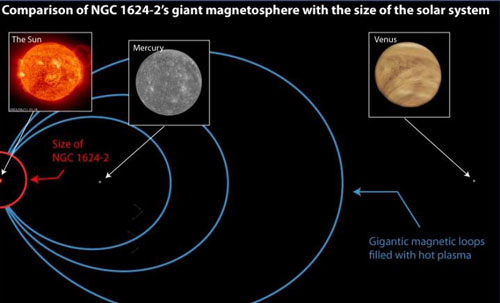
Hot, dense material surrounds O-type star with largest magnetic field known
Observations using NASA's Chandra X-ray Observatory revealed that the unusually large magnetosphere around an O-type star called NGC 1624-2 contains a raging storm of extreme stellar winds and dense plasma that gobbles up X-rays before they can escape into space.
September 23, 2015 Read more
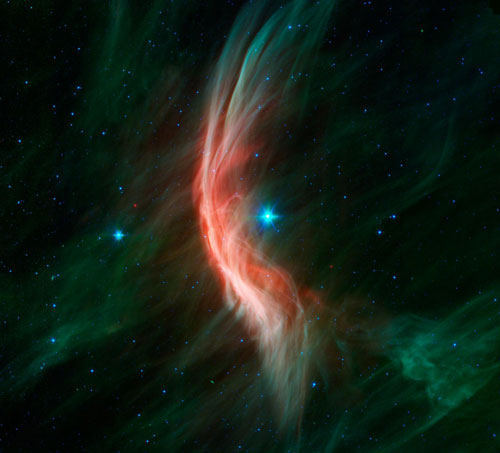
Radio telescopes could spot stars hidden in the galactic center
The center of our Milky Way galaxy is a mysterious place. Not only is it thousands of light-years away, it's also cloaked in so much dust that most stars within are rendered invisible. Harvard researchers are proposing a new way to clear the fog and spot stars hiding there. They suggest looking for radio waves coming from supersonic stars.
September 22, 2015 Read more
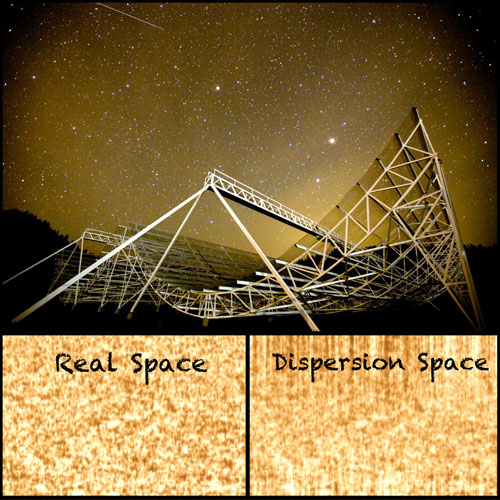
Researchers propose new way to chart the cosmos in 3D
If only calculating the distance between Earth and far-off galaxies was as easy as pulling out the old measuring tape. Now researchers are proposing a new way to calculate distances in the cosmos using mysterious bursts of energy.
September 18, 2015 Read more
Europlanet 2020 project launches new era of planetary collaboration in Europe
Europlanet 2020 RI will support 34 institutions in 19 countries across Europe over a period of four years. The project aims to tackle key scientific and technological challenges in modern space science by providing scientists with open access to state-of-the-art research data, models and facilities across the European Research Area.
September 15, 2015 Read more
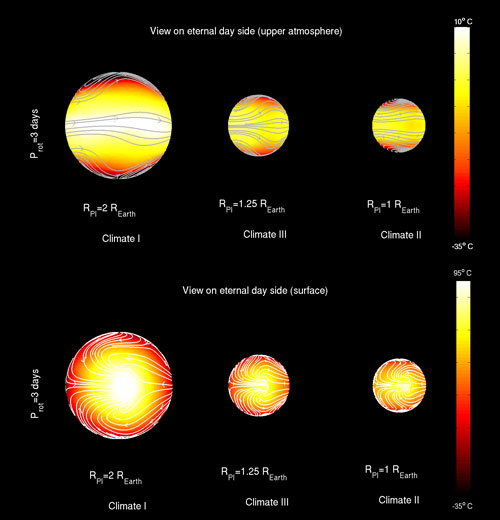
Rocky planets may be habitable depending on their 'air conditioning system'
The quest for potentially habitable planets is often interpreted as the search for an Earth twin. And yet, some rocky planets outside our Solar System may in fact be more promising candidates for further research. Scientists have run 165 climate simulations for exoplanets that permanently face their sun with the same side. They discovered that two of the three possible climates are potentially habitable.
September 14, 2015 Read more
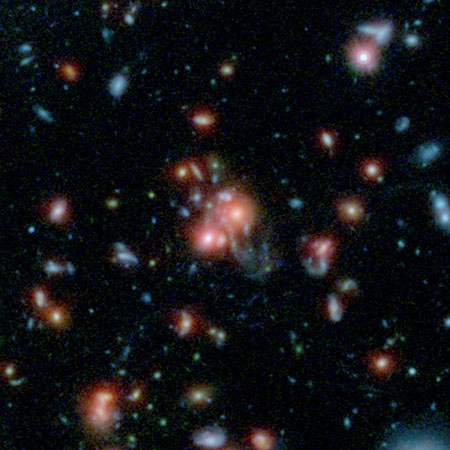
Massive galaxy cluster found to be bursting with new stars
The discovery, made with the help of W. M. Keck Observatory's MOSFIRE instrument, is the first to show that gigantic galaxies at the centers of massive clusters can grow significantly by feeding off gas stolen from other galaxies.
September 10, 2015 Read more
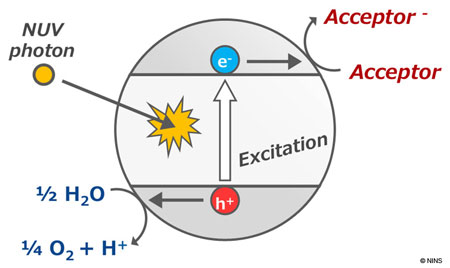
Oxygen is not definitive evidence of life on habitable exoplanets
Researchers have presented a novel hypothesis that it could be possible for planets to have large quantities of abiotic (non-biologically produced) oxygen. This study is a good example of interdisciplinary studies that combine knowledge from different fields of science to promote astrobiology in the search for life on extrasolar planets.
September 10, 2015 Read more