

Space Exploration News – Latest Headlines
 Subscribe to our Space Exploration News feed
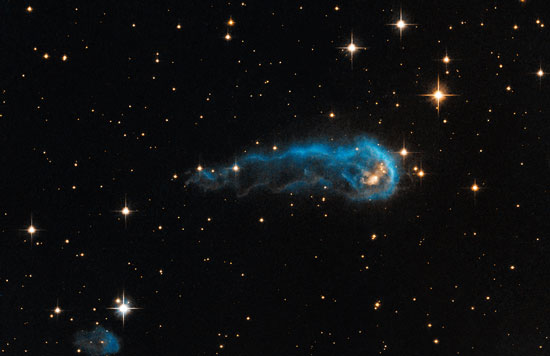
Hubble sees a cosmic caterpillar
The light-year-long knot of interstellar gas and dust, seen in this Hubble photo, resembles a caterpillar on its way to a feast. Harsh winds from extremely bright stars are blasting ultraviolet radiation at this 'wanna-be' star and sculpting the gas and dust into its long shape.
August 29, 2013 Read more
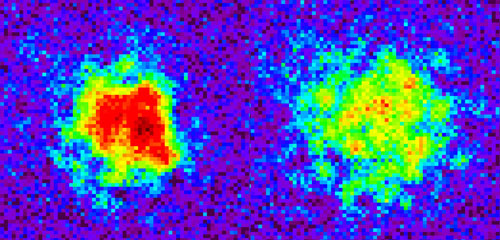
Ultracold Big Bang experiment successfully simulates evolution of early universe
Physicists have reproduced a pattern resembling the cosmic microwave background radiation in a laboratory simulation of the Big Bang, using ultracold cesium atoms in a vacuum chamber at the University of Chicago.
August 29, 2013 Read more
China to launch Lunar probe for landing mission
China's Chang'e-3 lunar probe is scheduled to be launched at the end of this year for a moon landing mission, the State Administration of Science, Technology and Industry for National Defence announced on Wednesday.
August 29, 2013 Read more
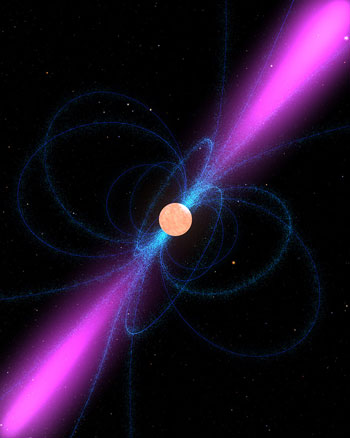
Neutron stars in the computer cloud
The combined computing power of 200,000 private PCs helps astronomers take an inventory of the Milky Way. The Einstein@Home project connects home and office PCs of volunteers from around the world to a global supercomputer. Using this computer cloud, an international team analysed archival data from the CSIRO Parkes radio telescope in Australia. Using new search methods, the global computer network discovered 24 pulsars.
August 29, 2013 Read more
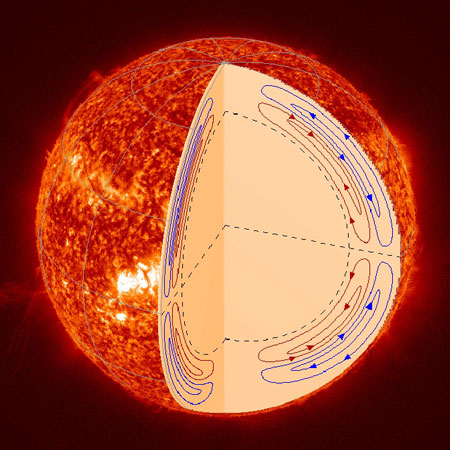
Solar Dynamics Observatory mission untangles motion inside the sun
Using an instrument on NASA's Solar Dynamics Observatory, called the Helioseismic and Magnetic Imager, or HMI, scientists have overturned previous notions of how the sun's writhing insides move from equator to pole and back again, a key part of understanding how the dynamo works. Modeling this system also lies at the heart of improving predictions of the intensity of the next solar cycle.
August 29, 2013 Read more
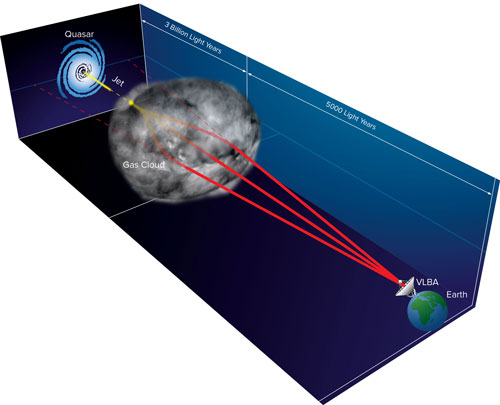
Milky Way gas cloud causes multiple images of distant quasar
Multiple-imaging event will help astronomers learn new details about turbulent gas within our own Milky Way galaxy.
August 28, 2013 Read more
MOND predicts dwarf galaxy feature prior to observations
MOND, a modified law of gravity, correctly predicted in advance of observations the velocity dispersion - the average speed of stars within a galaxy relative to each other - in 10 dwarf satellite galaxies of the Milky Way's giant neighbor Andromeda. MOND also detected subtle differences in gravity fields that dark matter theory says should be uniform.
August 28, 2013 Read more
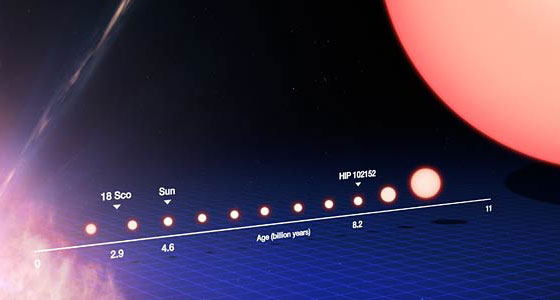
Oldest Solar Twin Identified - ESO's VLT provides new clues to help solve lithium mystery
A team led by astronomers in Brazil has used ESO's Very Large Telescope to study the oldest solar twin known to date. Located 250 light-years away, the star HIP 102152 is more like the Sun than any other solar twin - except that it is nearly four billion years older. This older twin may be host to rocky planets and gives us an unprecedented chance to see how the Sun will look when it ages.
August 28, 2013 Read more
Scientists detect magmatic water on Moon's surface
Scientists have detected magmatic water - water that originates from deep within the Moon's interior - on the surface of the Moon. These findings represent the first such remote detection of this type of lunar water, and were arrived at using data from NASA's Moon Mineralogy Mapper (M3).
August 27, 2013 Read more
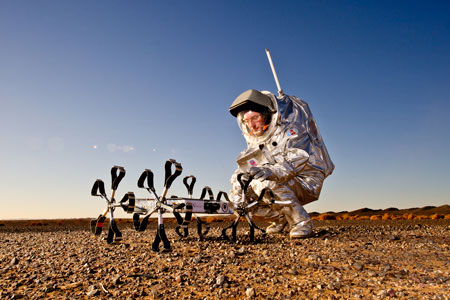
World Space Week 2013 'Exploring Mars, Discovering Earth' Analog Campaign, 4-10 October
From 4-10 October, more than twenty organizations spread across four continents will be exploring Mars - and discovering more about Earth in the process. A campaign of networked Mars analog activities is being launched to celebrate World Space Week (WSW) 2013.
August 27, 2013 Read more
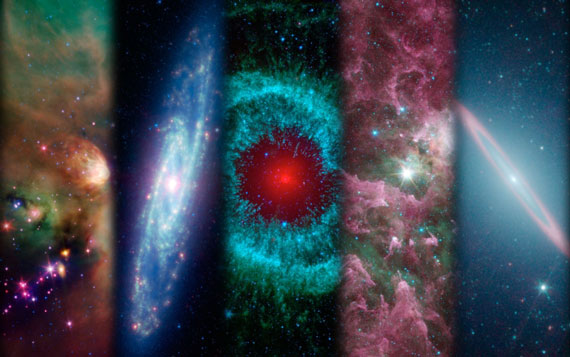
Spitzer telescope celebrates 10 years in space
Ten years after a Delta II rocket launched NASA's Spitzer Space Telescope, lighting up the night sky over Cape Canaveral, Fla., the fourth of the agency's four Great Observatories continues to illuminate the dark side of the cosmos with its infrared eyes.
August 23, 2013 Read more
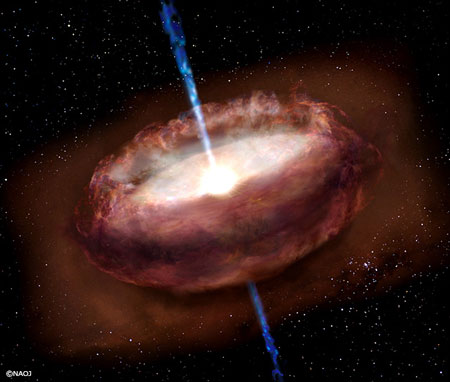
A fluffy disk around a baby star
An international team of astronomers that are members of the Strategic Exploration of Exoplanets and Disks with Subaru Telescope (SEEDS) Project has observed a disk around the young star RY Tau (Tauri). The team's analysis of the disk shows that a 'fluffy' layer above it is responsible for the scattered light observed in the infrared image.
August 23, 2013 Read more
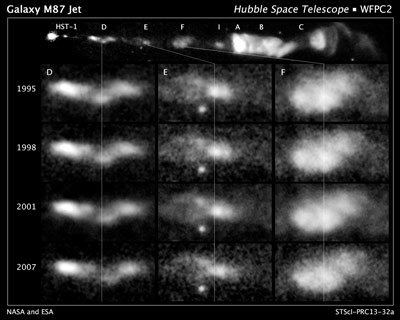
Hubble takes movies of space slinky
Astronomers have assembled, from more than 13 years of observations from NASA's Hubble Space Telescope, a series of time-lapse movies showing a jet of superheated gas - 5,000 light-years long - as it is ejected from a supermassive black hole.
August 22, 2013 Read more
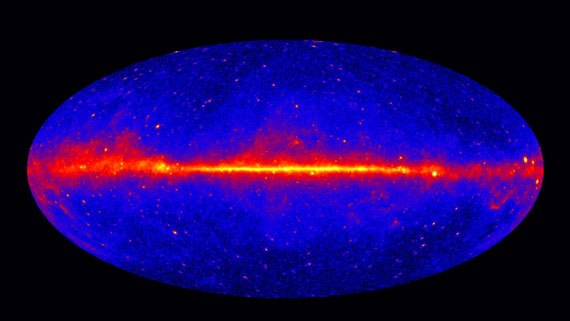
NASA's Fermi enters extended mission (w/video)
On Aug. 11, Fermi entered an extended phase of its mission - a deeper study of the high-energy cosmos. This is a significant step toward the science team's planned goal of a decade of observations, ending in 2018.
August 22, 2013 Read more

What's for dinner on Mars?
Imagine finding freeze-dried meats and fruits, dehydrated vegetables, egg crystals, ghee-like anhydrous butter, powdered milk and chipotle peppers in your kitchen, but not a morsel of fresh food. That's what happened to six 'astronauts' who lived in a simulated Martian base on the slopes of Hawaii's Mauna Loa volcano from April 16 to Aug. 13 as part of a HI-SEAS mission.
August 21, 2013 Read more
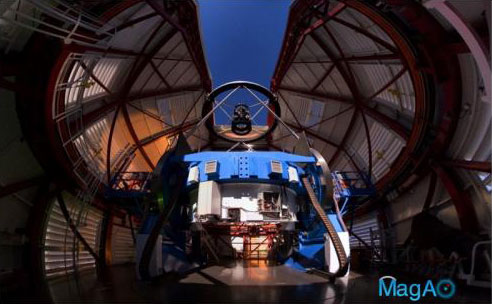
Highest-ever resolution photos of the night sky
A team of astronomers from three institutions has developed a new type of telescope camera that makes higher resolution images than ever before, the culmination of 20 years of effort.
August 21, 2013 Read more
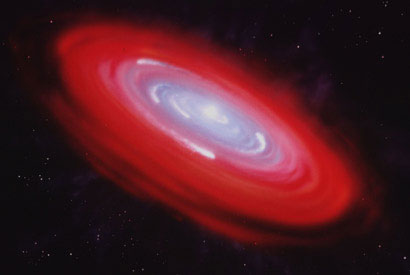
New theory points to 'zombie vortices' as key step in star formation
Scientists have proposed a new model that elucidates a key step in star formation. They point to 'zombie vortices' as a destabilizing force needed to help protostars accumulate the mass needed to grow into stars.
August 20, 2013 Read more
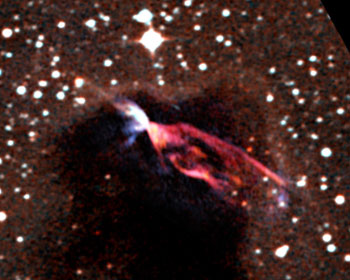
Starbirth surprisingly energetic: ALMA observations give new insights into protostars
While observing a newborn star, astronomers using the Atacama Large Millimeter/submillimeter Array (ALMA) telescope discovered twin jets of matter blasting out into space at record-breaking speed. These surprisingly forceful molecular 'winds' could help refine our understanding of how stars impact their cloudy nurseries and shape their emerging stellar systems.
August 20, 2013 Read more