

Space Exploration News – Latest Headlines
 Subscribe to our Space Exploration News feed
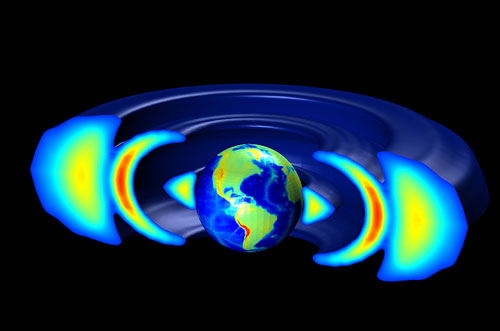
Scientists explain the formation of unusual ring of radiation in space
Since the discovery of the Van Allen radiation belts, scientists believed these belts consisted of two rings of highly charged particles. In February, scientists reported the discovery of a previously unknown third radiation ring - a narrow ring that briefly circled the Earth for a month. UCLA space scientists have successfully modeled and explained the unprecedented behavior of this third ring, and show that its energetic particles are driven by very different physics than the others.
September 22, 2013 Read more
International partnership releases Space Exploration Benefits Paper
NASA and the International Space Exploration Coordination Group (ISECG) released a white paper Friday outlining benefits of human exploration of space.
September 20, 2013 Read more
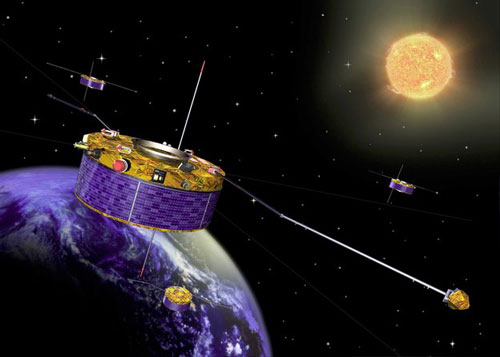
ESA's Cluster satellites in closest-ever 'dance in space'
Since 2000, the four identical satellites of the Cluster quartet have been probing Earth's magnetosphere in three dimensions. This week, two of them made their closest-ever approach, just 4 km, enabling valuable data to be acquired with unprecedented detail.
September 20, 2013 Read more
Curiosity Rover detects no methane on Mars
Data from NASA's Curiosity rover has revealed the Martian environment lacks methane. This is a surprise to researchers because previous data reported by U.S. and international scientists indicated positive detections.
September 19, 2013 Read more
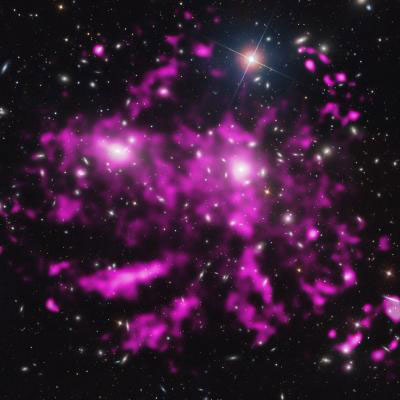
Clues to the growth of the colossus in the Coma cluster
A team of astronomers has discovered enormous arms of hot gas in the Coma cluster of galaxies by using NASA's Chandra X-ray Observatory and ESA's XMM-Newton. These features, which span at least half a million light years, provide insight into how the Coma cluster has grown through mergers of smaller groups and clusters of galaxies to become one of the largest structures in the universe held together by gravity.
September 19, 2013 Read more
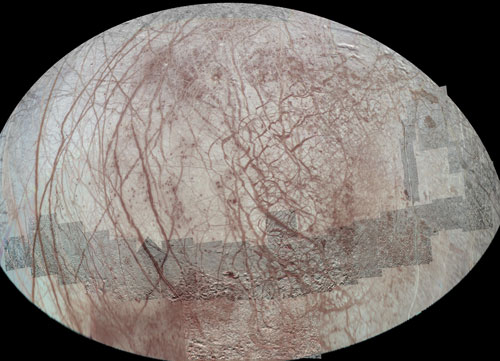
Long-stressed Europa likely off-kilter at one time
By analyzing the distinctive cracks lining the icy face of Europa, NASA scientists found evidence that this moon of Jupiter likely spun around a tilted axis at some point.
September 19, 2013 Read more
China's space station to open for foreign peers
China is willing to provide training and open the Chinese space station to foreign astronauts, senior space flight officials said.
September 19, 2013 Read more
Spacecraft aerocapture braking simulation marks key step towards real flight test
Researchers at EU-funded project AEROFAST ('Aerocapture for future space transportation') have successfully simulated a flight manoeuvre in which a space vehicle uses a planet's atmosphere to slow itself down.
September 18, 2013 Read more
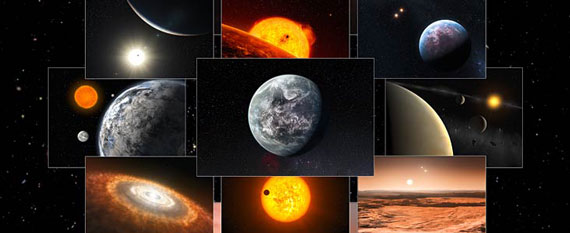
A decade of successful planet hunting - HARPS celebrates its tenth birthday
On 16-17 September 2013 a scientific meeting in Geneva entitled 10 Years of Science with HARPS celebrated a decade of full operation of the High-Accuracy Radial Velocity Planet Searcher (HARPS) - the world's foremost planet hunter. The meeting paid tribute to the extraordinary scientific results HARPS has provided and the unrivalled window it opens onto one of the most exciting areas of current astronomical science - the search for and characterisation of planets around other stars.
September 18, 2013 Read more
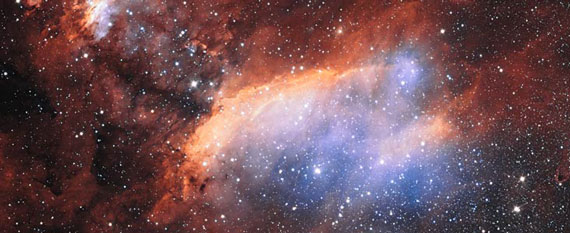
Young stars cooking in the Prawn Nebula
The glowing jumble of gas clouds visible in this new image make up a huge stellar nursery nicknamed the Prawn Nebula. Taken using the VLT Survey Telescope at ESO's Paranal Observatory in Chile, this may well be the sharpest picture ever taken of this object. It shows clumps of hot new-born stars nestled in among the clouds that make up the nebula.
September 18, 2013 Read more
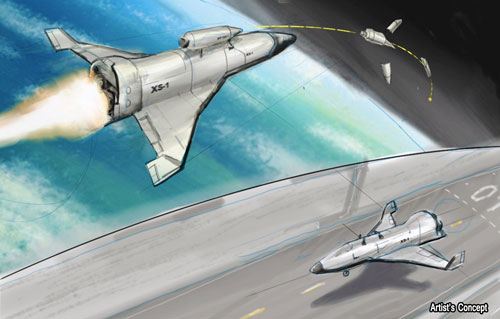
Experimental spaceplane shooting for 'aircraft-like' operations in orbit
New program seeks to lower satellite launch costs by developing a reusable hypersonic unmanned vehicle with costs, operation and reliability similar to traditional aircraft.
September 17, 2013 Read more
Study indicates space weather may be to blame for some satellite failures
MIT study finds that high-energy electrons in space may be to blame for some satellite failures.
September 16, 2013 Read more
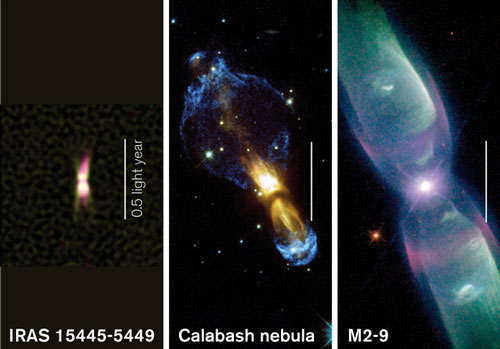
Magnetic jet shows how stars begin their final transformation
Astronomers have for the first time found a jet of high-energy particles from a dying star. The discovery, by a team including Chalmers scientists, is a crucial step in explaining how some of the most beautiful objects in space are formed - and what happens when stars like the sun reach the end of their lives.
September 16, 2013 Read more
Scientists discover cosmic factory for making building blocks of life
Scientists have discovered a 'cosmic factory' for producing the building blocks of life, amino acids.
September 15, 2013 Read more
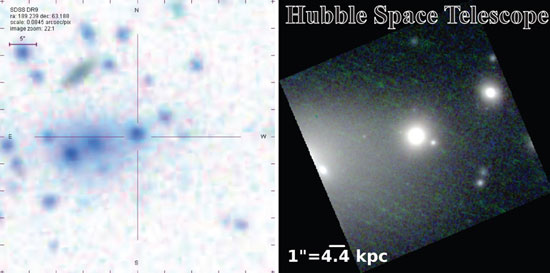
'Red nugget' galaxies were hiding in plain sight
In 2005 the Hubble Space Telescope spotted unusually small galaxies densely packed with red stars in the distant, young universe. They were nicknamed "red nuggets." Since no "red nuggets" were seen nearby, astronomers wondered why they had disappeared over time. New research shows that they didn't disappear completely. In fact, they were simply hidden within the data of previous surveys.
September 13, 2013 Read more
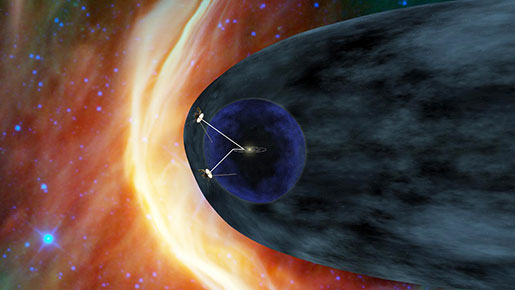
Voyager's departure from the heliosphere
New data from NASA's Voyager 1 spacecraft, which has been hurtling away from the sun since it was launched in 1977, indicates that the spacecraft has indeed left the comfort of the heliosphere and entered into a region of cold, dark space, known as interstellar space.
September 12, 2013 Read more
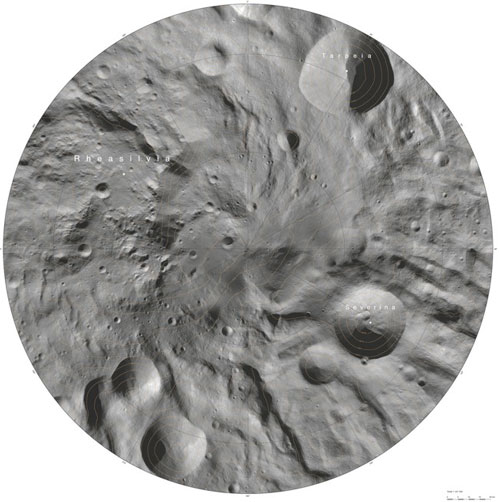
Take a virtual tour of Vesta with new high resolution atlases
An atlas of the asteroid, Vesta, created from images taken during the Dawn Mission's Low Altitude Mapping Orbit (LAMO), is now accessible for the public to explore online. The set of maps has been created from mosaics of 10 000 images from Dawn's framing camera (FC) instrument, taken at an average altitude of about 210 kilometres.
September 12, 2013 Read more
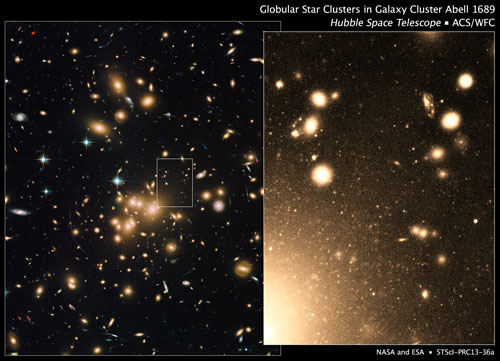
Hubble uncovers largest known population of star clusters
NASA's Hubble Space Telescope has uncovered the largest known population of globular star clusters, an estimated 160,000, swarming like bees inside the crowded core of the giant grouping of galaxies Abell 1689. By comparison, our Milky Way galaxy hosts about 150 such clusters.
September 12, 2013 Read more