

Space Exploration News – Latest Headlines
 Subscribe to our Space Exploration News feed
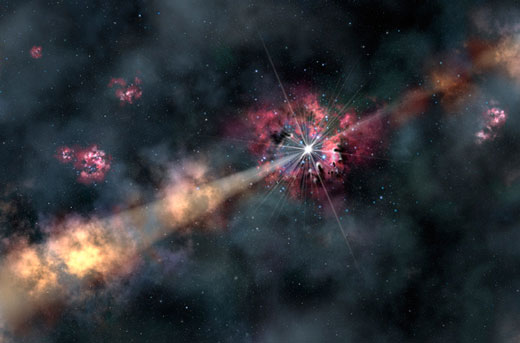
Explosion illuminates invisible galaxy in the dark ages
More than 12 billion years ago a star exploded, glowing so brightly that it outshone its entire galaxy by a million times. This brilliant flash traveled across space for 12.7 billion years to a planet that hadn't even existed at the time of the explosion -- our Earth. By analyzing this light, astronomers learned about a galaxy that was otherwise too small, faint and far away for even the Hubble Space Telescope to see.
August 6, 2013 Read more
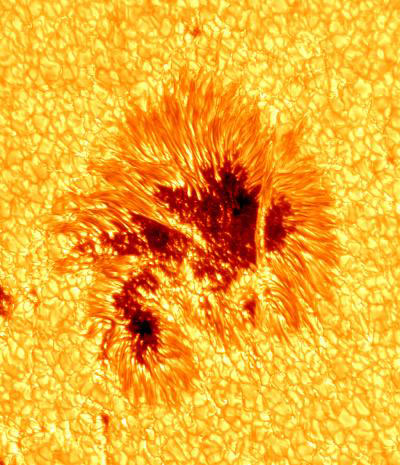
New and remarkable details of the sun now available from NJIT's Big Bear Observatory
Researchers at NJIT's Big Bear Solar Observatory in Big Bear, Calif., have obtained new and remarkably detailed photos of the sun with the New Solar Telescope. The photographs reveal never-before-seen details of solar magnetism revealed in photospheric and chromospheric features.
August 6, 2013 Read more
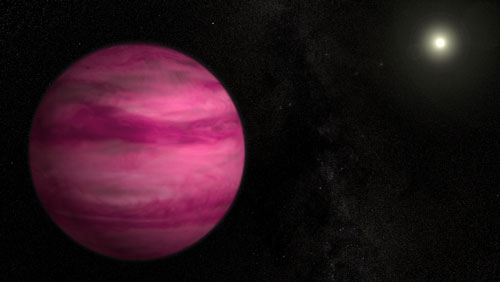
Astronomers image lowest-mass exoplanet around a sun-like star
Using infrared data from the Subaru Telescope in Hawaii, an international team of astronomers has imaged a giant planet around the bright star GJ 504. Several times the mass of Jupiter and similar in size, the new world, dubbed GJ 504b, is the lowest-mass planet ever detected around a star like the sun using direct imaging techniques.
August 5, 2013 Read more
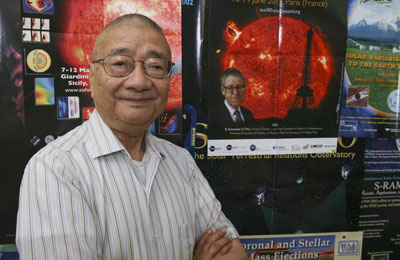
New research aids ability to predict solar storms, protect Earth
Three new solar modeling developments at The University of Alabama in Huntsville (UAH) are bringing scientists closer to being able to predict the occurrence and timing of coronal mass ejections from the sun.
August 5, 2013 Read more
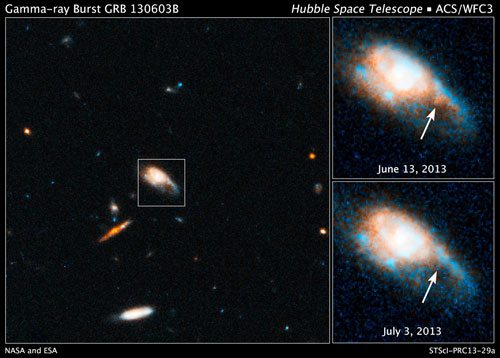
Hubble finds 'smoking gun' after gamma-ray burst
Probing the location of a recent short-duration gamma-ray burst in near-infrared light, astronomers using the Hubble Space Telescope found the fading fireball produced in the aftermath of the blast. The afterglow reveals for the first time a new kind of stellar blast called a kilonova.
August 3, 2013 Read more
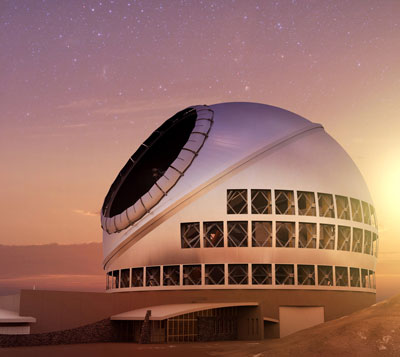
Mission to build world's most advanced telescope reaches major milestone
With the signing last week of a 'master agreement' for the Thirty Meter Telescope - destined to be the most advanced and powerful optical telescope in the world - the University of California and UCLA moved a step closer to peering deeper into the cosmos than ever before.
August 3, 2013 Read more
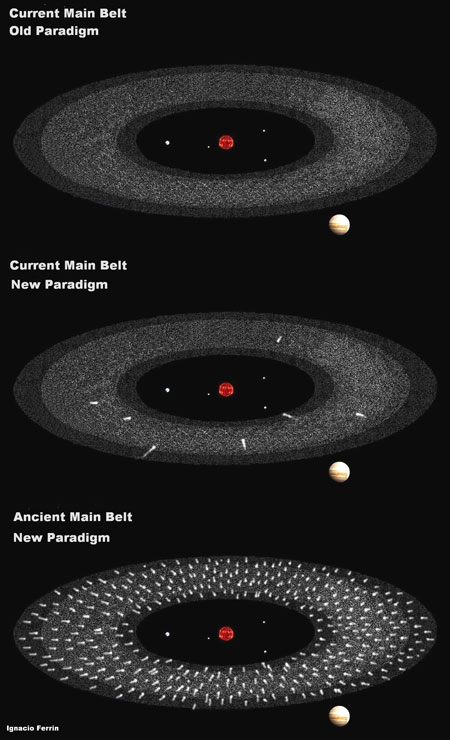
A cometary graveyard
Astronomers have discovered a graveyard of comets. The researchers describe how some of these objects, inactive for millions of years, have returned to life leading them to name the group the 'Lazarus comets'.
August 2, 2013 Read more
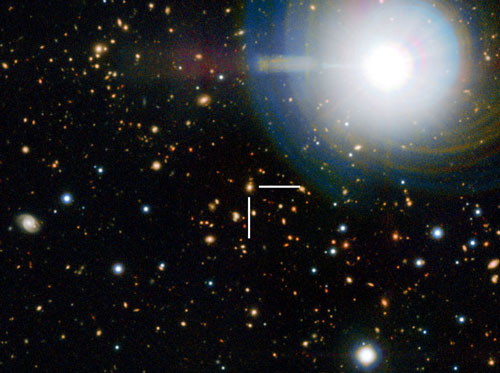
Why galaxies seemingly grow in old age
On average, galaxies that no longer form stars are larger today than they were several billion years ago. However, this has nothing to do with individual galaxies merging with others, as was long thought to be the case, concludes ETH-Zurich professor Marcella Carollo after evaluating data from the Hubble Space Telescope.
August 2, 2013 Read more
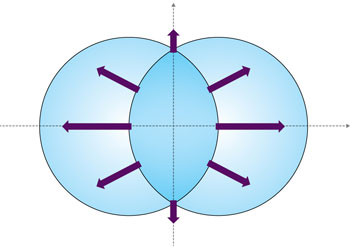
Shining light on the early Universe
A predicted experimental test will clarify how light interacts with matter at high energies.
August 2, 2013 Read more
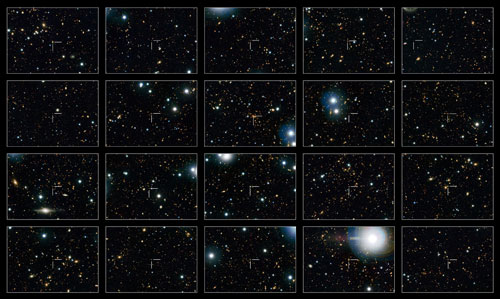
When galaxies switch off
Hubble's COSMOS survey solves 'quenched' galaxy mystery.
August 1, 2013 Read more
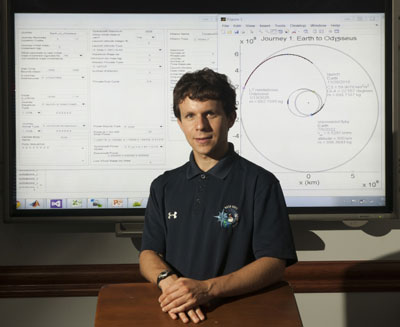
NASA technologist makes traveling to hard-to-reach destinations easier
A NASA technologist has developed a fully automated tool that gives mission planners a preliminary set of detailed directions for efficiently steering a spacecraft to hard-to-reach interplanetary destinations, such as Mercury, Jupiter, Saturn, and most comets and asteroids.
August 1, 2013 Read more
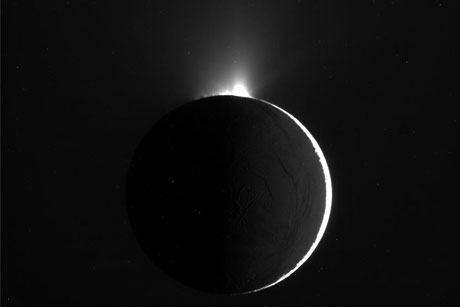
Saturn moon's mystery plume influenced by tides
Using Cassini data, astronomers have determined that the amount of water vapor and ice erupting from Enceladus depends on tidal forces from Saturn - the same phenomenon that creates tides on Earth.
July 31, 2013 Read more
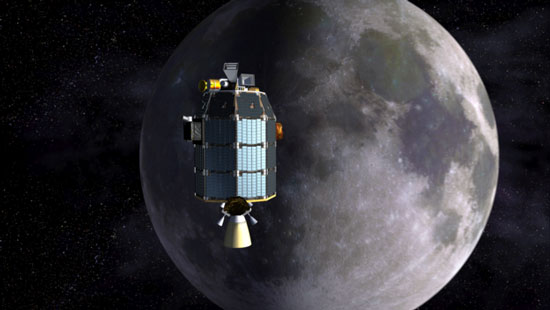
Laser communication set for Moon misison
An advanced laser system offering vastly faster data speeds is now ready for linking with spacecraft beyond our planet following a series of crucial ground tests. Later this year, ESA's observatory in Spain will use the laser to communicate with a NASA Moon orbiter.
July 30, 2013 Read more
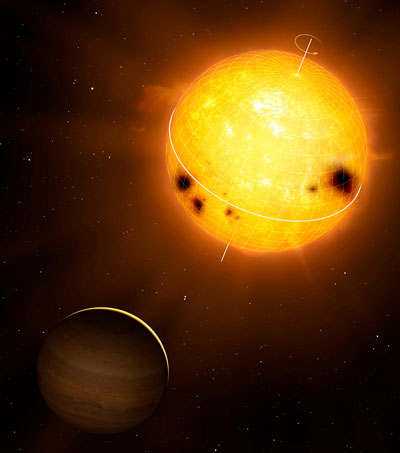
Interior rotation of a distant star revealed
With the help of asteroseismic data obtained by the CoRoT space telescope, scientists were able to determine the interior rotation of a Sun-like star - and characterise an exoplanet.
July 30, 2013 Read more
To infinity and beyond: teleporting humans into space
In the science fiction show, Star Trek, teleportation is a regular and significant feature. But how much time and power is required to send the data needed to teleport a human being? University of Leicester physics students have calculated the answer to this very question.
July 30, 2013 Read more
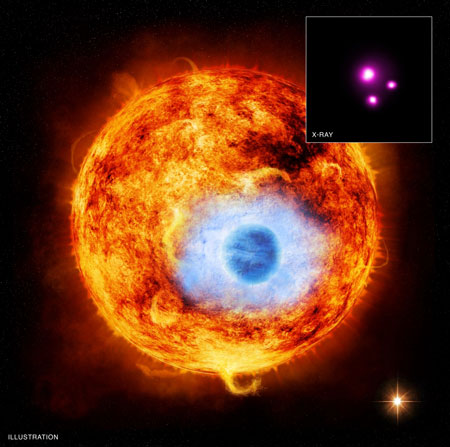
Chandra sees eclipsing planet in X-rays for first time
For the first time since exoplanets, or planets around stars other than the sun, were discovered almost 20 years ago, X-ray observations have detected an exoplanet passing in front of its parent star.
July 29, 2013 Read more
Removing complexity layers from the universe's creation
Understanding complexity in the early universe may require combining simpler models to interpret cosmological observations.
July 26, 2013 Read more
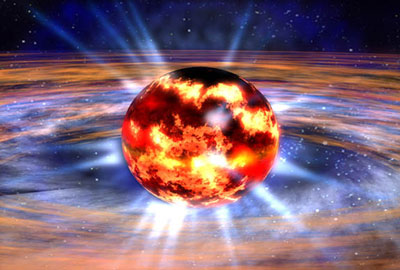
Scientists discover surprising importance of 'I Love Q' for understanding neutron stars
Scientists can learn a tremendous amount about neutron stars and quark stars without understanding their internal structure in detail, according to two Montana State University scientists.
July 26, 2013 Read more