

Space Exploration News – Latest Headlines
 Subscribe to our Space Exploration News feed
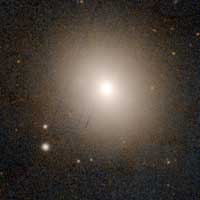
How fast is the universe expanding? Galaxies provide one answer
New measure of Hubble constant highlights discrepancy between estimates of our cosmic fate.
March 9, 2021 Read more
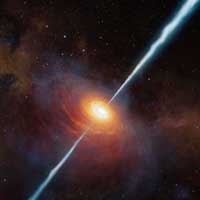
Most distant cosmic jet providing clues about early universe
Astronomers using the VLA and VLBA have found the most distant cosmic jet yet discovered, material propelled at nearly the speed of light by a supermassive black hole in the core of a galaxy some 13 billion light-years from Earth.
March 8, 2021 Read more
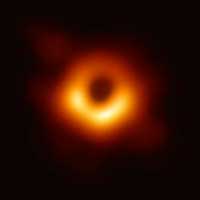
Establishing the origin of solar-mass black holes and the connection to dark matter
What is the origin of black holes and how is that question connected with another mystery, the nature of dark matter? Dark matter comprises the majority of matter in the Universe, but its nature remains unknown.
March 8, 2021 Read more
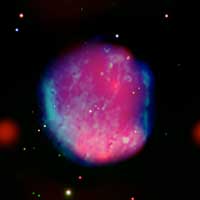
Debris of stellar explosion found at unusual location
eROSITA space telescope finds largest supernova remnant ever discovered with X-rays.
March 5, 2021 Read more
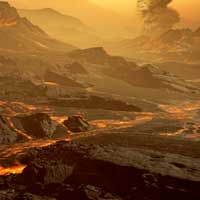
Earth has a hot new neighbour - and it's an astronomer's dream
A rocky planet discovered in the Virgo constellation could change how we look for life in the universe.
March 4, 2021 Read more
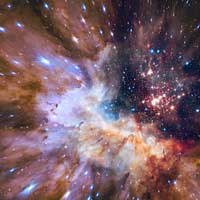
Will this solve the mystery of the expansion of the universe?
Physicists proposal that a new type of extra dark energy is involved.
March 3, 2021 Read more
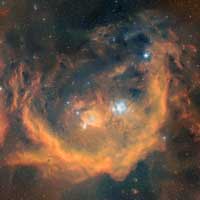
Sensing suns
Astronomers accurately measure the temperature of red supergiant stars.
March 1, 2021 Read more
New study suggests supermassive black holes could form from dark matter
Scientists propose that rather than the conventional formation scenarios involving 'normal' matter, supermassive black holes could instead form directly from dark matter in high density regions in the centres of galaxies.
February 24, 2021 Read more
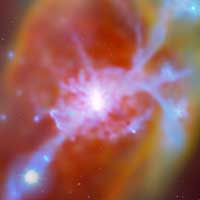
Researchers detect cold gas pipelines feeding early, massive galaxies
Astronomers have detected cosmic pipelines supplying the cold gases necessary for the formation of massive galaxies and the creation of stars. It is the first direct observational evidence of the phenomenon in the early universe.
February 24, 2021 Read more
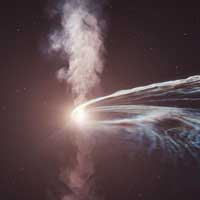
Ghost particle from shredded star reveals cosmic particle accelerator
From a black hole to the South Pole: Scientists identify first neutrino from a tidal disruption event.
February 24, 2021 Read more
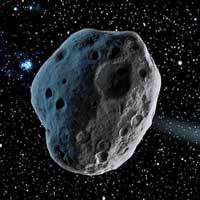
Farming on asteroids: Science future, not science fiction
Organic-layered asteroids could bear fruit - or wheat, or other crops - for future space exploration.
February 24, 2021 Read more
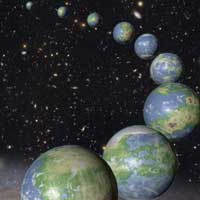
The Milky Way may be swarming with planets with oceans and continents like here on Earth
According to a new study, Earth, Venus and Mars were created from small dust particles containing ice and carbon. The discovery opens up the possibility that the Milky Way may be filled with aquatic planets.
February 23, 2021 Read more
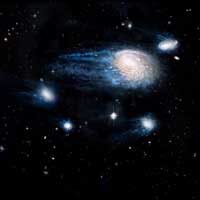
Big galaxies steal star-forming gas from their smaller neighbors
Large galaxies are known to strip the gas that occupies the space between the stars of smaller satellite galaxies. Astronomers have discovered that these small satellite galaxies also contain less 'molecular' gas at their centres.
February 22, 2021 Read more
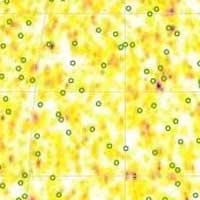
Astrophysicists propose that all high-energy cosmic neutrinos are born by quasars
Scientists studied the arrival directions of astrophysical neutrinos with energies more than a trillion electronvolts (TeV) and came to an unexpected conclusion: all of them are born near black holes in the centers of distant active galaxies powerful radio sources. Previously, only neutrinos with the highest energies were assumed to be obtained in sources of this class.
February 22, 2021 Read more
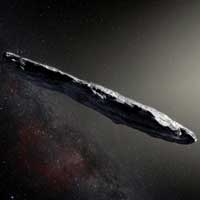
Has Earth been visited by an alien spaceship? Harvard professor Avi Loeb vs everybody else
Avi Loeb, a Harvard professor of astronomy, suggested in a recent book that asteroid Oumuamua is indeed an alien spaceship. But how feasible is this? And how come most scientists disagree with the claim?
February 18, 2021 Read more
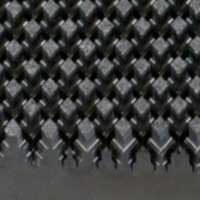
New metamaterials for studying the oldest light in the universe
To capture the ancient, cold light from the cosmic microwave background, researchers use specialized telescopes equipped with ultrasensitive cameras for detecting millimeter-wavelength signals. The next-generation cameras will contain up to 100,000 superconducting detectors.Scientists have developed a new type of metamaterials-based antireflection coating for the silicon lenses used in these cameras.
February 17, 2021 Read more

Removing space debris with gecko technology
Researchers have developed a mechanism for capturing space debris. This has now been successfully tested under space conditions onboard the International Space Station.
February 17, 2021 Read more
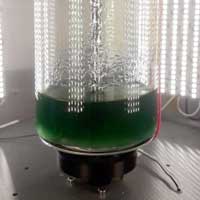
Biotechnology fit for the Red Planet
New method for growing cyanobacteria under Mars-like conditions.
February 16, 2021 Read more