

Space Exploration News – Latest Headlines
 Subscribe to our Space Exploration News feed
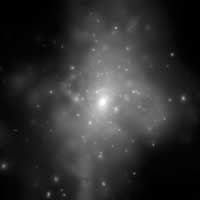
Precision measurements of intracluster light suggest possible link to dark matter
Faint light from rogue stars not bound to galaxies has been something of a mystery to scientists. The dimness of this intracluster light makes it difficult to measure, and no one knows how much there is. Scientists have made the most radially extended measurement of this light ever, and they've found that its distribution might point to the distribution of dark matter.
January 27, 2021 Read more
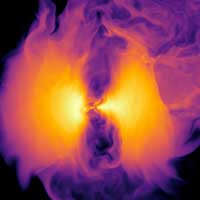
When galaxies collide
Models suggest galactic collisions can starve massive black holes.
January 25, 2021 Read more
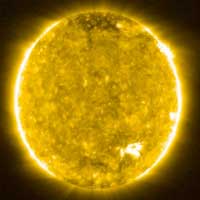
Magnetic waves explain mystery of Sun's outer layer (w/video)
A theory as to why the Sun's outer atmosphere differs in its chemical make-up from its inner layers has been confirmed by direct observation for the first time.
January 22, 2021 Read more
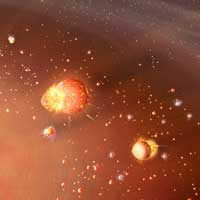
Solar System formation in two steps
Why are the planets of the inner Solar System dry and rocky, but the outer ones are not? Researchers discovered that a two-step formation process of the planets can explain the chronology and split in volatiles like water and isotope content of the inner and outer Solar System.
January 22, 2021 Read more
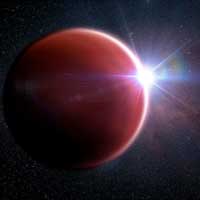
Astronomers discover first cloudless, Jupiter-like planet
Astronomers have detected the first Jupiter-like planet without clouds or haze in its observable atmosphere.
January 22, 2021 Read more
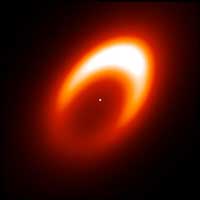
Astronomers see whirlwind around possible exoplanet-in-the-making
An international team of astronomers has discovered a whirlwind of dust and pebbles in orbit around a young star. It is possible that a planet is forming in the pebbles.
January 21, 2021 Read more
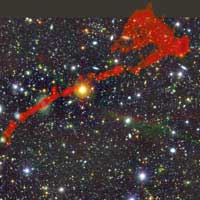
Cosmic beasts and where to find them
Two giant radio galaxies have been discovered with South Africa's powerful MeerKAT telescope. These galaxies are thought to be amongst the largest single objects in the Universe.
January 21, 2021 Read more

Astronomers estimate Titan's largest sea is 1,000-feet deep
Far below the gaseous atmospheric shroud on Saturn?s largest moon, Titan, lies Kraken Mare, a sea of liquid methane. Astronomers have estimated that sea to be at least 1,000-feet deep near its center - enough room for a potential robotic submarine to explore.
January 21, 2021 Read more

Oldest carbonates in the solar system
A meteorite that fell in northern Germany in 2019 contains carbonates which are among the oldest in the solar system; it also evidences the earliest presence of liquid water on a minor planet.
January 20, 2021 Read more
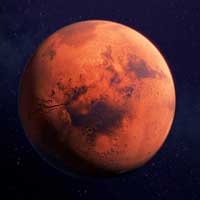
Mystery of Martian glaciers revealed
Research shows Mars had as many as six to 20 ice ages during the past 300-800 million years.
January 19, 2021 Read more
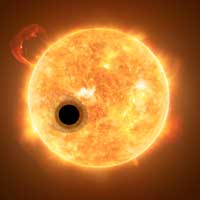
A 'super-puff' planet like no other
Astronomers discover that the core mass of exoplanet WASP-107b is much lower than previously thought possible for a gas-giant planet.
January 18, 2021 Read more
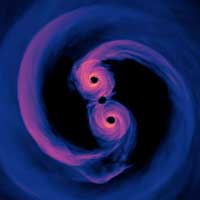
Quantum projects launched to solve universe's mysteries
Researchers will use cutting-edge quantum technologies to transform our understanding of the universe and answer key questions such as the nature of dark matter and black holes.
January 14, 2021 Read more
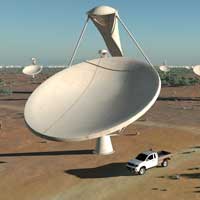
Can gravitational waves be detected by radio telescopes?
Two theoretical physicists are proposing a new approach to detect gravitational waves using a totally different type of observations: according to their calculations, parts of the waves should have converted to radio waves on their journey through the Universe, which might be measured by future radio telescopes.
January 14, 2021 Read more
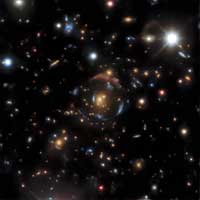
Doubling the number of known gravitational lenses
Astronomers hunting for gravitational lenses utilized machine learning to inspect the vast dataset known as the DESI Legacy Imaging Surveys, uncovering 1210 new lenses.
January 14, 2021 Read more
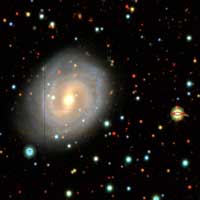
Building a giant 2D map of the universe to prepare for the largest 3D map
Nearly 200 researchers pitched in to gather, process, and stitch together images for half of the sky to prepare for the start of the Dark Energy Spectroscopic Instrument's observations.
January 14, 2021 Read more
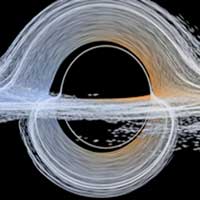
Could we harness energy from black holes?
A new study indicates energy can be extracted from black holes through reconnection of magnetic field lines.
January 13, 2021 Read more
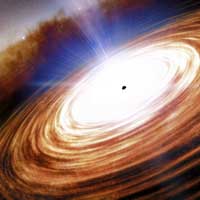
Astronomers discover most distant quasar
A team of astronomers has observed a luminous quasar 13.03 billion light-years from Earth - the most distant quasar discovered to date.
January 12, 2021 Read more
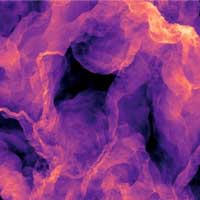
Unlocking the secrets of star formation
A new study by an international team of researchers has used computer power to map the so-called sonic scale, showing the key role turbulence plays in star formation.
January 11, 2021 Read more