| Nov 06, 2025 |
How water shapes chitin: Study reveals key differences in natural nanomaterials
New microscopy and simulations show how water interacts with two forms of chitin, revealing why one is more reactive and a better fit for future bio-based technologies.
(Nanowerk News) Researchers at the Nano Life Science Institute (WPI-NanoLSI), Kanazawa University, have used advanced 3D atomic force microscopy and molecular dynamics simulations to uncover how water behaves around two forms of chitin nanocrystals—and why that behavior matters.
|
|
Their findings, published in the Journal of the American Chemical Society ("Interplay between β-Chitin Nanocrystal Supramolecular Architecture and Water Structuring: Insights from Three-Dimensional Atomic force Microscopy Measurements and Molecular Dynamics Simulations"), offer fresh insight into how the molecular structure of chitin affects its mechanical performance, reactivity, and interactions with enzymes.
|
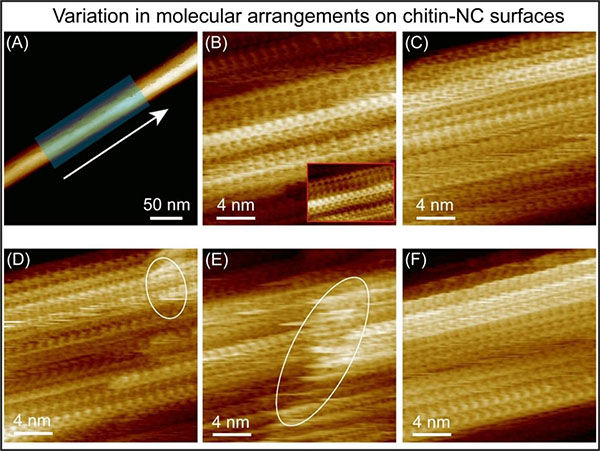 |
| (A) AFM topography image, showing an individual β-chitin NCs on mica, acquired in water. (B–F) High-resolution AFM images recorded along the fiber axis (across the shaded region in (A)), each covering an area of 20–30 nm × 20–30 nm, revealing the structural variations across the crystal surface. Ellipses highlight regions with fluctuating disordered domains on the surface, indicating the boundary between vertically stacked chitin sheets. (Image: Reproduced from DOI:10.1021/jacs.5c08484, CC BY)
|
|
Chitin is a natural polymer valued for its strong and versatile properties, making it a target for developing new bioengineered materials. It appears in two crystal forms: α-chitin, where molecules are aligned in alternating directions, and β-chitin, where molecules point the same way. These tiny differences at the molecular level affect how water organizes itself around each type and, as a result, how each form behaves in wet environments.
|
|
Until now, the specifics of how water arranges itself around these crystals were unclear. The research team, led by Ayhan Yurtsever and Takeshi Fukuma, combined 3D-AFM imaging with computer simulations to explore these hydration patterns under various pH levels. Their collaborators in Tokyo and Finland contributed to the chemical and computational analysis.
|
|
3D-AFM works by sensing nanoscale forces between a probe and a surface, offering both structural and chemical information. The team used this technology to create detailed 3D maps of chitin nanocrystals in water. Their images revealed that β-chitin has a surprisingly ordered structure with occasional disruptions that “lead to a structure resembling partially bitten corncobs or a brickwork pattern.” They add, “These different structural components are not merely external aggregates; instead, they constitute an integral part of the chitin fiber.” The order held steady even in mildly acidic environments (pH 3–5).
|
|
The researchers then zeroed in on how water molecules and hydrogen bonds formed on each type of chitin. α-chitin’s wider surface grooves held more water, creating a hydration layer that blocked interactions with ions or enzymes. This extra water made α-chitin less chemically reactive. In contrast, β-chitin’s tighter structure supported faster enzymatic reactions because its hydration layer allowed easier access to the surface. This structural insight may explain why enzymes break down one form of chitin more easily than the other.
|
|
The study suggests that understanding these hydration effects could lead to better materials for bioprotonic devices—which move protons instead of electrons—and hydrogels, where water transport is key.
|
|
“Collectively, this work links nanoscale interfacial structure to rational design strategies, advancing the effective development of sustainable, bio-based nanomaterials for energy and biomedical applications,” the researchers write. “Additionally, it provides valuable insights for the computational modeling of chitin surface interactions, crystallosolvate formation, and enzymatic hydrolysis, supporting the development of future material design strategies.”
|