Reference terms from Wikipedia, the free encyclopedia
 

Peripheral vision

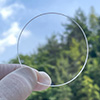
Peripheral vision, or indirect vision, is vision as it occurs outside the point of fixation, i.e. away from the center of gaze or, when viewed at large angles, in (or out of) the "corner of one's eye". The vast majority of the area in the visual field is included in the notion of peripheral vision. "Far peripheral" vision refers to the area at the edges of the visual field, "mid-peripheral" vision refers to medium eccentricities, and "near-peripheral", sometimes referred to as "para-central" vision, exists adjacent to the center of gaze.

 
Note:   The above text is excerpted from the Wikipedia article Peripheral vision, which has been released under the GNU Free Documentation License.
 

Check out these latest Nanowerk News:
 

Interface layer drives quantum dot tandem solar cells to record efficiency

Researchers used an ultrathin chlorinated polymer layer to cut charge losses and set efficiency records for all-PbS quantum dot tandem solar cells.

Modular nanorobot targets cancer cells and can be reused for other tasks

Researchers developed a versatile nanorobot with propulsion and payload modules. The two reusable modules autonomously self-assemble and could be used in medicine or industry.

Light color controls a photonic synapse that remembers and forgets

Researchers built a photonic synapse that strengthens or erases memory by light color, using a defect to mimic the brain's balanced learning.

Twisting 2D materials brings quantum light control closer to reality

Researchers show that twisting atom-thin boron nitride layers can tune quantum light emitters, offering new control for quantum technologies.

Open-air synthesis yields atom-precise iridium catalyst

A simple air-based method produces stable 15-atom iridium nanoclusters that outperform commercial catalysts for green hydrogen production.

Molecular simulations reveal why nanodrops spread

Simulations reveal why water nanodrops spread on surfaces: molecular structure at the contact line flips line tension, reshaping nanoscale wetting.

AI system monitors 2D semiconductor manufacturing at the atomic layer

Researchers combined low-temperature plasma processing with machine learning to synthesize and etch 6-inch MoS2 and WS2 wafers and predict film thickness in real time.

Paint it blacker: Carbon nanotube coating could make cars ultra-black

A new ultra-black automotive coating absorbs 99.9% of visible light, creating a deeper black finish that could be used on future luxury cars.

Real-time microscopy reveals how semiconductor nanowires grow, and how bismuth seeds can speed their formation

Scientists captured tellurium nanowire growth in liquid in real time, showing seed formation, material competition and bismuth-assisted deposition.

New nanotube membranes reveal unusually fast lithium-ion transport

Boron nitride nanotube membranes rapidly and selectively transport lithium ions, boosting prospects for clean energy, lithium recovery and molecular separation.