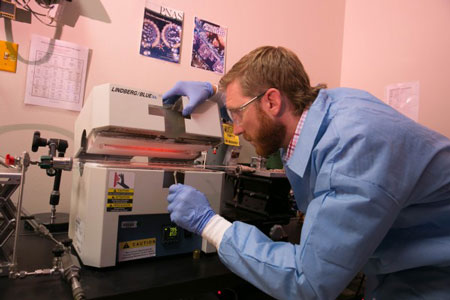
 In work that aims to protect soldiers from biological and chemical threats, a team of scientists has created a material that is highly breathable yet protective from biological agents.
Aug 3rd, 2016
Read more
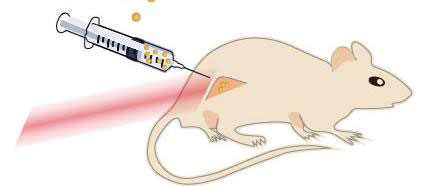 Researchers have developed a method that kills cancer cells using nanoparticles and lasers. The treatment has been tested on mice and it has been demonstrated that the cancer tumors are considerably damaged.
Aug 3rd, 2016
Read more
This new type of nanoparticles produce around ten times more contrast than the actual contrast agents and are responsive to specific environments.
Aug 3rd, 2016
Read more
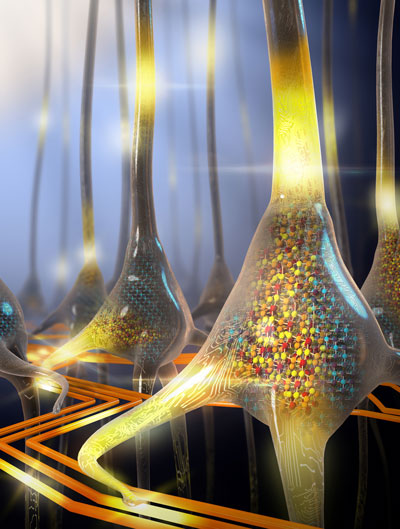 Scientists have created randomly spiking neurons using phase-change materials to store and process data. This demonstration marks a significant step forward in the development of energy-efficient, ultra-dense integrated neuromorphic technologies for applications in cognitive computing.
Aug 3rd, 2016
Read more
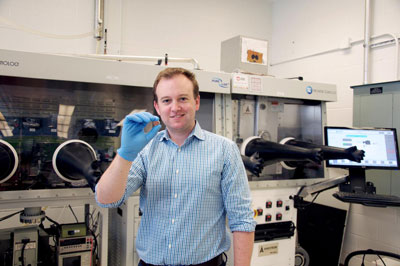 A team of chemists has created a battery that stores energy in a biologically derived unit, paving the way for cheaper consumer electronics that are easier on the environment.
Aug 3rd, 2016
Read more
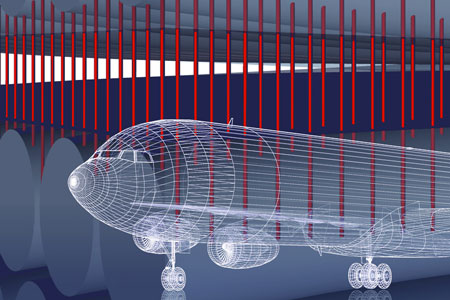 Method to reinforce these materials could help make airplane frames lighter, more damage-resistant.
Aug 3rd, 2016
Read more
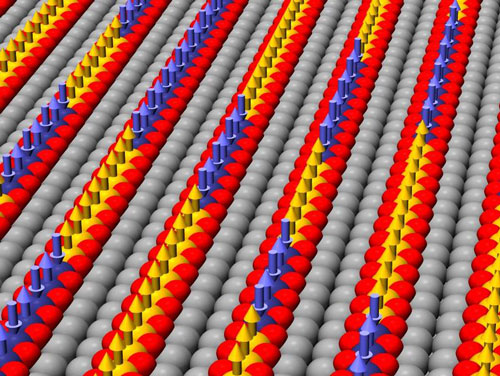 Physicists have successfully created one-dimensional magnetic atom chains for the first time. Their break-through provides a model system for basic research in areas such as magnetic data storage, as well as in chemistry.
Aug 3rd, 2016
Read more
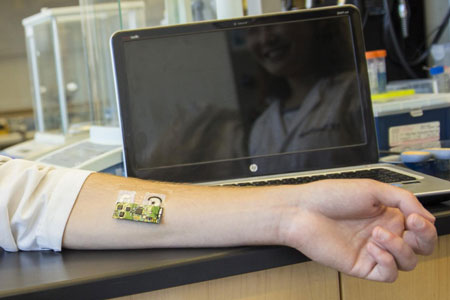 Engineers have developed a flexible wearable sensor that can accurately measure a person's blood alcohol level from sweat and transmit the data wirelessly to a laptop, smartphone or other mobile device.
Aug 2nd, 2016
Read more
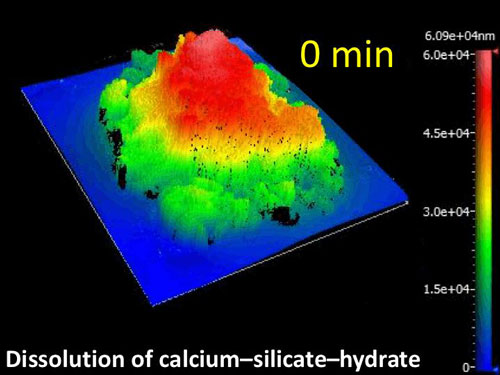 Researchers have clarified the origins of a mechanism responsible for the gradual deformation of concrete.
Aug 2nd, 2016
Read more
 Material can lead to new optical devices.
Aug 2nd, 2016
Read more
 The use of nanoscale magnetic whirlpools, known as magnetic skyrmions, to create novel and efficient ways to store data will be explored in a new GBP 7M research programme.
Aug 2nd, 2016
Read more
 New research shows how Geobacter bacteria grow as films on electrodes and generate electricity - a process that's ready to be scaled up to industrial levels.
Aug 2nd, 2016
Read more
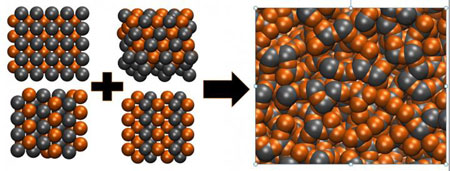 Research could pave the way for new strong, conductive materials.
Aug 2nd, 2016
Read more
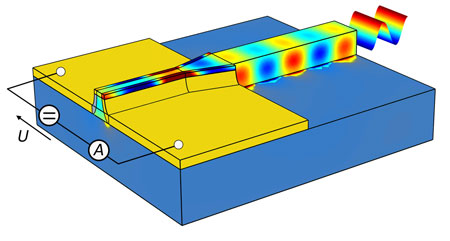 Researchers have now developed a novel type of photodetector that needs far less space than conventional ones. The component has a base area of less than one millionth of a square millimeter without the data transmission rate being affected adversely.
Aug 2nd, 2016
Read more
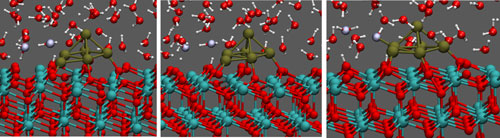 Thanks to a reaction that resembles a sort of proton pinball game, a thin layer of moisture on the surface of a catalysts can improve the efficiency of fuel cells, devices used to transform chemical energy directly into electricity without releasing greenhouse gases in emissions.
Aug 2nd, 2016
Read more
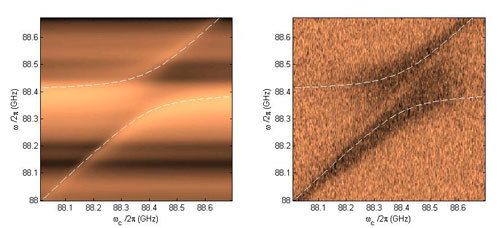 Where is the line between the quantum world and the classical world? A group of scientists explored this question by showing what was thought to be a quantum phenomenon can be explained classically.
Aug 2nd, 2016
Read more

 Subscribe to our Nanotechnology News feed