Click Chemistry: Definition, Reaction Types, and Biotechnology Uses
Definition: Click chemistry is a class of fast, high-yielding, and highly selective chemical reactions that join two molecular building blocks through a stable linkage under mild conditions. Reactions that also proceed safely inside living cells and organisms, without disturbing native biochemistry, are called bioorthogonal click reactions.
What Is Click Chemistry?
Click chemistry is a strategy for building molecules by snapping together two complementary chemical handles in a single, dependable step. Rather than relying on long multi-step syntheses, it uses a small set of reactions chosen because they are fast, give high yields, produce few or no byproducts, tolerate water and oxygen, and are easy to purify. The name captures the intent: two parts join with the reliability of a seatbelt buckle. The concept was introduced in 2001 by K. Barry Sharpless and colleagues, who argued that a handful of near-perfect reactions could assemble vast numbers of useful compounds.
The most important property for biology is selectivity. The signature click handles – chemical groups such as azides, terminal alkynes, and tetrazines – are essentially absent from living systems and unreactive toward the proteins, sugars, and nucleic acids that surround them. When a click reaction is selective and benign enough to run inside a living cell or animal without side reactions, it is called bioorthogonal. This combination of speed and selectivity is why click chemistry has become a standard tool across biotechnology, from labeling individual molecules to manufacturing targeted medicines.
At a glance:
- Core idea: join two building blocks with a fast, high-yield, highly selective reaction
- Signature reaction: azide + alkyne → stable 1,2,3-triazole ring
- Key handles: azide, terminal alkyne, strained cyclooctyne, tetrazine, trans-cyclooctene
- Bioorthogonal: click reactions that work inside living systems without side reactions
- Main families: CuAAC (copper-catalyzed), SPAAC (copper-free), tetrazine ligation
- Recognition: 2022 Nobel Prize in Chemistry
The breadth of use is striking. A researcher can feed a cell a sugar carrying an azide, then attach a fluorescent dye exactly where that sugar ends up; a chemist can fasten a cytotoxic drug to an antibody at one precise position; and a diagnostic team can build a radioactive tracer that assembles itself at a tumor inside a patient. In 2022 the Nobel Prize in Chemistry was awarded jointly to Carolyn R. Bertozzi, Morten Meldal, and K. Barry Sharpless for the development of click chemistry and bioorthogonal chemistry – the second chemistry Nobel of Sharpless's career.
The Click Chemistry Criteria and a Brief History
When Sharpless and co-workers defined click chemistry in 2001, they proposed deliberately strict criteria for ideal click reactions: they should be modular and wide in scope, give very high yields, generate only harmless byproducts, be stereospecific, and use simple reaction conditions with readily available starting materials and easy product isolation. Underlying these practical demands is a thermodynamic one: a true click reaction is usually strongly favored, with a large driving force that pushes it toward completion and limits reversal. Few reactions meet every criterion, which is precisely the point – the value lies in a small, trustworthy toolkit.
The field accelerated in 2002, when two groups independently reported that a copper catalyst dramatically speeds up and controls the union of an azide and an alkyne. This copper-catalyzed reaction became the workhorse of the field. Around the same time, Carolyn Bertozzi was developing chemistry that could be performed in living organisms to study cell-surface sugars, and her group coined the term “bioorthogonal” for reactions whose components neither interact with nor interfere with biology. The strain-promoted, copper-free version of the azide–alkyne reaction emerged from this effort, removing the toxic metal and opening click chemistry to use in living cells and animals.
How Does Click Chemistry Work?
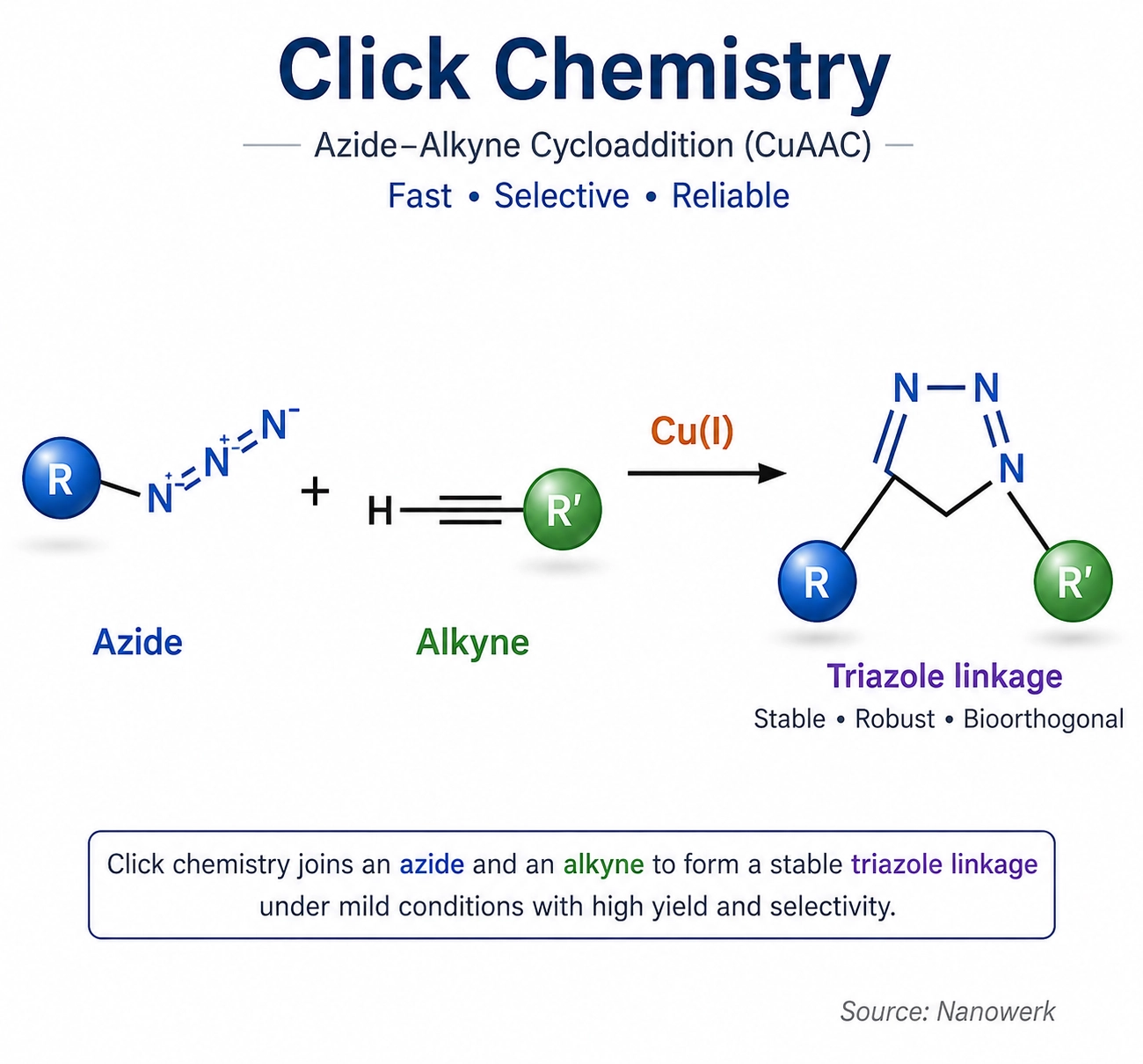
The defining click reaction is the azide–alkyne cycloaddition. An azide – three nitrogen atoms in a row – reacts with a terminal alkyne, a carbon–carbon triple bond at the end of a chain. The two groups combine in a cycloaddition, meaning their atoms come together to close a new ring without losing any atoms as byproducts. The product is a 1,2,3-triazole, a five-membered ring containing three nitrogen atoms. This triazole is chemically and thermally stable, resistant to acids, bases, and biological breakdown, which makes it an excellent permanent tether between two molecules.
Without help, the uncatalyzed azide–alkyne reaction is slow and produces a mixture of two ring arrangements. Adding a copper(I) catalyst changes everything: it accelerates the reaction by orders of magnitude and steers it to a single, defined product, the 1,4-disubstituted triazole. The copper activates the alkyne and assembles the new ring through a stepwise sequence at the metal center. This catalyzed process, abbreviated CuAAC for copper(I)-catalyzed azide–alkyne cycloaddition, proceeds in water at room temperature and is the version most chemists mean when they say “click.”
The reason these handles work so well in biological settings is that they occupy chemical territory that life does not use. Azides and alkynes are small, abiotic, and stable in water, and they essentially ignore the amino acids, DNA, and metabolites around them while reacting readily with each other. A handle can be installed on a target molecule in advance – chemically, or biosynthetically by feeding cells a building block that carries it – and then found later by its click partner attached to a probe. This pairing of an inert handle with a selective partner is the conceptual core of bioorthogonal labeling.
The Click Reaction Toolkit: CuAAC, SPAAC, and Tetrazine Ligation
Click chemistry is not a single reaction but a small family, and choosing among them is a trade-off between speed, the need for a catalyst, and compatibility with living systems. The copper-catalyzed reaction is fast and gives a clean single product, but copper ions are toxic to cells and can damage proteins and DNA, which restricts its use inside living organisms. To work in cells and animals, chemists turned to copper-free alternatives. In strain-promoted azide–alkyne cycloaddition, abbreviated SPAAC, the alkyne is bent into a strained eight-membered ring called a cyclooctyne; the built-in ring strain supplies the driving force the copper would otherwise provide, so no metal is needed.
A third major family, the tetrazine ligation, pairs a tetrazine with a strained alkene such as trans-cyclooctene through an inverse electron-demand Diels–Alder reaction that expels nitrogen gas. This reaction can be extraordinarily fast – among the fastest bioorthogonal reactions known – which makes it valuable when reagents must find each other quickly at very low concentrations, as in imaging and pretargeted therapy. Other click-type reactions, including the Staudinger ligation and sulfur(VI) fluoride exchange (SuFEx), extend the toolkit further. The table below summarizes the trade-offs that govern which reaction a project chooses.
| Reaction | Reacting partners | Catalyst | Relative speed | Typical use | Live-cell / in-vivo suitability |
|---|---|---|---|---|---|
| CuAAC | Azide + terminal alkyne | Copper(I) | Fast | In-vitro bioconjugation, materials, fixed cells | Generally poor unless carefully modified with protective ligands |
| SPAAC | Azide + strained cyclooctyne | None | Slow to moderate | Live-cell and in-vivo labeling | Good, with reagent-dependent background and hydrophobicity |
| Tetrazine ligation | Tetrazine + strained alkene | None | Very fast | Imaging, pretargeting, drug release | Good, with stability depending on the tetrazine and alkene partner |
| Staudinger ligation | Azide + phosphine | None | Slow | Early in-vivo labeling, niche uses | Good but usually limited by slow kinetics |
| SuFEx | Sulfonyl fluoride + nucleophile | Optional base | Moderate | Polymer and probe synthesis | Context-dependent; mostly synthetic and probe-design use |
The non-obvious trade-off is that the fastest and cleanest reaction is rarely the best for every job. CuAAC's copper requirement rules it out for most work inside living organisms, while the copper-free SPAAC is gentler but slower and relies on bulky, hydrophobic cyclooctynes that can complicate molecule design. Tetrazine ligation recovers the speed without a catalyst but demands more elaborate reagents whose stability must be managed. In practice, laboratories keep all of these in the toolbox and match the reaction to the setting rather than seeking one universal click.
What Is Click Chemistry Used For in Biotechnology?
The largest single use is bioconjugation: the controlled attachment of one molecule to another. Click handles let researchers fasten fluorescent dyes, biotin, polymers, or drug molecules onto antibodies, peptides, and oligonucleotides at defined positions and in high yield. Compared with older coupling chemistries that react with many surface groups at once, click reactions give homogeneous, well-defined products, which is central to modern protein engineering and to the manufacture of biopharmaceuticals.
A second major application is imaging biomolecules in their native environment. By feeding cells an unnatural sugar that carries an azide, researchers can let normal metabolism install the handle onto cell-surface glycans, then visualize those sugars with a copper-free clickable fluorophore – an approach Bertozzi's group used to image changing sugar coats on living cells and in whole organisms. The same metabolic-labeling logic is applied to newly made proteins, lipids, and RNA. A widely used example in molecular biology is the nucleoside analog EdU, an alkyne-tagged building block that is incorporated into newly synthesized DNA and then detected by clicking on a dye to measure cell proliferation.
Click chemistry is also a backbone technique of chemical proteomics. In activity-based protein profiling, a small reactive probe carrying an alkyne tags active enzymes in a complex mixture; a click reaction then attaches a reporter for detection or an affinity tag for enrichment before mass-spectrometry analysis. This strategy maps drug–protein interactions and post-translational modifications across the proteome, and it has become a standard way to find druggable sites on proteins. Related conjugation methods support the construction of biosensors, hydrogels for tissue engineering, and clickable nucleic acids for diagnostics.
Click Chemistry in the Clinic
In medicine, click chemistry first proved its value in manufacturing rather than inside the body. Antibody–drug conjugates – monoclonal antibodies carrying a potent cytotoxic payload – benefit greatly from controlled conjugation, which can produce more uniform products with the drug attached at defined positions. Some approved ADCs use conjugation reactions often discussed under the broader click-chemistry umbrella, especially thiol–maleimide coupling, while more canonical bioorthogonal reactions such as SPAAC and tetrazine ligation are especially important in research, imaging, pretargeting, and investigational site-specific ADC platforms. One common investigational route engineers an azide-bearing unnatural amino acid into the antibody and then clicks on the payload as part of cancer immunotherapy and targeted-treatment programs.
The more ambitious goal is to perform a click reaction inside a patient. In pretargeting, a tumor-binding agent carrying one click partner is given first and allowed to localize; a small clickable payload is then administered and reacts only where the first agent has accumulated. A variant called click-to-release uses the tetrazine reaction not only to capture a drug but to trigger its uncaging at the target site. SQ3370 has been evaluated as an investigational cancer therapeutic in a first-in-human dose-escalation trial: an injected clickable biopolymer was designed to capture and activate an attenuated doxorubicin prodrug at the tumor, allowing dose escalation beyond conventional doxorubicin limits without dose-limiting toxicity in the reported study. This was an early clinical demonstration of click chemistry in humans, but not an approved or established therapy. Click chemistry is similarly used to assemble pretargeted radiotracers, linking it to biomarker imaging and the broader goal of personalized medicine.
Limitations and Safety Considerations
No single click reaction is ideal for every situation. The fast copper-catalyzed reaction is constrained by the catalyst itself: copper ions generate reactive oxygen species and are toxic to cells, so CuAAC is generally unsuitable inside living organisms without protective ligands that shield the metal and accelerate the reaction. Copper-free SPAAC removes this hazard but is markedly slower, and its cyclooctyne reagents are bulky and hydrophobic, which can perturb the molecule they are attached to and, in some cases, react with cellular thiols.
The very fast tetrazine ligation has its own constraints. Trans-cyclooctene, its high-speed partner, can slowly isomerize in the body to an unreactive form, lowering the effective yield of an in-vivo reaction, and highly reactive tetrazines must be balanced against long-term stability. Across all variants, getting reagents to the right place at adequate concentration, minimizing background reactivity, and confirming that introduced handles do not alter a biomolecule's function remain practical challenges. These are engineering problems rather than fundamental barriers, and reagent design continues to narrow them.
Frequently Asked Questions
What is the difference between click chemistry and bioorthogonal chemistry? Click chemistry is a design philosophy for fast, reliable reactions that join molecular building blocks under mild conditions. Bioorthogonal chemistry refers to reactions that can occur inside living systems without reacting with native biomolecules. The two areas overlap strongly, but they are not identical: many bioorthogonal reactions are click reactions, while some click reactions, such as copper-catalyzed azide–alkyne cycloaddition, are not suitable for live biological systems because of the copper catalyst.
Why did click chemistry win the Nobel Prize? The 2022 Nobel Prize in Chemistry was awarded to Carolyn Bertozzi, Morten Meldal, and K. Barry Sharpless for developing click chemistry and bioorthogonal chemistry. The prize recognized a set of reactions that made it simple and reliable to snap molecules together, transforming drug discovery, diagnostics, materials science, and the ability to track biomolecules in living systems. It was Sharpless's second Nobel Prize in Chemistry.
What is the most common click reaction? The copper-catalyzed azide–alkyne cycloaddition, or CuAAC, is the most widely used click reaction. It joins an azide and a terminal alkyne to form a stable 1,2,3-triazole ring, is highly selective, and proceeds in water at room temperature. Because the copper catalyst is cytotoxic, copper-free variants such as strain-promoted cycloaddition and tetrazine ligation are preferred for work inside living cells and animals.
What is copper-free click chemistry? Copper-free click chemistry refers to click reactions that do not require a copper catalyst, making them better suited for live-cell and in-vivo work. The main examples are strain-promoted azide–alkyne cycloaddition, or SPAAC, which uses a strained cyclooctyne, and tetrazine ligation, which pairs a tetrazine with a strained alkene such as trans-cyclooctene.
Is click chemistry used in approved drugs? Some approved antibody–drug conjugates use conjugation reactions often discussed under the broader click-chemistry umbrella, especially thiol–maleimide coupling. More canonical bioorthogonal click reactions such as SPAAC and tetrazine ligation are especially important in research, imaging, pretargeting, and investigational site-specific bioconjugates. No click-activated in-body therapy has yet become a mainstream approved treatment; SQ3370 has been evaluated as an investigational cancer therapeutic in a first-in-human dose-escalation trial.
What are azides and alkynes in click chemistry? Azides and alkynes are the two small chemical handles used in the best-known click reaction. An azide is a group of three nitrogen atoms, and a terminal alkyne is a carbon–carbon triple bond at the end of a chain. Both are rare in biology, stable in water, and unreactive toward most biological molecules, so they react cleanly with each other when introduced into proteins, sugars, or nucleic acids.
Further Reading
Angewandte Chemie International Edition, Click Chemistry: Diverse Chemical Function from a Few Good Reactions
Angewandte Chemie International Edition, Bioorthogonal Chemistry: Fishing for Selectivity in a Sea of Functionality
Bioconjugate Chemistry, Click Chemistry: Reaction Rates and Their Suitability for Biomedical Applications