

Protein Engineering: Directed Evolution, Rational Design, and AI-Driven Approaches
What Is Protein Engineering?
Protein engineering is the discipline of designing and constructing proteins with new or improved properties by modifying their amino acid sequences. Natural proteins have been shaped by billions of years of evolution, but their functions rarely match the needs of modern medicine, industry, or research. Protein engineering—a subdiscipline of genetic engineering focused specifically on the protein product—bridges this gap by applying molecular biology, computational modeling, and artificial intelligence to tailor proteins for specific applications.
The field emerged in the early 1980s when advances in recombinant DNA technology made it possible to alter protein-coding genes in a controlled manner. Early work focused on site-directed mutagenesis—introducing planned amino acid substitutions guided by structural knowledge—to improve enzymes and antibodies. A pivotal shift came in 1993 when Frances Arnold demonstrated the first directed evolution of an enzyme, using iterative rounds of random mutagenesis and screening to improve a subtilisin protease for activity in an organic solvent without any structural understanding.
Arnold received the 2018 Nobel Prize in Chemistry for this work, sharing the award with George Smith and Gregory Winter, who developed phage display methods for evolving peptides and antibodies. A second Nobel Prize directly connected to protein engineering followed in 2024, when David Baker was recognized for computational protein design alongside Demis Hassabis and John Jumper, whose AlphaFold system solved the decades-old problem of predicting protein structure from sequence. Together, these awards underscore that protein engineering has matured into one of the central disciplines of modern biotechnology.
How Does Protein Engineering Work?
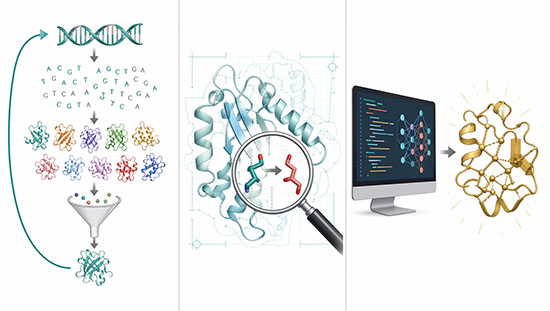
Protein engineering relies on three complementary strategies—directed evolution, rational design, and de novo computational design—that differ in how they navigate protein sequence space. A typical 300-amino-acid protein admits 20300 possible sequences, a number vastly exceeding the atoms in the observable universe. Each strategy uses a different logic to find useful sequences within this space.
Directed evolution works by mimicking natural selection in the laboratory. The gene encoding a target protein is subjected to random mutagenesis—typically through error-prone PCR, DNA shuffling, or saturation mutagenesis—to generate a library of thousands to millions of variants. Each variant is screened for the desired property, such as catalytic activity or thermostability, and the best performers become parents for the next round. Three to five rounds typically yield substantial improvements without requiring any structural knowledge of the protein.
Rational design takes the opposite approach: rather than generating random diversity, it uses structural and mechanistic information to identify amino acid positions where targeted mutations are likely to produce a desired effect. This approach depends on a high-resolution crystal structure or a reliable computational model. Techniques such as site-directed mutagenesis, loop grafting, and disulfide engineering allow precise modifications—for example, reshaping an enzyme’s active-site pocket to accommodate a non-natural substrate.
De novo computational design abandons modification of existing proteins altogether and instead creates entirely new amino acid sequences predicted to fold into desired three-dimensional structures. David Baker’s group at the University of Washington demonstrated this approach in 2003 by designing Top7, a 93-residue protein with a fold never observed in nature, whose crystal structure matched the computational model to within 1.2 Ångströms.
The Rosetta software suite, developed in Baker’s laboratory, became the foundational platform for de novo design and has since been used to create custom protein binders, self-assembling nanocages, and novel enzyme active sites. Rosetta’s physics-based energy functions model how amino acid sequences produced by protein synthesis fold into three-dimensional structures, enabling researchers to specify a target fold and computationally search for sequences that adopt it.
In practice, these strategies are increasingly combined. A common modern workflow uses computational design or rational design to generate an initial protein scaffold, then applies directed evolution to fine-tune its properties under real biological conditions. Semi-rational approaches, which use structural data to restrict mutagenesis to a small number of functionally important residues, occupy a productive middle ground between the two paradigms.
Comparison of Protein Engineering Strategies
The choice among directed evolution, rational design, and de novo computational design depends on the amount of structural information available, the desired outcome, and the experimental resources at hand. The table below summarizes the principal trade-offs.
| Feature | Directed Evolution | Rational Design | De Novo Computational Design |
|---|---|---|---|
| Starting point | Existing protein with some baseline activity | Existing protein with known structure | No starting protein required; begins from a target fold or function |
| Structural knowledge required | None | High (crystal structure or reliable model) | Moderate to high (computational modeling expertise) |
| Library size | 103–1010 variants per round | Typically fewer than 100 variants | Computationally generated; tens to thousands of candidates tested experimentally |
| Typical timeline | Weeks to months per round; 3–5 rounds typical | Days to weeks per design cycle | Hours to days for computation; weeks for experimental validation |
| Primary strength | Discovers unexpected beneficial mutations; no structural bias | Precise, targeted modifications with predictable outcomes | Creates proteins with no natural evolutionary history |
| Primary limitation | Requires a high-throughput screen or selection assay | Limited by accuracy of structural understanding | Experimental success rates vary; function harder to design than fold |
For optimizing an existing enzyme’s performance under industrial conditions, directed evolution remains the most reliable approach because it does not depend on understanding the molecular basis of improvement. When the goal is a specific, well-defined modification—such as humanizing a mouse antibody for therapeutic use—rational design is more efficient. De novo design excels when no natural protein performs the desired function, or when an entirely new molecular architecture is needed, such as a self-assembling protein nanoparticle for vaccine delivery.
The Role of Artificial Intelligence
Artificial intelligence has transformed protein engineering over the past several years. The 2020 release of AlphaFold2 by Google DeepMind demonstrated that deep learning could predict protein structures from amino acid sequences with near-experimental accuracy, effectively solving a problem that had resisted computational approaches for five decades. Although AlphaFold does not design new proteins, its structure predictions serve as essential inputs for design pipelines and have made rational design accessible for proteins that previously lacked experimental structures.
On the design side, deep-learning tools developed primarily in Baker’s laboratory have accelerated de novo protein creation. RFdiffusion, published in 2023, applies diffusion models—the same class of generative AI used in image synthesis—to generate novel protein backbones from simple molecular specifications. ProteinMPNN, a neural network for sequence design, predicts amino acid sequences that will fold into a given backbone structure with a recovery rate of approximately 52%, compared with 33% for the physics-based Rosetta approach it largely replaced.
Machine learning is also reshaping directed evolution. Protein language models, trained on millions of natural protein sequences, can predict which mutations are likely to improve a desired property, dramatically reducing the number of variants that need to be screened experimentally. Active learning workflows iteratively train predictive models on small experimental datasets and use them to propose the most informative variants for the next round of screening, compressing evolution campaigns that once required thousands of measurements into experiments involving only hundreds.
These AI tools complement rather than replace experimental methods. Computational predictions must still be validated in the laboratory, and properties that depend on complex biological context—such as how an engineered protein behaves inside a living cell or in the human body—remain beyond the reach of current models. The most productive protein engineering programs integrate computational prediction with experimental screening in iterative cycles.
Applications in Medicine and Industry
Protein engineering underpins some of the most commercially important products in modern biopharmaceuticals. Humanized and fully human monoclonal antibodies—engineered to minimize immune rejection while retaining high-affinity target binding—represent the fastest-growing class of therapeutics, used against cancers, autoimmune diseases, and infectious agents. Antibody engineering techniques such as affinity maturation by phage display, Fc region modification to tune immune effector functions, and bispecific antibody construction all rely on protein engineering principles.
Engineered enzymes are central to industrial biotechnology. Subtilisins optimized by directed evolution for stability in detergent formulations were among the earliest commercial successes of the field. Today, engineered enzymes catalyze reactions in the production of pharmaceuticals, biofuels, food ingredients, and textiles. Arnold’s laboratory demonstrated that directed evolution can expand enzyme catalysis beyond natural chemistry entirely, producing enzymes that catalyze reactions involving silicon–carbon and boron–carbon bond formation—transformations with no known biological precedent.
De novo designed proteins are beginning to enter clinical use. Self-assembling protein nanoparticles created computationally at the Institute for Protein Design served as the scaffold for SKYCovione, a COVID-19 vaccine developed with SK Bioscience that became the first de novo designed medicine approved for use in humans. Designed protein binders that target disease-related molecules with picomolar affinity are advancing through preclinical development as potential therapeutics for cancer, viral infections, and inflammatory diseases.
Beyond therapeutics, engineered proteins serve as biosensors for detecting environmental contaminants, as biomarkers for diagnostics, and as tools in basic research. Engineered fluorescent proteins, derived from the green fluorescent protein through extensive mutagenesis, now span the visible spectrum and are indispensable tools in cell biology and neuroscience. Engineered CRISPR-Cas9 variants with reduced off-target activity or altered protospacer adjacent motif (PAM) requirements are direct products of protein engineering applied to genome editing tools.
Future Directions
The convergence of AI-driven design, high-throughput experimental validation, and increasingly powerful DNA sequencing and synthesis technologies is accelerating the pace of protein engineering. Gene synthesis costs have fallen to the point where libraries of computationally designed sequences can be ordered and tested in weeks. Deep mutational scanning—which measures the fitness effects of every possible single amino acid substitution in one experiment—creates rich datasets that further train and improve AI models.
A major frontier is the design of proteins with complex, multi-step functions rather than simple binding or single-reaction catalysis. Engineering enzymes that catalyze non-natural multi-step reaction cascades, designing molecular machines with moving parts, and creating signaling proteins that respond to specific inputs with programmed outputs all remain substantially harder than designing static folds or single-target binders. Advances in proteomics and high-throughput functional assays are helping to close this gap.
Integration with synthetic biology is extending protein engineering from individual molecules to entire cellular systems. Engineered metabolic pathways composed of multiple optimized enzymes can convert simple feedstocks into complex chemicals, and engineered regulatory proteins can implement logic circuits inside living cells. As design tools become more accurate and accessible, the ability to program biology at the molecular level through protein engineering will increasingly shape medicine, manufacturing, and environmental remediation.
Frequently Asked Questions
What is the difference between protein engineering and genetic engineering? Genetic engineering broadly refers to the manipulation of an organism’s DNA, which can include inserting, deleting, or modifying genes for purposes ranging from agriculture to gene therapy. Protein engineering is a more focused discipline that specifically aims to alter the amino acid sequence or structure of a protein to change its function, stability, or other properties. Genetic engineering provides many of the molecular tools used in protein engineering, but the two fields differ in scope and objectives.
Can protein engineering create proteins that do not exist in nature? Yes. De novo protein design, a branch of protein engineering, creates entirely new amino acid sequences that fold into predetermined three-dimensional structures with no evolutionary precedent. The first successful example was Top7, a 93-residue protein designed computationally in 2003 by David Baker and colleagues. More recent deep-learning tools such as RFdiffusion and ProteinMPNN have greatly expanded the range of novel protein architectures and functions that can be designed from scratch.
How long does a typical directed evolution experiment take? A conventional directed evolution campaign involving manual rounds of mutagenesis, library construction, screening, and selection typically requires weeks to months per round, with most projects completing three to five rounds. Continuous directed evolution systems such as PACE (phage-assisted continuous evolution) can compress this timeline dramatically by running mutation and selection simultaneously inside living cells, achieving in days what traditional approaches accomplish in months.
What role does AlphaFold play in protein engineering? AlphaFold, developed by Google DeepMind, predicts the three-dimensional structure of a protein from its amino acid sequence with near-experimental accuracy. In protein engineering, AlphaFold accelerates rational design by providing high-quality structural models for proteins that lack experimental crystal structures, enabling researchers to identify mutation sites, model active-site geometries, and validate computational designs before laboratory testing. AlphaFold does not design new proteins itself, but its structure predictions serve as essential inputs for design pipelines such as RFdiffusion and ProteinMPNN.
Are engineered proteins safe for use as medicines? Engineered proteins used as therapeutics undergo the same rigorous preclinical and clinical testing required of any drug before regulatory approval. Dozens of engineered protein therapeutics are already approved and widely used, including humanized monoclonal antibodies, engineered insulin analogs, and modified clotting factors. Safety concerns specific to engineered proteins include immunogenicity (the risk that the body recognizes the protein as foreign and mounts an immune response) and off-target binding, both of which are evaluated extensively during development.
Further Reading
Nature Reviews Molecular Cell Biology, Exploring Protein Fitness Landscapes by Directed Evolution
Chemical Reviews, Directed Evolution: Methodologies and Applications
