

Microarray Definition: How DNA Microarrays Work, Types, and Uses
What Is a Microarray?
Definition: A microarray is a small, flat substrate carrying an ordered grid of microscopic probe features, each containing a known biological molecule, that is used to measure many molecular targets in parallel through binding and a fluorescence or equivalent readout.
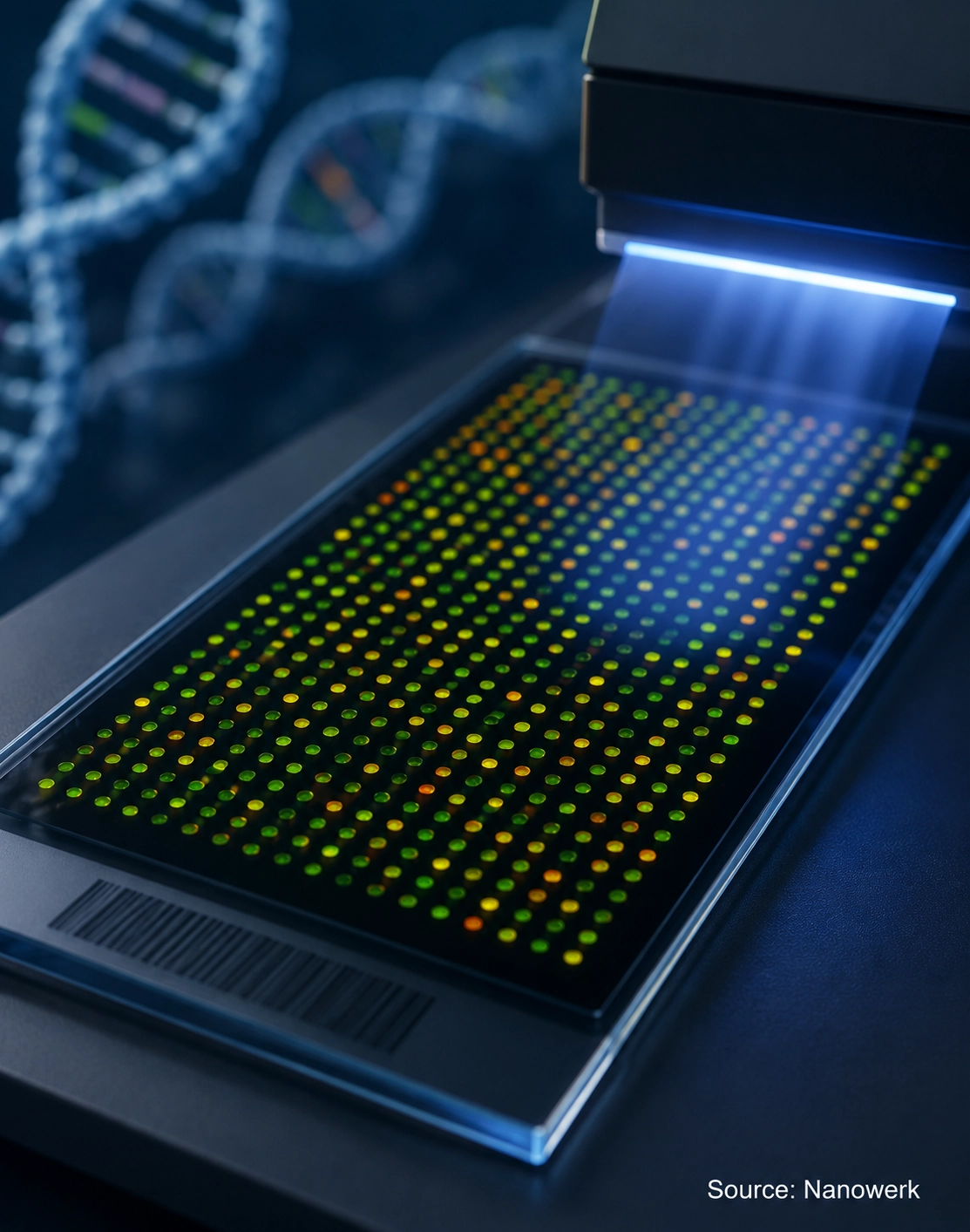
In simple terms: a microarray is a chip covered with a regular pattern of tiny dots. Each dot contains a known molecule, usually a short piece of DNA, a protein, or an antibody. A labeled sample is washed over the chip, the labels stick to matching dots, and a scanner reads the whole grid at once.
A microarray is an addressable array of probe molecules – typically short DNA oligonucleotides, complementary DNAs, proteins or antibodies – immobilized at known positions on a glass, silicon or polymer surface. When a labeled biological sample is applied, target molecules in the sample bind selectively to their matching probes. The resulting pattern and intensity of binding is read as a high-density image and converted into a numeric data matrix.
Microarrays made it possible to measure thousands of genes, variants, or proteins in one assay instead of testing one target at a time. A gene-expression array can measure transcripts from tens of thousands of genes, while a genotyping array can assay hundreds of thousands to millions of variants on one chip. A single biological target may also be represented by several probe features, which helps distinguish true signal from probe-specific noise.
At a glance:
- Microarray: a substrate with an ordered grid of probe features for parallel binding assays
- Probe: known molecule (DNA oligo, cDNA, protein, antibody) immobilized at each spot
- Target: labeled molecule in the sample that hybridizes or binds to a matching probe
- Density: commercial arrays typically carry 10,000 to several million probe features
- Readout: fluorescence intensity at each spot, scanned and converted to a numeric matrix
- Core uses: gene expression profiling, SNP genotyping, copy-number analysis, methylation profiling, protein and antibody screening
How Does a Microarray Work?
Every microarray begins with a solid substrate, usually a glass slide, silicon wafer or polymer film, on which probes are deposited or synthesized at known positions. Two common fabrication routes are contact printing of pre-made probes, in which a robot deposits droplets containing cDNAs or oligonucleotides onto a coated slide, and in situ photolithographic synthesis, in which short oligonucleotides are built base by base directly on the surface using light-directed chemistry.
In many gene-expression workflows, RNA is extracted from a sample and converted into labeled cDNA or amplified and labeled cRNA, depending on the platform. The labeled material is hybridized to the array, where complementary sequences bind through standard base pairing. After washing removes unbound material, a laser scanner reads fluorescence at every probe location. After background correction and normalization, signal intensity is used as an estimate of the original transcript abundance.
Two-color and one-color formats are both used. In a two-color experiment, two samples are labeled with different dyes and co-hybridized to the same array, so the dye ratio at each spot reports relative abundance between conditions. In a one-color experiment, used by many commercial expression and genotyping platforms, one labeled sample is hybridized per array and signals are compared across arrays after normalization.
Because the final signal depends on sample quality, labeling efficiency, hybridization conditions and scanner settings, microarray experiments require careful controls and normalization. Turning raw images into differentially expressed genes or genotype calls also requires bioinformatics pipelines for background correction, quality control and statistical testing across many features at once.
Types of Microarrays
The microarray principle has been adapted to many molecular targets. The shared idea is a regular grid of immobilized probes interrogated by a labeled sample in parallel; what varies is the chemistry of the probes, the targets they detect, and the question the platform is designed to answer.
DNA Expression Arrays
DNA expression arrays measure messenger RNA abundance. They were the original application introduced by Schena and colleagues using printed cDNA spots and were soon extended to high-density in situ oligonucleotide arrays. Modern expression arrays use short or long oligonucleotide probes and can report transcript levels for most protein-coding genes in humans, mice and many model organisms.
SNP and Genotyping Arrays
Genotyping arrays interrogate single-nucleotide polymorphisms across the genome. They use allele-specific probes for each SNP, and the relative hybridization signal reveals which alleles a sample carries. Genotyping arrays underpin many genome-wide association studies and ancestry or trait-testing workflows, where a single chip can score hundreds of thousands to several million SNPs at low per-sample cost.
Comparative Genomic Hybridization and Chromosomal Microarrays
Comparative genomic hybridization arrays, often called array CGH or chromosomal microarrays, detect copy-number changes by comparing labeled patient DNA to a reference. They identify deletions and duplications too small to see by conventional G-banded karyotyping. Modern chromosomal microarrays often combine CGH with SNP probes on the same chip, so copy number and regions of homozygosity can be reported together.
Tiling and Functional Genomics Arrays
Tiling arrays use overlapping probes that cover a genomic region or whole genome at high resolution. They have been used for chromatin immunoprecipitation on chip (ChIP-chip), DNA methylation mapping and resequencing of selected regions. Methylation arrays remain among the most common ways to profile the epigenome at hundreds of thousands of CpG sites in human samples.
Protein, Antibody and Glycan Microarrays
The same parallel-binding format is also applied to proteins. In a forward-phase antibody array, capture antibodies are immobilized in spots and a sample is added so target proteins bind to their cognate antibodies, generating a multiplex protein profile related in principle to ELISA. In reverse-phase arrays, samples themselves are spotted and probed with antibodies. Functional protein, glycan, peptide and aptamer arrays extend the approach to additional molecular classes.
Tissue Microarrays
Tissue microarrays are not molecular-probe chips in the DNA-array sense. They are arrays of small tissue cores from different patients or specimens embedded in one paraffin block, allowing one immunohistochemistry or in situ hybridization stain to be applied across many samples simultaneously. They are widely used in pathology research to validate biomarker candidates across large cohorts.
Microarrays Versus RNA-Seq and Other Methods
For gene expression, microarrays have largely been overtaken by RNA sequencing in new research studies, but they have not disappeared. RNA-Seq measures transcripts by sequencing rather than hybridization and offers a wider dynamic range, detection of novel transcripts and isoforms, and better quantitative behavior at very low expression levels. Microarrays are restricted to targets represented by probes on the chip, but they are fast, relatively inexpensive per sample at scale, simpler computationally, and compatible with large legacy expression data sets.
| Property | Microarray | RNA-Seq | qPCR |
|---|---|---|---|
| Measurement principle | Fluorescence after hybridization to fixed probes | Sequencing of fragmented cDNA; transcript counts | Real-time fluorescence during DNA amplification |
| Targets per sample | Tens of thousands of pre-selected features | Whole transcriptome, including novel and rare transcripts | One to about one hundred targets per reaction set |
| Dynamic range | Limited by background at the low end and saturation at the high end | Wide, limited mainly by sequencing depth | Wide for individual transcripts, with limited throughput |
| Cost per sample | Low to moderate at scale | Moderate to high, depending on read depth | Low per assay, expensive for large gene-by-sample matrices |
| Typical use | Genotyping, copy-number diagnostics, large-cohort expression profiling, legacy comparisons | New transcriptome studies, isoform analysis, single-cell work | Confirmation of a small number of selected targets |
The choice is rarely all or nothing. Genotyping arrays remain widely used in large biobank studies because they are inexpensive per sample and can be combined with imputation to infer many additional variants. Chromosomal microarrays remain important in selected pediatric and prenatal diagnostic settings. Expression microarrays remain in use in some clinical assays and in studies designed for direct comparison with earlier microarray data sets.
Applications in Research
Microarrays shaped a generation of molecular biology research. Expression profiling on arrays helped produce the first molecular classifications of cancers, showing that tumors that look similar under the microscope can have distinct gene-expression signatures. Microarray expression atlases also mapped tissue-specific and developmental-stage-specific gene activity in humans, mice, plants and many model organisms.
Genotyping arrays opened the era of genome-wide association studies, in which hundreds of thousands of variants are tested for association with a trait or disease across very large cohorts. Many common-variant risk loci for diseases such as type 2 diabetes, schizophrenia, inflammatory bowel disease and coronary artery disease were first identified using SNP arrays. Tiling arrays and ChIP-chip studies also contributed early genome-wide maps of histone modifications, DNA methylation and transcription factor binding sites.
Protein, peptide, glycan and antibody microarrays have been used to map autoantibody repertoires in autoimmune disease, profile immune responses to pathogens, and discover biomarker candidates for cancer and infection. Their adaptability to different biomolecule classes is why microarrays are best understood as an evolving family of parallel assay formats rather than a single technology.
Microarrays in Clinical Diagnostics
In clinical use, microarrays have settled into well-defined niches. Chromosomal microarray analysis is recommended as a first-tier diagnostic test for individuals with unexplained developmental delay, intellectual disability, autism spectrum disorders or multiple congenital anomalies in specific guideline contexts. It can detect pathogenic copy-number changes that are too small for conventional G-banded karyotyping.
In oncology, validated gene-expression assays can guide treatment decisions in selected early-stage breast cancer patients. MammaPrint, a 70-gene expression signature developed by Agendia, became the first in vitro diagnostic multivariate index assay cleared by the U.S. Food and Drug Administration when it received 510(k) clearance in 2007. Later prospective clinical evidence supported withholding adjuvant chemotherapy in selected patients with high clinical risk but low genomic risk.
Genotyping arrays are also used in pharmacogenomic testing and in population-scale biobank programs that link genetic data to electronic health records. Specialized microarrays have also been used to detect pathogens, identify antibiotic-resistance genes, and screen agricultural crops or livestock for breeding-relevant traits.
Limitations and Best Practices
The principal limitation of microarrays is that they only measure what their probes are designed to detect. A gene, variant or protein that is not represented on the chip is invisible, and a probe that cross-hybridizes to a related sequence can produce ambiguous signal. Fluorescence hybridization also has limited dynamic range: highly abundant transcripts can saturate the detector, while rare transcripts can be lost in background. Sequencing-based methods avoid many of these limits, which is why they have displaced microarrays for most discovery-style expression and variant work.
Best-practice microarray work depends on careful sample preparation, biological and technical replication, established normalization methods, and statistical analysis that controls for the large number of comparisons inherent in measuring many features. Reporting standards such as Minimum Information About a Microarray Experiment (MIAME) and benchmarking studies such as MicroArray Quality Control (MAQC) improved cross-platform reproducibility and transparency. Independent validation of key findings, traditionally by qPCR and increasingly by RNA-Seq, remains standard practice.
Frequently Asked Questions
What is a microarray used for? Microarrays are used to measure many molecular features in one experiment. Common uses include gene-expression profiling, SNP genotyping, copy-number analysis, methylation profiling, and protein or antibody screening. In medicine, chromosomal microarrays are used for selected developmental and congenital-disorder indications, while some validated expression-array assays are used in oncology.
What is the difference between a microarray and RNA-Seq? A microarray measures the abundance of transcripts whose probes are present on the chip, through hybridization and fluorescence. RNA-Seq measures detectable transcripts by sequencing fragmented cDNA, which gives it a larger dynamic range and the ability to detect novel transcripts and isoforms. Microarrays remain useful where cost, speed, clinical validation, or compatibility with legacy data matters.
Are microarrays still used today? Yes. RNA sequencing has replaced microarrays for many new gene-expression studies, but microarrays remain important in specific niches. Chromosomal microarrays are still used in clinical genetics for copy-number analysis, SNP arrays remain widely used in large cohort and biobank studies, methylation arrays are common in epigenomics, and some validated expression-array assays remain in clinical use.
Can a microarray detect mutations? A microarray can detect specific variants whose probes are designed onto the chip, including known single-nucleotide polymorphisms, defined point mutations on targeted arrays, and copy-number changes such as microdeletions and microduplications on a chromosomal microarray. It cannot find arbitrary new mutations the chip was not designed for, which is one reason sequencing is preferred for discovery-style variant detection.
Who invented the microarray? The format most people now mean by microarray was introduced by Mark Schena, Dari Shalon, Ronald Davis and Patrick Brown at Stanford in 1995, using cDNA probes printed on glass. Photolithographic, in situ synthesis of oligonucleotide arrays, the basis of the Affymetrix GeneChip platform, was developed in parallel by Stephen Fodor and colleagues and applied to expression monitoring by David Lockhart and coworkers in 1996.
How accurate are microarrays? For well-designed probes and controlled sample preparation, microarray measurements are usually reproducible, especially for moderately to highly expressed transcripts. Performance is weaker near the detection limit, at saturating signal, and for probes that cross-hybridize with related sequences. Reliable studies use careful quality control, normalization, replication, and independent validation of key findings.
Further Reading
Nature Biotechnology, Expression Monitoring by Hybridization to High-Density Oligonucleotide Arrays
Nature Reviews Genetics, Microarray Technology: Beyond Transcript Profiling and Genotype Analysis
