

What Is a Virus? Definition, Structure and Biotech Uses
What Is a Virus?
Virus, in one sentence: A virus is a non-cellular infectious particle made of DNA or RNA inside a protein coat that can reproduce only inside a living host cell.
In simple terms: a virus is a tiny package of genetic instructions with a delivery system. Outside a cell it is metabolically inert. Once inside a susceptible cell, it redirects the cell's machinery to copy the viral genome, make viral proteins and assemble new virus particles. Because viruses cannot grow, divide or generate energy independently, they are classified as obligate intracellular parasites rather than as conventional organisms.
Viruses infect every form of cellular life. Animal viruses include the agents of influenza, measles, HIV/AIDS and COVID-19; plant viruses cause major agricultural losses in crops such as cassava, rice and tomato; and bacteriophages, the viruses of bacteria, are the most abundant biological entities on the planet. The collection of all viruses in a given environment is called the virome, and its study has become a central part of modern microbiome research.
At a glance:
- What it is: a non-cellular infectious particle that replicates only inside a host cell
- Core parts: a nucleic acid genome (DNA or RNA) and a protein capsid, sometimes plus a lipid envelope
- Size: typically 20–300 nm, far smaller than most bacteria
- Hosts: animals, plants, fungi, protists, bacteria and archaea
- Classification: by genome type, capsid symmetry and host, formalized by the International Committee on Taxonomy of Viruses (ICTV)
- Why they matter: they cause major human and crop diseases and serve as essential tools in vaccines, gene therapy and molecular biology
Virus: Key Points
A virus is best understood as a genome with a delivery system rather than as an organism in the usual sense.
- A virus is not a cell.
- Every virus contains a DNA or RNA genome.
- Viruses replicate only inside host cells.
- Viral genomes and replication strategies vary widely.
- Viruses cause disease, but they are also useful biotechnology tools.
This diversity is why a single antiviral drug rarely works against more than a narrow set of viruses, and why vaccines and treatments usually have to be tailored to particular viral families or replication strategies.
Structure of a Virus: Virion, Capsid, Envelope and Genome
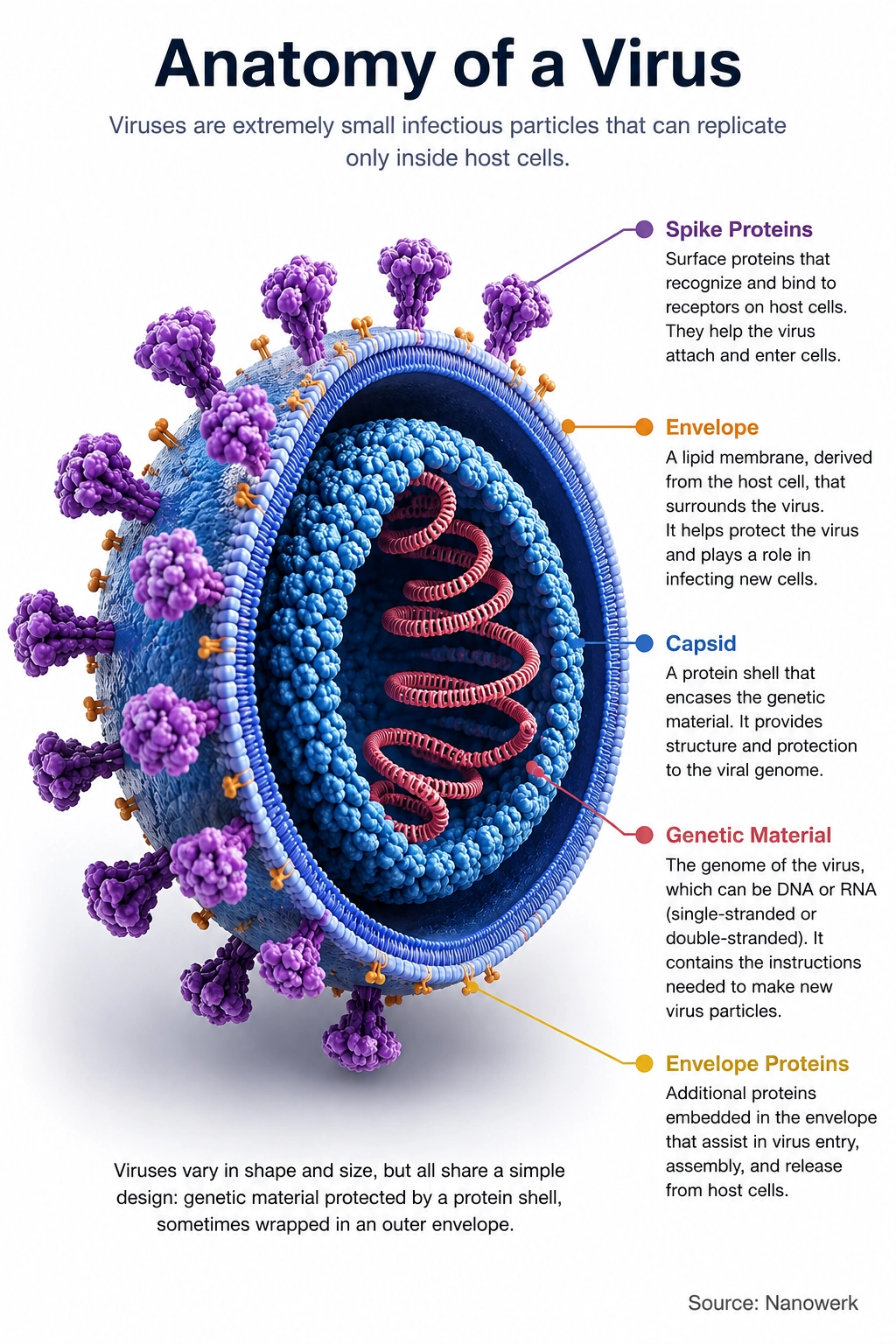
A complete infectious virus particle is called a virion. Every virion has at least two components: a genome made of nucleic acid and a protein shell, the capsid, that encloses and protects it. The capsid is built from many copies of one or a few protein subunits arranged with helical or icosahedral symmetry. Icosahedral capsids, roughly spherical assemblies built from twenty triangular faces, are the most common architecture across viral families and provide a strong, economical container for the genome. Helical capsids form rod-shaped or filamentous particles, as in tobacco mosaic virus and rabies virus.
Many viruses also acquire a lipid envelope derived from host cell membranes as they leave the cell, studded with viral glycoproteins that bind specific receptors on target cells and mediate entry. Enveloped viruses include influenza, HIV, herpes viruses and the coronaviruses; non-enveloped (or "naked") viruses such as poliovirus and norovirus rely on capsid proteins alone for attachment and tend to be more resistant to drying and detergents.
The viral genome itself is striking in its variety. It can be DNA or RNA, single-stranded or double-stranded, linear or circular, and as small as a few thousand nucleotides or, in giant viruses such as mimivirus, more than one million base pairs. Some viruses package additional enzymes inside the particle to begin replication immediately after entry; retroviruses such as HIV, for example, carry reverse transcriptase, which copies their RNA genome into DNA inside the host cell.
How Do Viruses Replicate?
Viral replication is a stepwise takeover of the host cell. Although the details vary widely between families, almost all viruses go through the same broad phases: attachment, entry, uncoating, genome replication and gene expression, assembly, and release. Each step depends on specific interactions between viral and cellular molecules and represents a potential target for antiviral drugs or vaccine-induced antibodies.
Attachment, Entry and Uncoating
Infection begins when a viral surface protein recognizes and binds a specific receptor on the host cell. This requirement for a matching receptor is one of the main reasons viruses have narrow host ranges and tissue preferences, or tropism. SARS-CoV-2, for example, uses its spike protein to bind the ACE2 receptor on human respiratory and intestinal cells, while HIV binds CD4 together with a coreceptor on certain immune cells. After binding, the virus enters the cell either by fusion of its envelope with the plasma membrane or by being taken up into a vesicle and releasing its contents into the cytoplasm. Once inside, the capsid is disassembled in a process called uncoating, exposing the genome to the cell's machinery.
Genome Replication and Gene Expression
The next step depends on what kind of genome the virus carries. DNA viruses such as herpesviruses typically use both their own enzymes and the host cell's DNA-replication machinery, often inside the nucleus. RNA viruses such as influenza, hepatitis C and SARS-CoV-2 carry or encode an RNA-dependent RNA polymerase that copies their RNA genome in the cytoplasm; this enzyme has no exact counterpart in human cells, which makes it an attractive antiviral target. Retroviruses are different again: they reverse-transcribe their RNA into DNA and integrate it into the host genome, where it is then transcribed and translated using the cell's normal machinery. In all cases, viral messenger RNAs are translated by host ribosomes, so protein synthesis itself is borrowed wholesale from the cell.
Assembly and Release
Newly made capsid proteins and genome copies then assemble into progeny virions, often at specific cellular sites and with the help of scaffolding or chaperone proteins. Many non-enveloped viruses accumulate in the cytoplasm and are released when the host cell ruptures, while enveloped viruses usually bud through a host membrane, picking up their lipid envelope and embedded viral proteins as they leave. Depending on the virus and host cell, a single infected cell can release from tens to many thousands of new particles, and this amplification is what makes viral infections spread so rapidly through tissues and populations.
Classification of Viruses: DNA, RNA, and the Baltimore System
Because viruses do not appear to share one simple universal origin and differ profoundly in genome chemistry, they are classified by a combination of criteria rather than by a single taxonomy. The most widely used framework was proposed by David Baltimore in 1971 and groups viruses by the form of their genome and how that genome is converted into messenger RNA. The key question in the Baltimore system is: how does this virus make messenger RNA that host ribosomes can translate into protein? The system places every virus into one of seven groups, from double-stranded DNA viruses through to retroviruses. It complements the formal taxonomic hierarchy maintained by the International Committee on Taxonomy of Viruses (ICTV), which assigns each virus to a series of ranks including realm, kingdom, phylum, family, genus and species. As of the 2024 ICTV ratification, more than fourteen thousand virus species had been formally established, and the hierarchy has been expanded to fifteen ranks to accommodate viral diversity discovered through metagenomics.
| Baltimore group | Genome type | Replication strategy | Familiar examples |
|---|---|---|---|
| I | Double-stranded DNA | DNA copied to mRNA by host or viral RNA polymerase | Herpesviruses, adenoviruses, poxviruses, many familiar bacteriophages |
| II | Single-stranded DNA | Converted to double-stranded DNA, then transcribed | Parvoviruses, circoviruses |
| III | Double-stranded RNA | Viral RNA polymerase copies each strand into mRNA | Rotaviruses, reoviruses |
| IV | Positive-sense single-stranded RNA | Genome acts directly as mRNA; copied by viral polymerase | Polio, hepatitis C, dengue, SARS-CoV-2 |
| V | Negative-sense single-stranded RNA | Genome must be copied into mRNA by virion-packaged polymerase | Influenza, measles, rabies, Ebola |
| VI | Single-stranded RNA, reverse-transcribing | RNA reverse-transcribed to DNA and integrated into host genome | HIV and other retroviruses |
| VII | Double-stranded DNA, reverse-transcribing | DNA transcribed to RNA, then reverse-transcribed back to DNA | Hepatitis B virus |
A non-obvious point in this comparison is that the Baltimore group, more than the host species, predicts how a virus will behave and how it can be treated. Group IV positive-sense RNA viruses, for example, share a common reliance on RNA-dependent RNA polymerases and on viral proteases that cleave a polyprotein, and antivirals developed against one such virus often inspire candidates against another. Reverse-transcribing viruses, Groups VI and VII, are uniquely vulnerable to nucleoside analog inhibitors of reverse transcriptase, which is why long-acting HIV therapies and hepatitis B treatments share a deep mechanistic family resemblance.
Viral Diversity, Origin and Evolution
For most of the twentieth century, virology focused on the relatively small number of viruses that could be grown in laboratory cell cultures or isolated from sick patients, plants and animals. The arrival of high-throughput DNA sequencing and especially metagenomics changed that picture completely. One influential analysis estimated that the total number of distinct virus species on Earth lies between roughly 107 and 109, and a 2022 study of more than five thousand metatranscriptomes expanded the known global RNA virome roughly five-fold. Bacteriophages dominate this hidden majority, outnumbering bacteria by roughly an order of magnitude in many environments and shaping microbial communities including the human gut microbiome.
Where viruses come from is a long-debated question. The three main hypotheses are that viruses descended from primitive replicators that predate cellular life, that they regressed from once-independent cells, or that they originated as fragments of cellular nucleic acid that escaped and acquired the ability to package themselves. Modern comparative genomics suggests no single explanation fits all viruses: different lineages appear to have arisen independently, combining capsid-forming proteins captured from cellular hosts with replication modules from other genetic elements. Once they exist, viruses evolve under unusually intense pressure, with high mutation rates in RNA viruses, frequent recombination, and constant selection by host immune systems producing some of the fastest molecular evolution observed anywhere in biology.
Viruses and Human Disease
Viruses cause a substantial fraction of the world's infectious-disease burden, from common, self-limiting illnesses such as the cold and influenza to chronic infections such as HIV, hepatitis B and hepatitis C, and to outbreaks of severe disease caused by Ebola, dengue, measles and SARS-CoV-2. Some viruses also cause cancer: persistent infection with high-risk human papillomaviruses is the cause of nearly all cervical cancers, and hepatitis B and C are major drivers of liver cancer worldwide. The clinical picture of a viral infection depends on the cells it targets, how much damage replication causes and how the immune system responds.
Two features of viral disease are particularly important. RNA viruses copy their genomes with relatively low fidelity and generate large amounts of genetic variation, allowing them to evolve rapidly under immune or drug pressure; influenza's seasonal antigenic drift and the emergence of successive SARS-CoV-2 variants are direct consequences. Many of the most dangerous viral diseases of recent decades, including HIV, SARS, MERS, Ebola, Nipah and SARS-CoV-2, originated in animals and crossed into humans, often via intermediate hosts, which is why surveillance of animal viromes is now considered a central pillar of pandemic preparedness. Defense against viruses combines innate immunity, adaptive immunity in the form of antibodies and T cells that recognize viral antigens, and a growing pharmacopoeia of antiviral drugs and vaccines, the latter now including inactivated viruses, live-attenuated viruses, recombinant viral proteins and mRNA vaccines.
Viruses in Biotechnology and Medicine
The same properties that make viruses formidable pathogens also make them powerful biotechnological tools. Viruses are highly evolved nucleic-acid delivery systems, and biotechnology has repeatedly co-opted that capability. The major applications fall into three areas: viral vectors for gene therapy and vaccination, bacteriophage-based therapies, and the use of viral components as workhorses in molecular biology.
Viral Vectors for Gene Therapy and Vaccines
Modified viruses are routinely used to deliver therapeutic genes into human cells. Adeno-associated virus (AAV) vectors underpin approved gene therapies for inherited retinal disease, spinal muscular atrophy and severe haemophilia, while lentiviral vectors are used ex vivo to engineer the T cells that drive CAR-T cancer immunotherapies, and adenoviral vectors have been deployed in vaccines against Ebola and COVID-19. The common principle is to remove the viral genes needed for replication and replace them with a transgene of interest, so the modified virus can enter cells and deliver its cargo but cannot reproduce or cause disease.
Bacteriophage Therapy
Bacteriophages are also being developed as targeted therapies against bacterial infections, particularly those caused by multidrug-resistant organisms. Because each phage typically infects only a narrow range of bacterial strains, phage cocktails can be assembled to kill a pathogen while sparing the rest of the patient's microbiome. Phage therapy has been used for decades in parts of Eastern Europe and is now in formal clinical trials in Western countries, including studies in cystic fibrosis lung infections and complicated urinary tract infections, while engineered phages and phage-derived enzymes are being explored as alternatives or adjuncts to treatments compromised by antibiotic resistance.
Viruses as Molecular Biology Tools
Beyond clinical use, viral components are everywhere in the molecular biology toolkit. Reverse transcriptases originally isolated from retroviruses make RNA sequencing and PCR-based diagnostics possible; bacteriophage T7 RNA polymerase is the workhorse enzyme used to produce mRNA in vitro, including the mRNA in COVID-19 vaccines; and phage display, which expresses peptide libraries on the surface of bacteriophage particles, is a foundational technique for engineering therapeutic antibodies. The CRISPR-Cas9 system itself evolved as a bacterial defense against phages, one of many cases in which understanding viruses has paid off in unexpected ways for biotechnology.
Frequently Asked Questions
Are viruses alive? Whether viruses are alive depends on how life is defined. Viruses have genomes, evolve by natural selection and reproduce, but they lack their own metabolism and cannot replicate outside a living cell. Most biologists therefore classify viruses as obligate intracellular parasites that sit at the edge of the definition of life rather than placing them firmly inside or outside it.
What is the difference between a virus and a bacterium? Bacteria are single-celled organisms with their own metabolism, ribosomes and ability to reproduce on their own. Viruses are much smaller, are not cells, and cannot reproduce without taking over a host cell's machinery. Antibiotics target bacterial cells and have no effect on viruses, which is why antiviral drugs are needed for viral infections.
How big is a virus? Most viruses are between about 20 and 300 nanometres in diameter, far smaller than typical bacteria and well below the limit of light microscopy. Familiar examples include poliovirus at roughly 30 nanometres and influenza at about 100 nanometres. Some giant viruses such as mimivirus exceed 500 nanometres and overlap in size with small bacteria.
How do viruses spread between people? Viruses spread through routes that match where they replicate. Respiratory viruses such as influenza and SARS-CoV-2 travel in airborne droplets and aerosols. Gastrointestinal viruses such as norovirus spread through contaminated food, water or surfaces. Bloodborne viruses such as HIV and hepatitis B move through needles, transfusions or sexual contact, and others are spread by insect vectors or from mother to child.
Why is it harder to make antiviral drugs than antibiotics? Viruses replicate inside host cells using many of the host's own components, so most viral processes are difficult to block without harming the patient. Antibiotics, by contrast, can target bacterial structures such as cell walls and prokaryotic ribosomes that humans do not share. Antiviral development focuses on the smaller set of distinctly viral targets, such as viral polymerases, proteases and entry proteins.
What is a virus made of? A virus particle, or virion, consists of a genome of DNA or RNA enclosed in a protein shell called the capsid. Many viruses also have a lipid envelope derived from host cell membranes, studded with viral surface proteins that mediate attachment and entry. Some viruses package additional enzymes inside the particle to start replication after they enter a cell.
Further Reading
Environmental Microbiology, The global virome: How much diversity and how many independent origins?
Archives of Virology, Changes to virus taxonomy and the ICTV Statutes ratified by the International Committee on Taxonomy of Viruses (2024)
Nature Reviews Methods Primers, Phage therapy
Nature Reviews Drug Discovery, mRNA vaccines for infectious diseases: principles, delivery and clinical translation
