

Nanotechnology News – Latest Headlines

10 billion bits of entanglement achieved in silicon
Scientists from Oxford University have made a significant step towards an ultrafast quantum computer by successfully generating 10 billion bits of quantum entanglement in silicon for the first time - entanglement is the key ingredient that promises to make quantum computers far more powerful than conventional computing devices.
January 20, 2011 Read more
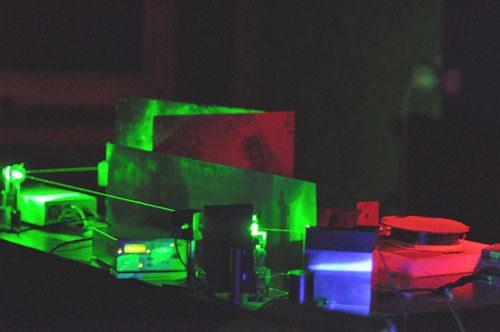
NIST advances single photon management for quantum computers
The quantum computers of tomorrow might use photons, or particles of light, to move around the data they need to make calculations, but photons are tricky to work with. Two new papers by researchers working at the National Institute of Standards and Technology (NIST) have brought science closer to creating reliable sources of photons for these long-heralded devices.
January 20, 2011 Read more
Effects of atomic-scale roughness on adhesion between diamond surfaces
Researchers have shown that atomic-scale surface roughness has a strong influence on adhesion for diamond, amorphous carbon, and model diamond nanocomposites.
January 20, 2011 Read more
Real-world graphene devices may have a bumpy ride
Electronics researchers love graphene. But creating graphene-based devices will be challenging, say researchers at the National Institute of Standards and Technology (NIST), because new measurements show that layering graphene on a substrate transforms its bustling speedway into steep hills and valleys that make it harder for electrons to get around.
January 20, 2011 Read more
Secrets of mysterious metal hotspots uncovered by new single molecule imaging technique
The secrets behind the mysterious nano-sized electromagnetic 'hotspots' that appear on metal surfaces under a light are finally being revealed with the help of a BEAST. Researchers at the Berkeley Lab have developed a single molecule imaging technology, dubbed the Brownian Emitter Adsorption Super-resolution Technique (BEAST), that has made it possible for the first time to directly measure the electromagnetic field inside a hotspot.
January 19, 2011 Read more

Triblock spheres provide a simple path to complex structures
University of Illinois materials scientists have developed a simple, generalizable technique to fabricate complex structures that assemble themselves. The team demonstrated that they can produce a large, complex structure - an intricate lattice - from tiny colloidal particles called triblock Janus spheres.
January 19, 2011 Read more
Start of the Ulm Helmholtz Institute
New battery technologies to be in the focus of the research facility of Karlsruhe Institute of Technology in cooperation with Ulm University.
January 19, 2011 Read more
'Beneath the Surface', a monthly science webinar series on the tissue-biomaterial interface
New monthly science webinar series launched by the Surfaces in Biomaterials Foundation to promote active discussion and new technology approaches biomedical surface science and engineering.
January 19, 2011 Read more
Advance could speed use of genetic material RNA in nanotechnology
Scientists are reporting an advance in overcoming a major barrier to the use of the genetic material RNA in nanotechnology - the field that involves building machines thousands of times smaller than the width of a human hair and now is dominated by its cousin, DNA.
January 19, 2011 Read more
Killer paper for next-generation food packaging
Foods could get a longer shelf life using 'killer paper', a new packaging material made of antibacterial nanoparticles.
January 19, 2011 Read more
No longer just a spectator, silicon oxide gets into the electronics action on computer chips
Computer chips contain silicon oxide, a substance that scientists once regarded as a mere insulator but now appears to be an active part of electronic processes that power cell phones, computers, and other products.
January 19, 2011 Read more
Nanoparticles to make textiles
Research by two Victoria University PhD graduates has advanced cutting edge technology that combines wool with gold and silver to create a new range of multi functional textiles.
January 19, 2011 Read more
Nanowissenschaftler entwickeln Farben, die die Luft reinigen
Stickoxide, aber auch Keime in der Luft koennen moeglicherweise in Zukunft ohne grossen technischen Aufwand oder Filter unschaedlich gemacht werden.
January 19, 2011 Read more
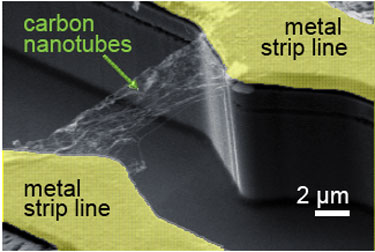
Speed detection of electrons in nanoscale photodetectors
Scientists have found a way to directly measure the time during which photo-excited electrons flow in nanoscale photodetectors.
January 19, 2011 Read more
Findings on pollution damage to human airways could yield new therapies
Researchers from Duke University Medical Center have identified how nanoparticles from diesel exhaust damage lung airway cells, a finding that could lead to new therapies for people susceptible to airway disease.
January 19, 2011 Read more
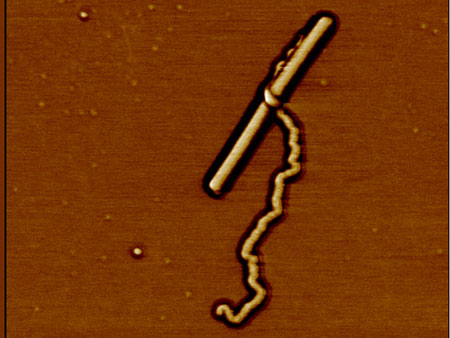
Researchers synthesize giant molecule
Producing molecules comparable with large bio-molecules in size, shape and structure is an age-old dream of organic chemists. An international research team has now succeeded in synthesising the biggest macromolecule to date.
January 19, 2011 Read more
 Subscribe to our Nanotechnology News feed