

Nanotechnology News – Latest Headlines
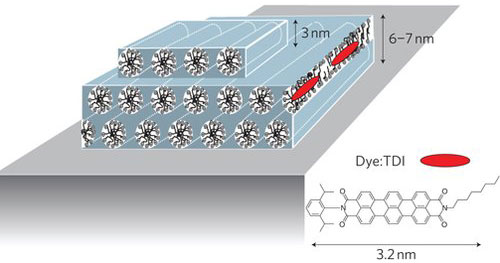
Wie von Zauberhand geschaffen - Silikat-Nanokanal Wachstum
Wissenschaftler des Exzellenzclusters 'Nanosystems Initiative Munich' an derLMU haben eine Methode entwickelt, mit der sie Silikat-Nanoroehrchen trotz ihrer geringen Groesse direkt beim Wachsen zusehen koennen.
January 14, 2011 Read more
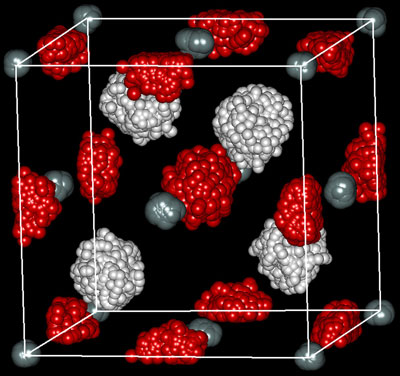
Simulations explain the peculiar nature of molecular hydrogen vibration under high pressure
Most of our Universe consists of hydrogen atoms, which are often found under extraordinarily high pressure as high as tens of millions of times the atmospheric pressure of Earth. Understanding the exotic physics of such a high-pressure regime will contribute to our understanding of planet formation, hydrogen storage, room temperature superconductivity and other fields, explains Toshiaki Iitaka from the RIKEN Advanced Science Institute in Wako.
January 14, 2011 Read more
New microscope records firing of thousands of individual neurons in 3-D
Imaging system could help reveal 'miscommunications' in autism, schizophrenia.
January 14, 2011 Read more
Nano-Leuchtkugeln auf Wanderschaft
Nanopartikel spielen eine wesentliche Rolle bei der Entwicklung zukuenftiger diagnostischer und therapeutischer Methoden fuer Tumorerkrankungen, beispielsweise als Transporter fuer Wirkstoffe oder als Kontrastmittel. Aufnahme und Verteilung von Nanopartikeln im Tumorgewebe haengen dabei stark von der Partikelgroesse ab. Um dies systematisch untersuchen zu koennen, haben Wissenschaftler jetzt einen Satz fluoreszierender Nanopartikel verschiedener Durchmesser zwischen 10 und 150 nm hergestellt.
January 14, 2011 Read more
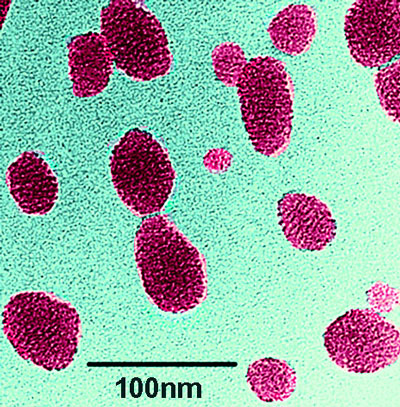
Brightest fluorescent nanoparticles synthesized
Clarkson University Physics Professor Igor Sokolov and his team have discovered a method of making the brightest ever synthesized fluorescent silica nanoparticles.
January 14, 2011 Read more
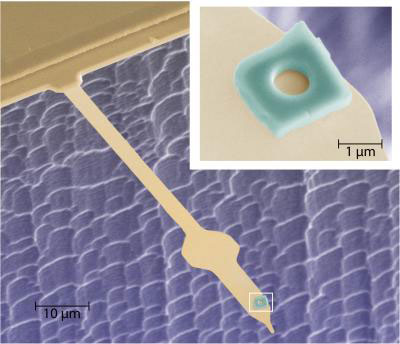
Physicists observe exotic state in an unconventional superconductor
A new fractional vortex state observed in an unconventional superconductor may offer the first glimpse of an exotic state of matter predicted theoretically for more than 30 years. University of Illinois physicists, led by Raffi Budakian, describe their observations of a new fractional vortex state in strontium ruthenium oxide (SRO).
January 13, 2011 Read more
Self-assembling structures open door to new class of materials
Researchers at the University of Illinois and Northwestern University have demonstrated bio-inspired structures that self-assemble from simple building blocks: spheres. The helical 'supermolecules' are made of tiny colloid balls instead of atoms or molecules. Similar methods could be used to make new materials with the functionality of complex colloidal molecules.
January 13, 2011 Read more
New tool for cell research may help unravel secrets of disease
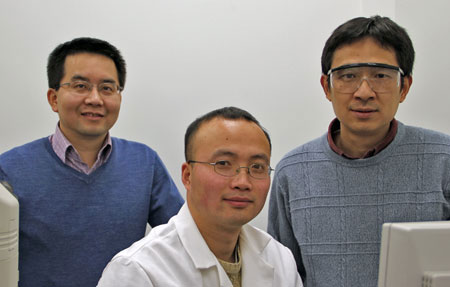
Advancements in understanding rotational motion in living cells may help researchers shed light on the causes of deadly diseases, such as Alzheimer's, according to Ning Fang, an associate scientist at the U.S. Department of Energy's Ames Laboratory and faculty member at Iowa State University.
January 13, 2011 Read more
Polymer with amazing self-healing properties
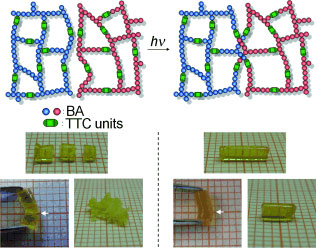
Materials with self-healing properties could help extend the durability of products and make repairs easier. Krzysztof Matyjaszewski and his co-workers at Carnegie Mellon University (Pittsburgh, USA) and Kyushu University (Japan) have now developed a polymer that can repair itself when irradiated with UV light - over and over again.
January 13, 2011 Read more
Scientists find fast, easy way to make hydrogen nanosensors
A team of Northern Illinois University scientists, with a major role played by NIU Ph.D. students, has discovered a new, convenient and inexpensive way to make high performance hydrogen sensors using palladium nanowires.
January 13, 2011 Read more

Tissue engineering meets nanotechnology: A look at tomorrow's medicine
Tissue engineers seek to develop functioning substitutes for damaged tissues and organs. Generally, this means seeding cells onto 3-dimensional porous scaffolds made of biomaterials, which provide mechanical support and instructive cues for the developing engineered tissue. Now it's time to go to the next level, and make complex tissues that can really do things - contract, release growth factors, conduct electrical signals and more. Things our own cells and tissues do.
January 13, 2011 Read more
Bundesregierung verabschiedet 'Initiative Nanotechnologie Aktionsplan 2015'
Acht Bundesministerien buendeln unter Federfuehrung des Bundesforschungsministeriums in der 'Nano-Initiative Aktionsplan 2015' ihre Forschungsfoerderung.
January 13, 2011 Read more
Nanomechanical testing in materials research and development
The conference Nanomechanical Testing in Materials Research and Development from October 9-14, 2001 in Lanzarote, Canary Islands, Spain, will bring together all people working in the field of nano- and micromechanical testing in materials research. It will provide a forum for discussion of the latest activities in application of nano- and micromechanical testing methods.
January 13, 2011 Read more
New 'frozen smoke' material: 1 ounce could carpet three football fields
Scientists are reporting the development of a new, ultra-light form of 'frozen smoke' - renowned as the world's lightest solid material - with amazing strength and an incredibly large surface area.
January 13, 2011 Read more
Quantum quirk contained
Researchers at the University of Calgary, in Canada, collaborating with the University of Paderborn, in Germany, are working on a way to make quantum networks a reality.
January 12, 2011 Read more
3-D map of atoms sheds light on nanoscale interfaces in teeth, may aid materials design
Using a highly sophisticated atomic-scale imaging tool on a sea creature's tooth, two Northwestern University researchers have peeled away some of the mystery of organic/inorganic interfaces that are at the heart of tooth and bone structure.
January 12, 2011 Read more
 Subscribe to our Nanotechnology News feed