

Nanotechnology News – Latest Headlines
New study determines the biokinetics of titanium dioxide nanoparticles
A new study (pdf) just published by the Umweltbundesamt (Federal Environment Agency) in Germany has looked at the quantitative biokinetic analysis of radioactively labelled, inhaled titanium dioxide nanoparticles in a rat model.
December 23, 2010 Read more
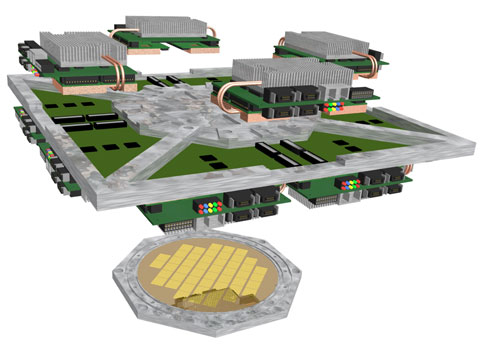
Brain-inspired computer architectures
European Commission provides funding of 8.5 million euros for the international BrainScaleS project.
December 23, 2010 Read more
DARPA funds partnership between Singapore's Institute of Microelectronics and University of Washington for triple boost to miniaturization efforts
Advances in miniaturisation have led to the increasing adoption of microsystems in a wide array of applications. Continued miniaturisation, however, impacts the assembly of the components, the integration of passive components and overall system performance. To address these challenges, the Defense Advanced Research Projects Agency (DARPA) is funding a research collaboration between the Institute of Microelectronics (IME), a research institute of the Agency for Science, Technology and Research (A*STAR) and University of Washington's Department of Electrical Engineering.
December 23, 2010 Read more
Ever-sharp urchin teeth may yield tools that never need honing
Researchers describe the self-sharpening mechanism used by the California purple sea urchin to keep a razor-sharp edge on its choppers.
December 23, 2010 Read more

Nanostructured surfaces could be an alternative to de-icing planes
Research from MIT and GE demonstrates that a proposed passive solution for preventing ice on wings won't work - but suggests an alternative.
December 22, 2010 Read more
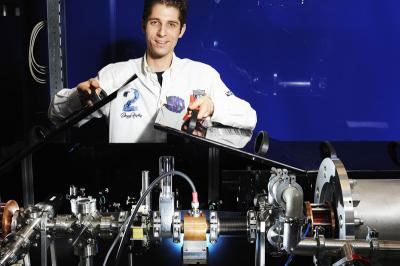
Eindhoven University builds affordable alternative to mega-laser X-FEL
Stanford University in the USA has an X-FEL (X-ray Free Electron Laser) with a pricetag of hundreds of millions. It provides images of 'molecules in action', using a kilometer-long electron accelerator. Researchers at Eindhoven University of Technology (TU/e) have developed an alternative that can do many of the same things. However this alternative fits on a tabletop, and costs around half a million euro.
December 22, 2010 Read more
EU funds project to explore atomic scale and single-molecule logic gate technologies
On January 1, 2011, the European project AtMol will be officially launched for 4 years. AtMol is to open the atomic scale era of molecular computing integrating state of the art atomic scale technologies, new quantum architectures with multi-scale interconnection and packaging techniques for a single molecule to compute and be packaged into a molecular chip.
December 22, 2010 Read more
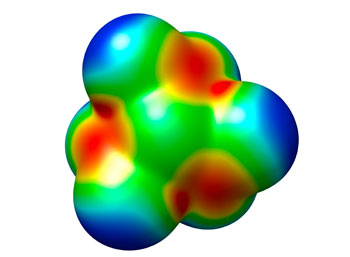
Discovery of new molecule can lead to more efficient rocket fuel
Trinitramid - that's the name of the new molecule that may be a component in future rocket fuel. This fuel could be 20-30 percent more efficient in comparison with the best rocket fuels we have today.
December 22, 2010 Read more
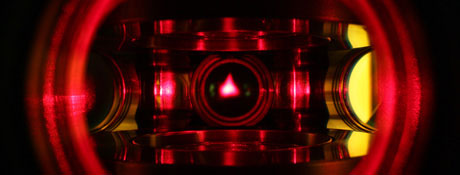
Scientists observe paradoxical quantum phenomenon
Direct proof of the hitherto controversial Efimov effect.
December 22, 2010 Read more
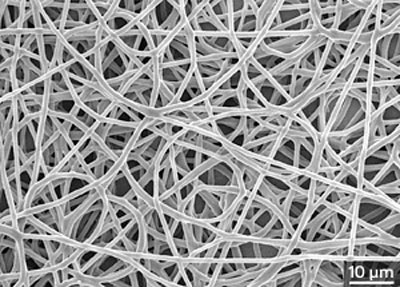
Biomaterials: Close to the bone
Porous structures made from a copolymer of polyhydroxybutyrate and polyethylene glycol are ideal scaffolds for bone regeneration.
December 22, 2010 Read more
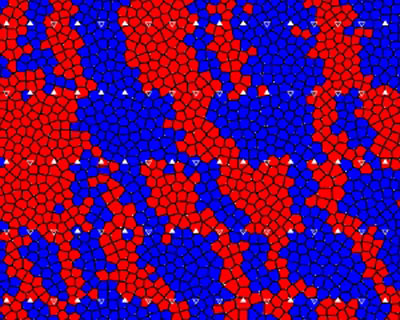
Data storage: Explore new dimensions
An advanced channel model may help push the capacity limits of future magnetic recording media.
December 22, 2010 Read more
PhD Positions in NanoBioTechnology in Munich
Call for applications for PhD positions at the International Doctorate Program NanoBioTechnology.
December 21, 2010 Read more
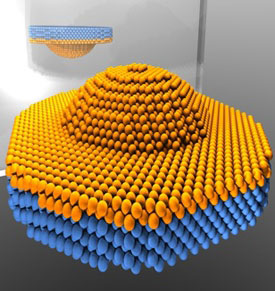
Quantum dots are not dots
Researchers from the Quantum Photonics Group at DTU Fotonik in collaboration with the Niels Bohr Institute, University of Copenhagen surprise the scientific world with the discovery that light emission from solid-state photon emitters, the so-called quantum dots, is fundamentally different than hitherto believed.
December 21, 2010 Read more
Schweiz stellt Leitfaden zu synthetischen Nanomaterialien vor
In der Schweiz hat das Staatssekretariat fuer Wirtschaft SECO einen Leitfaden erarbeitet fuer das Erstellen von Sicherheitsdatenblaettern fuer Chemikalien, welche aus Nanomaterialien bestehen oder solche enthalten.
December 21, 2010 Read more
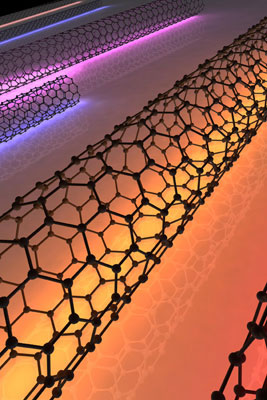
Carbon nanotubes could be ideal optical antennae
Just as walkie-talkies transmit and receive radio waves, carbon nanotubes can transmit and receive light at the nanoscale, Cornell researchers have discovered.
December 21, 2010 Read more
EU Project NanoDiaRA: Seminar on 'Science Meets Society'
The EU project 'Development of novel nanotechnology based diagnostic systems for Rheumatoid Arthritis and Osteoarthritis' (NanoDiaRA) held its first seminar on 'Science meets Society'.
December 21, 2010 Read more
 Subscribe to our Nanotechnology News feed