

Nanotechnology News – Latest Headlines
Max Planck Society launches website for junior female scientists
Minerva-FemmeNet, the Max Planck Society's mentoring programme for junior female scientists, has launched a new website: www.minerva-femmenet.mpg.de provides information on programmes for junior and senior female scientists, alumnae and anyone interested.
April 14, 2010 Read more
Smart textiles for enhanced personal protection and nanomedicine: The key to future healthcare
A special bumper issue of NANO Magazine focuses on two topics - textiles and nanomedicine.
April 14, 2010 Read more
Einblick in die Nanowelt - das Unsichtbare sichtbar machen
Die Friedrich-Alexander Universitaet Erlangen-Nuernberg bekommt ein neues 'Auge', mit dem Wissenschaftler die Wunderwelt von Nanomaterialen untersuchen koennen: Am 30. April 2010 weiht die Universitaet das Transmissionselektronenmikroskop TITAN3 und das eigens dafuer errichtete Gebaeude in einem Festakt offiziell ein.
April 14, 2010 Read more
Quantum dot lasers open application fields in biomedicine and nanosurgery
Researchers at the Technische Universitaet Darmstadt have found a new method for generating tunable wavelengths, as well as more easily switching back and forth between two wavelengths, employing quantum-dot lasers. Prospective application fields are biomedicine and nanosurgery.
April 14, 2010 Read more
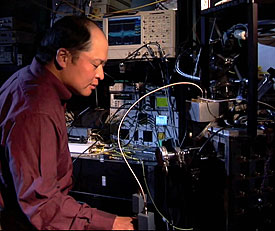
New detector counts photons with 99 percent efficiency
Scientists at the National Institute of Standards and Technology (NIST) have developed the world's most efficient single photon detector, which is able to count individual particles of light traveling through fiber optic cables with roughly 99 percent efficiency.
April 14, 2010 Read more
New drug design technique could dramatically speed discovery process
Scientists here are taking the trial and error out of drug design by using powerful computers to identify molecular structures that have the highest potential to serve as the basis for new medications.
April 14, 2010 Read more
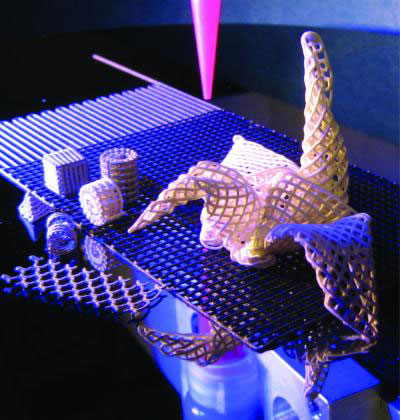
Printed origami offers new technique for complex structues
Although it looks small and unassuming, the tiny origami crane sitting in a sample dish in University of Illinois professor Jennifer Lewis' lab heralds a new method for creating complex three-dimensional structures for biocompatible devices, microscaffolding and other microsystems.
April 14, 2010 Read more
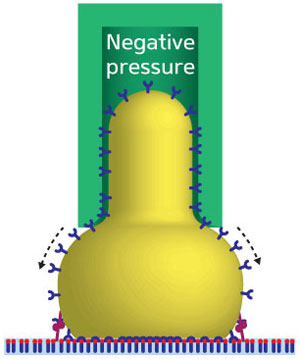
Cell adhesion: Sticky predictions
More accurate measurements of the forces that bind cells together have been made possible by a new computer model.
April 14, 2010 Read more
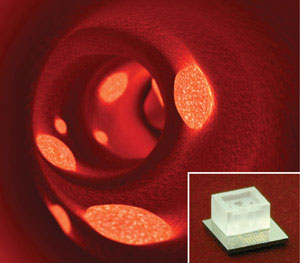
Cell detection chip provides fast and selective detection of low levels of vascular disease biomarkers
To reduce patient discomfort and delay in vascular disease diagnosis, a team led by Yu Chen from the Institute of Microelectronics of A*STAR, Singapore, has developed a microfluidic device that rapidly detects low EPC levels in blood-cell samples.
April 14, 2010 Read more
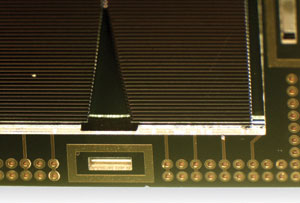
Integrated electronics: Keeping cool
A compact water-circulation system prevents stacks of electronic chips from getting too hot.
April 14, 2010 Read more
eBeam Initiative members publish collaborative results at Photomask Japan 2010
The eBeam Initiative, a forum dedicated to the education and promotion of a new design-to-manufacturing approach known as design for e-beam (DFEB), today announced that several of its members will jointly present the latest breakthroughs in design-for-e-beam (DFEB) mask technology at Photomask Japan 2010 - one of the world's premier symposia for advanced lithography mask technology.
April 14, 2010 Read more
How Nanoparticles penetrate thin layers of fullerenes
Physicists discover an important mechanism for the decomposition of nano-composites.
April 14, 2010 Read more
New nanotool is a molecular switch that turns itself on or off
Two chemists at The Scripps Research Institute have synthesized a new nano-scale scientific tool - a tiny molecular switch that turns itself on or off as it detects metallic ions in its immediate surroundings.
April 13, 2010 Read more
Ultrasharp nano-electrode harnesses electric current from plant cell
In an electrifying first, Stanford scientists have plugged in to algae cells and harnessed a tiny electric current. They found it at the very source of energy production - photosynthesis, a plant's method of converting sunlight to chemical energy.
April 13, 2010 Read more
New method paves way for more sensitive and precise diagnostics
EU-funded scientists in Sweden have developed a novel method to study genetic variation directly in individual cells and in tissues. Their findings provide valuable new insights into gene expression in humans that could significantly improve diagnostic tests.
April 13, 2010 Read more
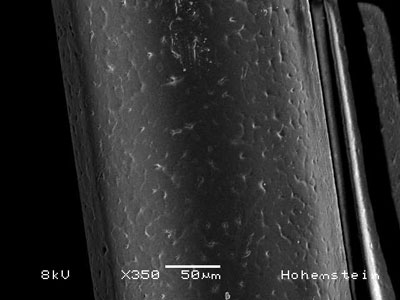
Neuer Ansatz optimiert Lotus-Effekt von schmutzabweisenden Textilien
Mittels einer neuen Faserstrukturierung wurde der schmutzabweisende Effekt erstmals durch eine faserimanente Strukturierung der Oberflaeche realisiert.
April 13, 2010 Read more
 Subscribe to our Nanotechnology News feed