

Nanotechnology News – Latest Headlines
The Global Language Monitor releases global study of top 10 most confusing yet widely used high tech buzzwords for 2007
The Global Language Monitor has found the most confusing yet frequently cited high tech buzzwords in 2007 to be iPOD, Flash, Cookie, Nano and Kernel followed by Megahertz, Cell (cell as in cell phone), Plasma, De-duplication, and Blu-Ray.
October 17, 2007 Read more
Look, Ma, no batteries: Powering nanoelectronics with light
Scientists have developed solar cells 200 hundred times thinner than a human hair that they believe will power the nanoscale gadgetry of tomorrow.
October 16, 2007 Read more
Researchers measure carbon nanotube interaction
Researchers for the first time have been able to measure a specific interaction for a single functional group with carbon nanotubes using chemical force microscopy.
October 16, 2007 Read more
Experts discussed issues of nanotechnology risk management
Experts from government, academia, consulting companies, non-profit organizations and industry convened at NanoTX 07 earlier this month to discuss issues of nanotechnology risk management.
October 16, 2007 Read more
Public talk on how videogames affect social perceptions of nanotechnologies
'Digital Matters: Video Games and the Cultural Transcoding of Nanotechnology,' will explore the cross-traffic between nanotechnologies and video games and how gamers' perceptions and knowledge of nanotechnologies may be influenced by the gamesâ?? narratives and images.
October 16, 2007 Read more
New nanotechnology wastewater treatment system for removing heavy metals
Resulting from the combination of water treatment investigations with the latest in material science, a new type of nanomaterial called nanostructured silica has been found to detect and eliminate toxic contaminants from wastewaters in efficient and economically viable ways.
October 16, 2007 Read more
Gold nanorods shed light on new approach to fighting cancer
Researchers have shown how tiny 'nanorods' of gold can be triggered by a laser beam to blast holes in the membranes of tumor cells, setting in motion a complex biochemical mechanism that leads to a tumor cell's self-destruction.
October 16, 2007 Read more
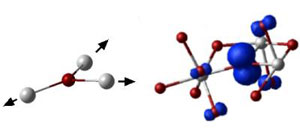
Novel gate dielectric materials: perfection is not enough
For the first time theoretical modeling has provided a glimpse into how promising dielectric materials are able to trap charges, something which may affect the performance of advanced electronic devices.
October 16, 2007 Read more
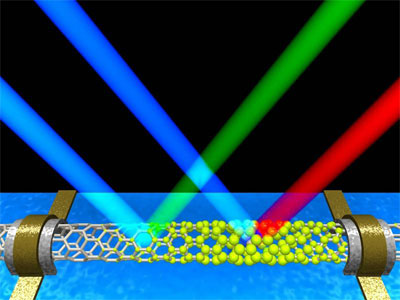
IBM scientists create method to measure the performance of carbon nanotubes as building blocks for ultra tiny computer chips of the future
IBM scientists announced that they have measured the distribution of electrical charges in tubes of carbon that measure less than 2 nanometers in diameter.
October 16, 2007 Read more
Medical nanoimaging pinpoints cause of cataracts
At the Institut Curie, Simon Scheuring has for the first time observed a diseased tissue at very high resolution using atomic force microscopy (AFM). By studying the membranes of cells in a patient's eye cataract, Scheuring has discovered the molecular cause of this disease.
October 15, 2007 Read more
Fred Kavli to Introduce Prestigious Science Awards at DC Climate Conference
On October 22, Fred Kavli, a Norwegian-born philanthropist, will introduce three new science prizes worth $1 million each at a science conference in Washington, DC. The Kavli Prizes are currently accepting nominations for their first ever awards in 2008 in astrophysics, nanoscience and neuroscience.
October 15, 2007 Read more
HP's Stanley Williams to discuss nanoscale computing at UCSC's Silicon Valley Center
R. Stanley Williams, a senior fellow at Hewlett-Packard Laboratories and founding director of HP's Quantum Science Research group, will discuss nanoscale computing in a free public lecture on Thursday, October 25, hosted by UC Santa Cruz.
October 15, 2007 Read more
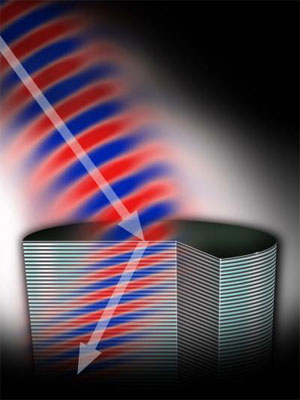
Novel semiconductor structure bends light 'wrong' way - the right direction for many applications
A research team has created an easy-to-produce material from the stuff of computer chips that has the rare ability to bend light in the opposite direction from all naturally occurring materials. This startling property may contribute to significant advances in many areas, including high-speed communications, medical diagnostics and detection of terrorist threats.
October 14, 2007 Read more
Free 10-hour nanotechnology course
In case you get bored this weekend and want to brush up on your nanotechnology skills, Glenn Fishbine has posted a free nanotechnology course on his website.
October 13, 2007 Read more
Nanoengineers mine tiny diamonds for drug delivery
Researchers have shown that nanodiamonds - much like the carbon structure as that of a sparkling 14 karat diamond but on a much smaller scale - are very effective at delivering chemotherapy drugs to cells without the negative effects associated with current drug delivery agents.
October 12, 2007 Read more
 Subscribe to our Nanotechnology News feed