

Nanotechnology News – Latest Headlines
New environmental chamber aids nano-studies of metal oxides
A new environmental chamber constructed by the Materials Science Division at Argonne allows researchers to watch materials as they grow step-by-step while interacting in elevated-temperature, reactive-gas environments.
May 8, 2006 Read more
Development of three highly interconnected nanoscale architectures using spin-wave technology
Engineers at the UCLA Henry Samueli School of Engineering and Applied Science are announcing a critical new breakthrough in semiconductor spin-wave research.
May 8, 2006 Read more
Metal-embedding method helps tiny sensors function in extreme environments
University of Wisconsin-Madison mechanical engineers have developed a method for fabricating packages of tiny sensors that measure temperature more accurately than bulk thermocouples. Inserted unobtrusively in critical locations, these metal-embedded micro-thin film thermocouples could more effectively monitor conditions and diagnose problems during manufacturing processes such as injection-molding or die-casting.
May 5, 2006 Read more
Breakthrough in fabricating molecular electronics
Scientists from Philips Research and the University of Groningen (the Netherlands) have for the first time fabricated arrays of molecular diodes on standard substrates with high yields.
May 4, 2006 Read more
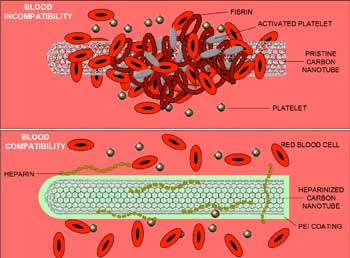
Blood-compatible nanoscale materials possible using heparin
Researchers from Rensselaer Polytechnic Institute have engineered nanoscale materials that are blood compatible using heparin, an anticoagulant. The heparin biomaterials have potential for use as medical devices and in medical treatments such as kidney dialysis.
May 4, 2006 Read more
Breakthrough in semiconductor spin wave research
Engineers at the UCLA Henry Samueli School of Engineering and Applied Science are announcing a critical new breakthrough in semiconductor spin-wave research.
May 4, 2006 Read more
New method for rapid molecule sorting and delivery
IBM researchers have demonstrated a new nanoscale method that both rapidly separates very small numbers of molecules and also delivers them precisely onto surfaces with unprecedented control.
May 2, 2006 Read more
Unexpected plasmonics discovery
T-rays show a strange tendency to travel slower if they are sent down smaller metal wires.
May 2, 2006 Read more
Nanotubes act as thermal velcro to reduce computer-chip heating
Engineers have created carpets made of tiny cylinders called carbon nanotubes to enhance the flow of heat at a critical point where computer chips connect to cooling devices called heat sinks, promising to help keep future chips from overheating.
May 1, 2006 Read more
Targeted quantum dots image tumor blood supply
Using polymer-coated quantum dots targeted to a molecule found on newly growing blood vessels, a team at the Stanford University has shown for the first time that quantum dots can image the blood supply of a tumor.
May 1, 2006 Read more
Polymer nanotubes as molecular probes and DNA carriers
By growing polymers on a porous aluminum oxide template, researchers at the Seoul National University in Korea have fabricated polymer nanotubes to which they can attach two different types of molecules.
May 1, 2006 Read more
Dual properties of carbon nanotubes revealed
For the first time, researchers have directly measured the electronic structure of individual carbon nanotubes whose physical properties had already been determined.
April 28, 2006 Read more

A biosensor layered like lasagna
In a mixing of pasta metaphors, Pacific Northwest National Laboratory scientists have used electrostatic attraction to layer reactive biological molecules lasagna-like around spaghetti-like carbon nanotubes.
April 28, 2006 Read more
Water and nanoelectronics will mix to create ultra-dense memory storage devices
Excessive moisture can typically wreak havoc on electronic devices, but now researchers have demonstrated that a little water can help create ultra-dense storage systems for computers and electronics.
April 26, 2006 Read more
Double duty: Magnetic nanotechnology holds promise in fighting cancer, advancing computing
Detecting cancer and reinventing computing are two challenges that seemingly have little, if anything, to do with each other. A Stanford researchers thinks differently.
April 25, 2006 Read more
Ultrasound combined with nanoparticles might one day replace biopsies
Nanotechnology may one day help physicians detect the very earliest stages of serious diseases like cancer, a new study suggests. It would do so by improving the quality of images produced by one of the most common medical diagnostic tools, the ultrasound machine.
April 24, 2006 Read more
 Subscribe to our Nanotechnology News feed