

Space Exploration News – Latest Headlines
 Subscribe to our Space Exploration News feed
Two Google Lunar Xprize teams announce rideshare partnership for mission to the Moon In 2016
HAKUTO, the only Japanese team competing for the $30 million Google Lunar XPRIZE, has announced a contract with fellow competitor, Astrobotic, based in Pittsburgh, Pa., to carry a pair of rovers to the moon.
February 23, 2015 Read more
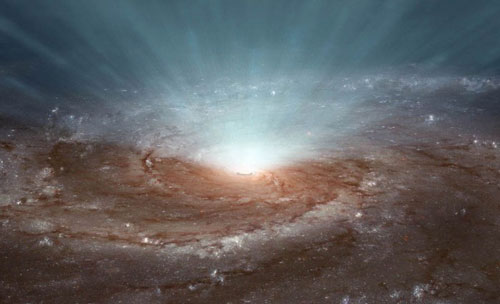
Giving shape to black holes' intense winds
By looking at the speed of ambient gas spewing out from a well-known quasar, astronomers are gaining insight into how black holes and their host galaxies might have evolved at the same time.
February 20, 2015 Read more
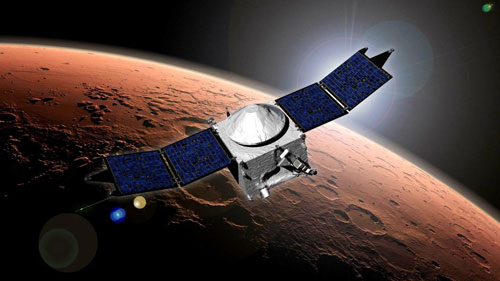
NASA's MAVEN spacecraft completes first deep dip campaign
NASA's Mars Atmosphere and Volatile Evolution has completed the first of five deep-dip maneuvers designed to gather measurements closer to the lower end of the Martian upper atmosphere.
February 20, 2015 Read more
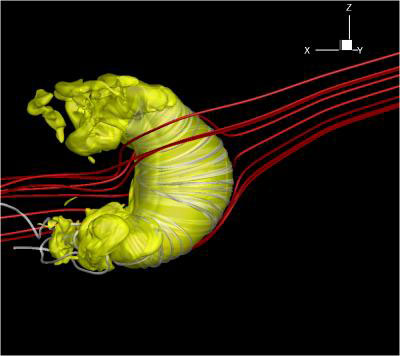
A new view of the solar system: Astrophysical jets driven by the sun
The magnetic field of the sun plays a crucial role in shaping the heliosphere - the domain of the sun - by accelerating the solar wind into a pair of jets.
February 19, 2015 Read more
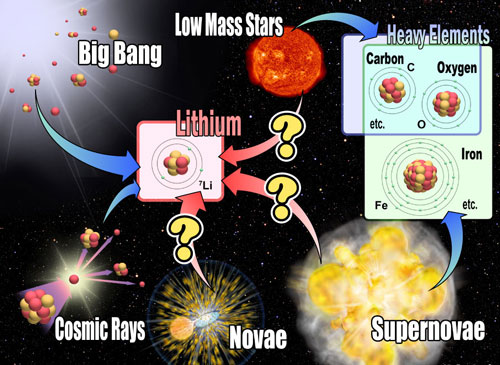
Classical nova explosions are major lithium factories in the Universe
Lithium is a key element in the strudy of the chemical evolution of the universe because it likely was and is produced in several ways: through Big Bang nucleosynthesis, in collisions between energetic cosmic rays and the interstellar medium, inside stellar interiors, and as a result of novae and supernova explosions.
February 19, 2015 Read more
For the first time, spacecraft catch a solar shockwave in the act
Solar storm found to produce 'ultrarelativistic, killer electrons' in 60 seconds.
February 18, 2015 Read more
Laser 'ruler' holds promise for hunting exoplanets (w/video)
A team of researchers have successfully demonstrated how a solar telescope can be combined with a piece of technology that has already taken the physics world by storm - the laser frequency comb (LFC).
February 18, 2015 Read more
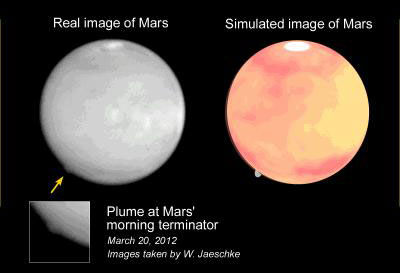
The highest plume ever observed on Mars
Researchers are studying images of a mysterious bulge that rose up more than 200 km from the surface.
February 18, 2015 Read more
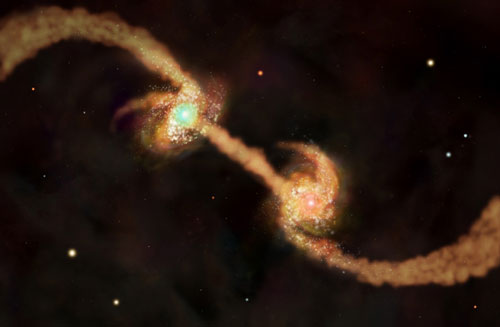
Dark matter guides growth of supermassive black holes
A new study of football-shaped collections of stars called elliptical galaxies provides new insights into the connection between a galaxy and its black hole. It finds that the invisible hand of dark matter somehow influences black hole growth.
February 18, 2015 Read more
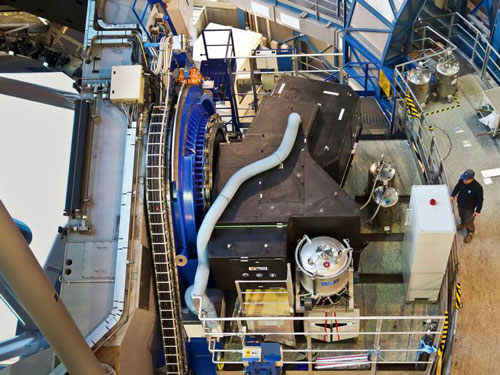
The strange case of the missing dwarf
New SPHERE instrument shows its power.
February 18, 2015 Read more
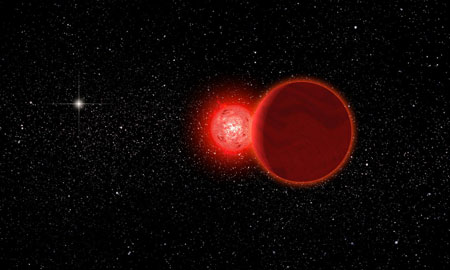
A close call of 0.8 light years
Astronomers identify the closest known flyby of a star to our solar system: A dim star that passed through the Oort Cloud 70,000 years ago.
February 17, 2015 Read more
With new data, Planck satellite brings early universe into focus
One of the project leaders offers insight into the latest data release from the Planck space telescope.
February 17, 2015 Read more
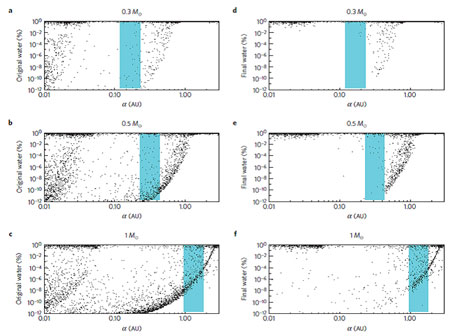
The mystery of cosmic oceans and dunes
Simulations by researchers at Tokyo Institute of Technology and Tsinghua University indicate that Earth-like planets are more likely to be found orbiting Sun-like stars rather than lower-mass stars that are currently targeted, in terms of water contents of planets.
February 17, 2015 Read more
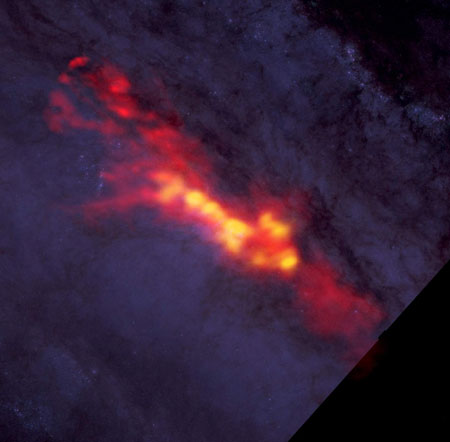
Why do starburst galaxies 'burst'?
Starburst galaxies transmute gas into new stars at a dizzying pace - up to 1,000 times faster than typical spiral galaxies like the Milky Way. To help understand why some galaxies 'burst' while others do not, an international team of astronomers used the Atacama Large Millimeter/submillimeter Array (ALMA) to dissect a cluster of star-forming clouds at the heart of NGC 253, one of the nearest starburst galaxies to the Milky Way.
February 16, 2015 Read more
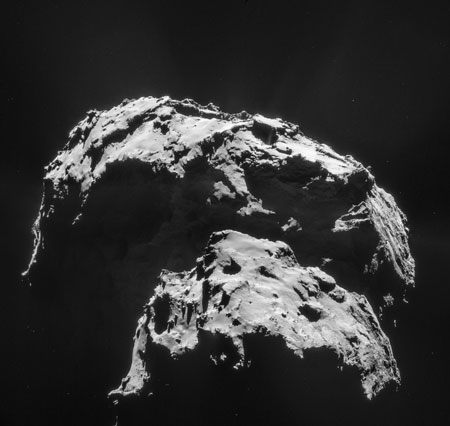
Why comets are like deep fried ice cream
Astronomers tinkering with ice and organics in the lab may have discovered why comets are encased in a hard, outer crust.
February 16, 2015 Read more
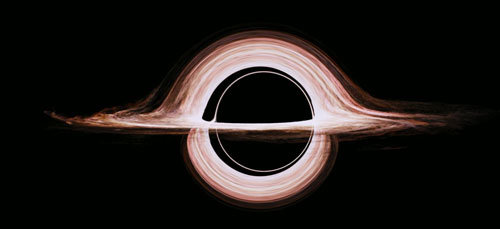
'Interstellar' technology throws light on spinning black holes
The team responsible for the Oscar-nominated visual effects at the centre of Christopher Nolan's epic, Interstellar, have turned science fiction into science fact by providing new insights into the powerful effects of black holes.
February 13, 2015 Read more
Life on other planets: Alternative chemistries of life
Ideas about directing evolution of life forms on Earth and finding life on other planets are rapidly morphing from science-fiction fantasy into mainstream science.
February 12, 2015 Read more
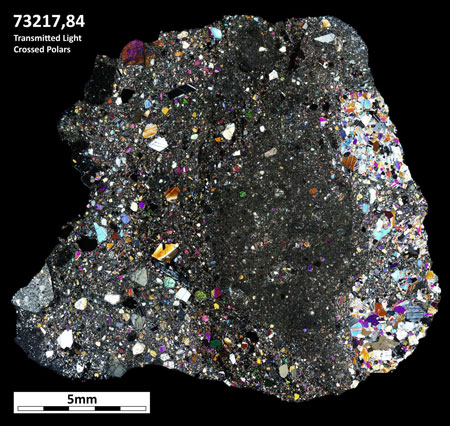
Application of laser microprobe technology to Apollo samples refines lunar impact history
It's been more than 40 years since astronauts returned the last Apollo samples from the moon, and since then those samples have undergone some of the most extensive and comprehensive analysis of any geological collection. Researchers have now refined the timeline of meteorite impacts on the moon through a pioneering application of laser microprobe technology to Apollo 17 samples.
February 12, 2015 Read more