

Space Exploration News – Latest Headlines
 Subscribe to our Space Exploration News feed
Fungal pathogen shows profound effects from spaceflight
At Arizona State University's Biodesign Institute, Cheryl Nickerson and her team have been investigating the intriguing effects of spaceflight on microbial pathogens.
December 17, 2013 Read more
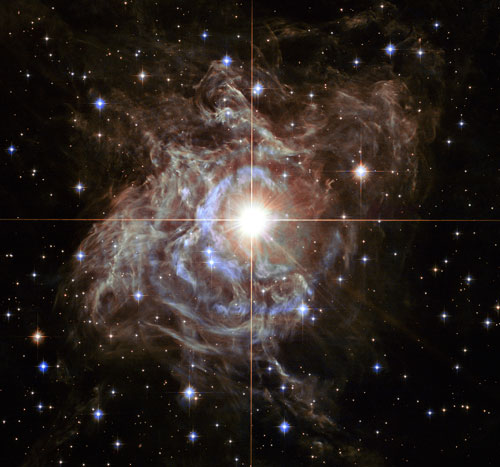
Hubble watches super star create holiday light show
This festive NASA Hubble Space Telescope image resembles a holiday wreath made of sparkling lights. The bright southern hemisphere star RS Puppis, at the center of the image, is swaddled in a gossamer cocoon of reflective dust illuminated by the glittering star. The super star is ten times more massive than our Sun and 200 times larger.
December 17, 2013 Read more
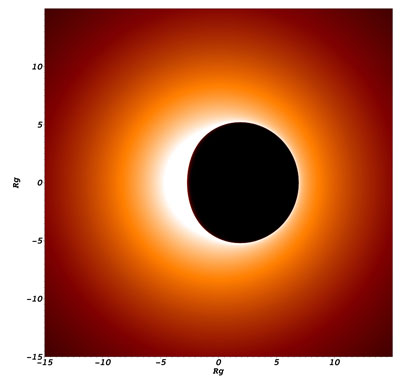
Astrophysicists to construct the first accurate image of a black hole
Was Einstein right? The European Research Council (ERC) has awarded 14 Million Euros to a team of European astrophysicists to construct the first accurate image of a black hole. The team will test the predictions of current theories of gravity, including Einstein's theory of General Relativity.
December 17, 2013 Read more
China Plans to Launch Chang'e-5 in 2017
China plans to launch lunar probe Chang'e-5 in 2017, according to the State Administration of Science, Technology and Industry for National Defense.
December 17, 2013 Read more
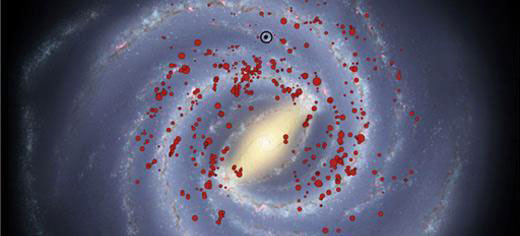
Massive stars mark out Milky Way's 'missing' arms
A 12-year study of massive stars has reaffirmed that our Galaxy has four spiral arms, following years of debate sparked by images taken by NASA's Spitzer Space Telescope that only showed two arms.
December 17, 2013 Read more
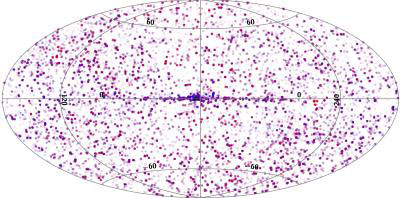
Swift satellite catches 100,000 new cosmic X-ray sources
Astronomers from University of Leicester provide new insights into cosmic phenomena.
December 16, 2013 Read more
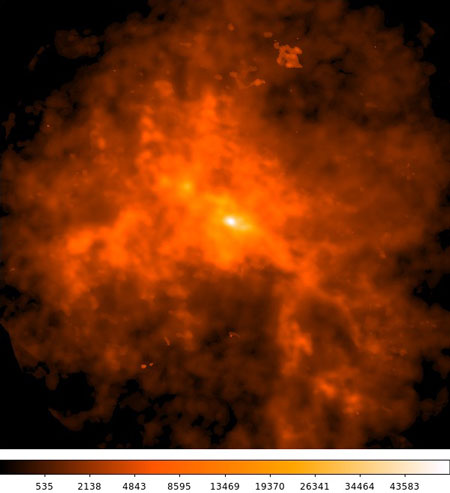
SMA reveals giant star cluster in the making
W49A might be one of the best-kept secrets in our galaxy. This star-forming region shines 100 times brighter than the Orion nebula, but is so obscured by dust that very little visible or infrared light escapes. The Smithsonian's Submillimeter Array has peered through the dusty fog to provide the first clear view of this stellar nursery.
December 16, 2013 Read more
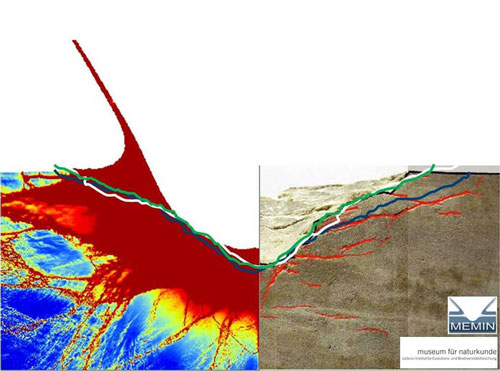
Close-up on impact craters
Scientists are currently trying to gain a better understanding of how craters are formed. Their work involves smashing miniature meteorites into rock under laboratory conditions - and then analyzing the craters using ultrasound tomography.
December 16, 2013 Read more
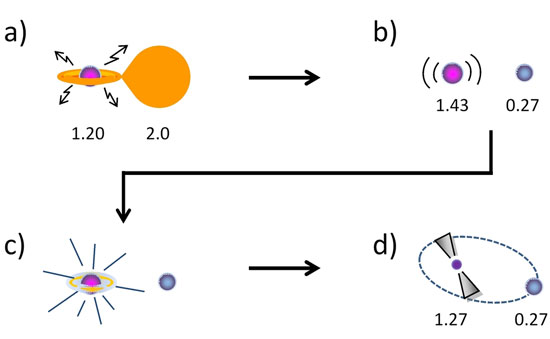
The manifold path to millisecond pulsars
Two astronomers from Bonn have proposed a new path for the formation of a newly discovered class of millisecond pulsars with similar orbital periods and eccentricities. In the scenario of Paulo Freire and Thomas Tauris, a massive white dwarf star accretes matter and angular momentum from a normal companion star and grows beyond the critical Chandrasekhar mass limit. The new hypothesis makes several testable predictions about this recently discovered sub-class of millisecond pulsars.
December 16, 2013 Read more
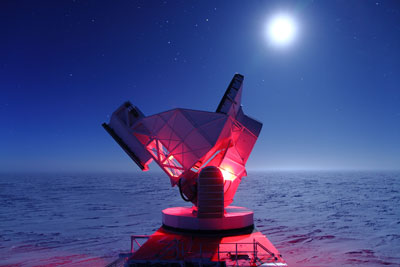
Swirls in remnants of Big Bang may hold clues to universe's infancy
South Pole Telescope scientists have detected for the first time a subtle distortion in the oldest light in the universe, which may help reveal secrets about the earliest moments in the universe's formation.
December 14, 2013 Read more
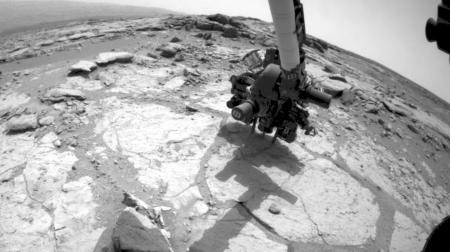
First rock dating experiment performed on Mars
Although researchers have determined the ages of rocks from other planetary bodies, the actual experiments - like analyzing meteorites and moon rocks - have always been done on Earth. Now, for the first time, researchers at Caltech have successfully determined the age of a Martian rock - with experiments performed on Mars. This work could not only help in understanding the geologic history of Mars but also aid in the search for evidence of ancient life there.
December 13, 2013 Read more
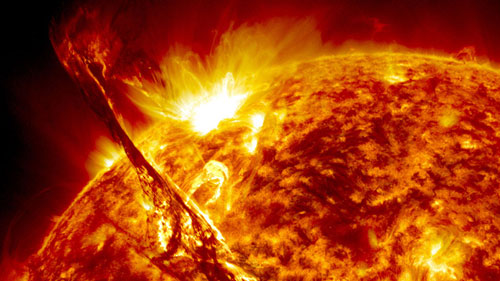
Fast radio bursts might come from nearby stars
First discovered in 2007, 'fast radio bursts' continue to defy explanation. These cosmic chirps last for only a thousandth of a second. The characteristics of the radio pulses suggested that they came from galaxies billions of light-years away. However, new work points to a much closer origin - flaring stars within our own galaxy.
December 12, 2013 Read more
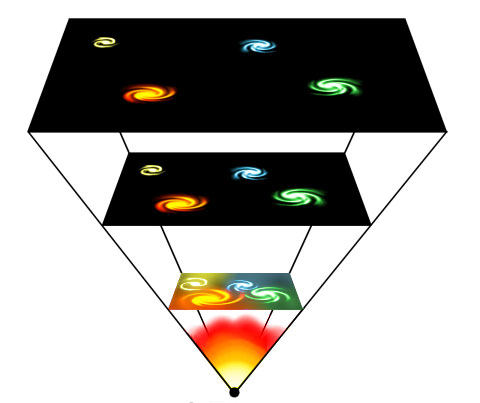
Collapse of the universe is closer than ever before
Maybe it happens tomorrow. Maybe in a billion years. Physicists have long predicted that the universe may one day collapse, and that everything in it will be compressed to a small hard ball. New calculations from physicists at the University of Southern Denmark now confirm this prediction - and they also conclude that the risk of a collapse is even greater than previously thought.
December 12, 2013 Read more
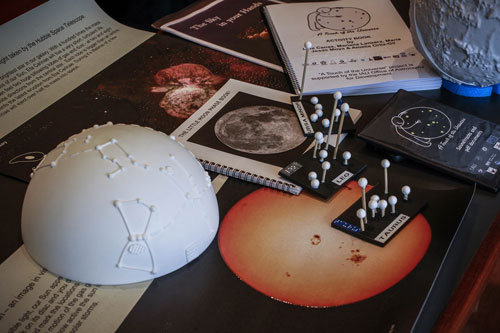
A touch of the Universe
The Astronomic Observatory of the University of Valencia has undertaken this year the project 'A touch of the Universe', a non-profit mission that aims to create thirty kits with tactile astronomical activities for children with visual difficulties.
December 12, 2013 Read more
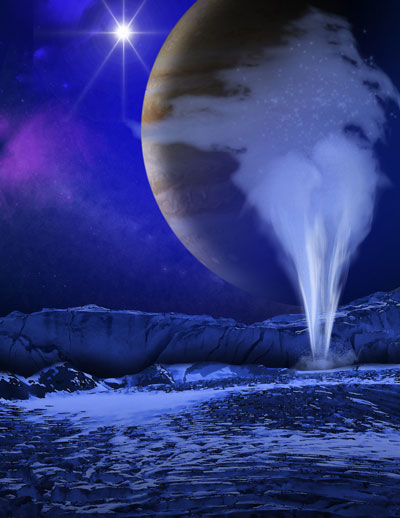
Hubble Space Telescope sees evidence of water vapor venting off Jovian moon
NASA's Hubble Space Telescope has observed water vapor above the frigid south polar region of Jupiter's moon Europa, providing the first strong evidence of water plumes erupting off the moon's surface.
December 12, 2013 Read more
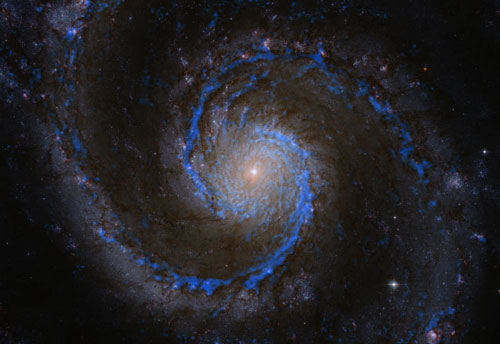
In the stellar delivery room
Molecular clouds in the whirlpool galaxy appear to be embedded in fog, whose pressure is crucial in determining the birth of suns.
December 11, 2013 Read more
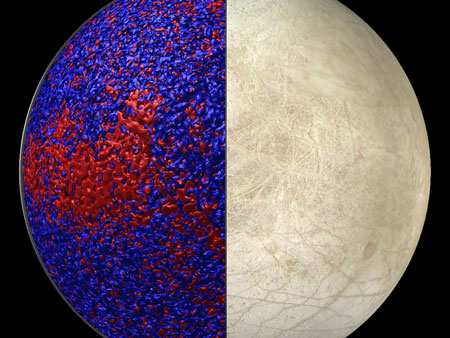
The heat pump in Europa's ocean
Researchers model currents beneath the frozen surface of Jupiter's moon.
December 10, 2013 Read more
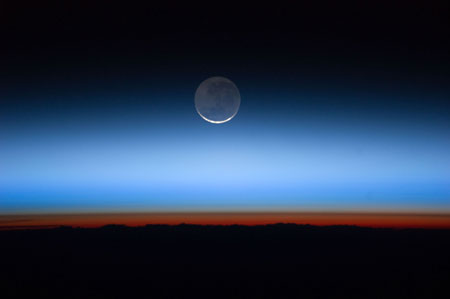
Astronomers solve temperature mystery of planetary atmospheres
An atmospheric peculiarity the Earth shares with Jupiter, Saturn, Uranus and Neptune is likely common to billions of planets, University of Washington astronomers have found, and knowing that may help in the search for potentially habitable worlds.
December 10, 2013 Read more