

Casimir Force: How Quantum Vacuum Fluctuations Create Attraction at the Nanoscale
What is the Casimir Force?
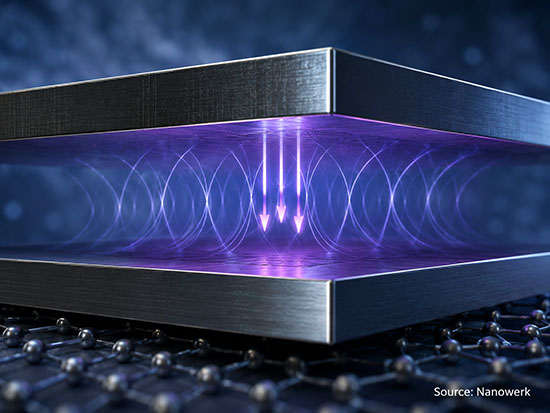
The Casimir force is a quantum fluctuation-induced interaction between closely spaced uncharged bodies. In its best-known form, it appears as an attraction between two parallel conducting plates in vacuum.
Predicted in 1948 by the Dutch physicist Hendrik Casimir, the force is a measurable consequence of how nearby materials modify the electromagnetic field. Even empty space is not completely still in quantum theory: the electromagnetic field has zero-point fluctuations. When two surfaces are brought very close together, the spectrum of fluctuations between them differs from the spectrum in the surrounding space, producing a mechanical force. In real materials, the more general Casimir-Lifshitz force depends on optical properties, geometry, temperature, and any medium between the surfaces.
For two perfectly conducting, perfectly flat, infinite parallel plates separated by a distance d in vacuum at zero temperature, the Casimir pressure is −π2ℏc/(240 d4), where ℏ is the reduced Planck constant and c is the speed of light. The steep 1/d4 scaling explains why the effect is negligible at ordinary distances but important at nanometer-scale gaps. Between ideal plates, the pressure is tiny at 1 µm but rises toward atmospheric pressure at about 10 nm. In practical devices, surface roughness, electrostatic patch potentials, capillary forces, adsorbates, and material response all influence the measured force.
Key takeaways:
- The Casimir force is a fluctuation-induced interaction between uncharged bodies, most often attractive for two similar surfaces in vacuum.
- The ideal parallel-plate pressure scales as 1/d4, so the effect grows rapidly below about 100 nm.
- Casimir, Casimir-Polder, and van der Waals interactions are related regimes of electromagnetic dispersion forces.
- Materials, geometry, temperature, and intervening fluids can tune, reduce, or in special cases reverse the force.
How the Casimir Force Arises from Vacuum Fluctuations
In quantum electrodynamics, every allowed electromagnetic mode carries a zero-point energy of ½ℏω even in its lowest-energy state. Conducting or dielectric boundaries change which modes contribute to the field energy. As the distance between two bodies changes, the total electromagnetic energy of the system changes as well; the Casimir force is the resulting energy gradient. Equivalent derivations based on radiation pressure, scattering theory, or field correlations give the same physical result and show that the effect is electromagnetic, not gravitational.
The simple textbook explanation is useful but incomplete. A more realistic framework, developed by Evgeny Lifshitz in the 1950s, treats the force as arising from fluctuating currents and charges inside the materials. These fluctuations radiate electromagnetic fields that scatter from neighboring bodies. Lifshitz theory naturally includes finite conductivity, dielectric materials, temperature, and intervening media, reducing to Casimir's ideal-plate result for perfect conductors in vacuum and to familiar van der Waals forces at very short separations.
This connection is important because the exact distance dependence is not universal. Molecule-molecule, atom-surface, sphere-plate, and plate-plate interactions all scale differently. At very short distances, the finite speed of light can often be neglected and the interaction is described as non-retarded van der Waals attraction. At larger distances, retardation changes which frequencies dominate, producing Casimir-Polder or Casimir behavior depending on the geometry. For ideal parallel plates, this retarded pressure scales as 1/d4.
Material and Geometry Dependence
The ideal formula applies only to perfectly conducting, perfectly flat, infinite plates at zero temperature. Real Casimir experiments involve metals with finite conductivity, dielectric layers, finite-thickness films, surface roughness, contamination, finite temperature, and curved or patterned surfaces. Material dependence enters through the dielectric response of each body over a broad range of frequencies. Highly reflective metals such as gold and platinum usually produce strong attraction; semiconductors and dielectrics produce smaller forces; and selected material-fluid combinations can produce repulsive Casimir-Lifshitz interactions.
For gold-coated surfaces, the measured force can be substantially lower than the ideal-conductor prediction because gold is not a perfect mirror at the relevant frequencies. Thin-film thickness, surface roughness, adsorbed water, oxide layers, and residual electrostatic patch potentials can further shift the result. These corrections are not minor bookkeeping details: they determine whether precision measurements agree with a chosen material model and whether nanoscale devices stick, slide, or remain stable.
Geometry is equally important. Experiments rarely use two parallel plates because holding micrometer-scale plates parallel to nanometer precision is difficult. Most precision measurements use a sphere-plate configuration and interpret the force with the proximity force approximation, which treats the curved surface as many local parallel-plate separations. Modern scattering and numerical methods can handle more complex shapes and have shown that patterned surfaces, gratings, and high-aspect-ratio nanostructures can produce forces that depart strongly from simple plate-based estimates.
Measuring the Casimir Force
Casimir's 1948 prediction was difficult to test because the force is small, surface preparation is demanding, and stray electrostatic effects can mimic the signal. Marcus Sparnaay reported an early measurement in 1958, but quantitative confirmation came much later. In 1997, Steve Lamoreaux measured the force between gold-coated surfaces with a torsion pendulum and found agreement with theory at about the five-percent level. Soon after, Mohideen and Roy used an atomic force microscope with a metallized microsphere to measure the force at separations of tens to hundreds of nanometers.
Today, Casimir measurements commonly use atomic force microscopy, MEMS torsional oscillators, microresonators, or specialized torsion pendulums. Atomic force microscopy detects cantilever deflection as a coated sphere approaches a plate. MEMS and microresonator methods often measure shifts in resonance frequency caused by the force gradient. Precision work requires careful calibration of separation, surface roughness, contact potential, residual charge, temperature, and mechanical stiffness.
A persistent challenge is separating the true Casimir-Lifshitz interaction from electrostatic backgrounds. Even nominally grounded metals can contain microscopic work-function variations, known as patch potentials, which generate residual forces. Theoretical modeling is also subtle because different treatments of metal response at low frequency can predict slightly different thermal corrections. These issues do not cast doubt on the existence of the Casimir force, but they explain why high-precision comparisons between experiment and theory remain technically demanding.
Engineering Implications: Stiction in MEMS and NEMS
The Casimir force matters in nanotechnology because it grows rapidly as surfaces approach each other. In MEMS and NEMS, movable beams, switches, mirrors, and membranes often operate with gaps from a few tens to a few hundreds of nanometers. In this regime, Casimir attraction can combine with van der Waals, electrostatic, and capillary forces to pull structures into contact with a substrate or electrode.
This failure mode is called stiction. Once two nanoscale or microscale surfaces touch, adhesion may exceed the mechanical restoring force, permanently immobilizing the device. Stiction has affected accelerometers, RF microswitches, micromirrors, adaptive optics arrays, and nanomechanical relays. Designers therefore consider Casimir and related dispersion forces when choosing gap sizes, spring constants, coatings, surface textures, and release processes.
The same interaction can also be useful. A predictable, contactless force can tune the resonance of micro- and nanomechanical oscillators, create nonlinear mechanical behavior, or provide actuation without wires or applied voltage. In practice, the engineering question is rarely whether the Casimir force exists, but whether it should be suppressed, compensated, or exploited.
Tuning, Reducing, and Reversing the Casimir Force
Because the Casimir-Lifshitz force depends on electromagnetic response and geometry, it can be engineered. Three broad approaches are commonly used: material choice, surface structuring, and dynamic control.
Material choice
Changing the optical response of one or both surfaces changes the force. Replacing a gold surface with a less reflective film, adding a dielectric coating, or using a semiconductor can reduce the attraction. In a fluid, the sign can even reverse under specific conditions: Lifshitz theory predicts repulsion when the dielectric response of the intervening liquid lies between those of the two solids over the dominant frequency range. In 2009, Munday, Capasso, and Parsegian measured a repulsive Casimir-Lifshitz force between a gold-coated sphere and a silica surface immersed in bromobenzene.
Geometry and metasurface engineering
Surface patterning provides another route to control. Gratings, trenches, nanopillars, and other structured surfaces change the scattering of electromagnetic fluctuations and can reduce or reshape the force compared with flat plates. Photonic crystals, metamaterials, and engineered nanocoatings offer additional levers because they alter reflectivity and mode structure over the frequencies that dominate the interaction. These approaches are promising but require full electromagnetic modeling; simple additive or pairwise approximations often fail for strongly patterned surfaces.
Dynamical control
The force can also be changed in time by modulating material properties. Photo-exciting carriers in a semiconductor, switching a phase-change material, or driving a surface near a phase transition can alter the Casimir interaction on demand. Related dynamical Casimir effects arise when boundary conditions change rapidly enough to convert vacuum fluctuations into real excitations. These ideas are being explored in optomechanical, microwave, and quantum-photonic systems.
Applications and Current Research Directions
For nanotechnology, the main application of Casimir physics is design insight: it tells engineers how closely spaced uncharged surfaces will interact when electrostatic forces are minimized. This matters for MEMS switches, nanomechanical resonators, scanning probe systems, colloids, and layered van der Waals heterostructures. In liquids, material choice can create attractive, repulsive, or equilibrium interactions between particles and surfaces, linking Casimir-Lifshitz physics with colloidal assembly and Brownian motion.
The Casimir force is also a tool for fundamental physics. Precision measurements place bounds on hypothetical short-range forces that would appear as small deviations from the predicted distance dependence. Casimir torque between anisotropic materials, lateral Casimir forces between corrugated surfaces, and force measurements involving nanostructures probe directional and shape-dependent components of electromagnetic vacuum stress. On-chip nanophotonic and optical-cavity platforms are extending these studies into regimes where mechanical motion, light confinement, and fluctuation-induced forces are coupled.
Current research focuses on making the force more predictable and more useful: improved material models, better control of patch potentials and surface roughness, engineered repulsion in fluids, patterned and anisotropic surfaces, phase-change materials, topological materials, and time-modulated systems. As fabrication pushes reliable gaps below 100 nm, accurate modeling of the Casimir-Lifshitz force is becoming a practical engineering requirement rather than a niche topic in quantum electrodynamics.
FAQ: Casimir Force
Who first predicted and measured the Casimir force?
Hendrik Casimir predicted the force in 1948, deriving the ideal result for two parallel uncharged conducting plates in vacuum. Marcus Sparnaay reported an early measurement in 1958, but quantitative confirmation came in 1997, when Steve Lamoreaux measured the force between gold-coated surfaces with a torsion pendulum and found agreement with theory at about the five-percent level.
Why does the Casimir force matter at the nanoscale but not in everyday life?
The ideal parallel-plate pressure scales as the inverse fourth power of separation. At micrometer distances it is extremely small; at separations of tens of nanometers it can become comparable to other surface forces. That is the operating range of many MEMS and NEMS devices, where small unwanted attractions can cause sticking or pull-in.
Can the Casimir force be repulsive?
Yes, but not for two identical ordinary surfaces in vacuum. Repulsion can occur in selected solid-fluid-solid systems when the dielectric response of the fluid lies between those of the two solids over the relevant frequency range. The best-known demonstration measured repulsion between a gold-coated sphere and a silica surface immersed in bromobenzene.
How is the Casimir force related to van der Waals forces?
They are related forms of electromagnetic dispersion forces. At very short separations, non-retarded van der Waals interactions dominate. At larger separations, the finite speed of light changes the interaction, producing Casimir-Polder behavior for atoms near surfaces and Casimir behavior for extended bodies. The distance dependence depends on geometry, so molecule-molecule and plate-plate forces should not be compared with a single universal power law.
Why is the Casimir force a problem for MEMS and NEMS devices?
Movable MEMS and NEMS parts may sit only tens or hundreds of nanometers from nearby surfaces. At these gaps, Casimir attraction can add to electrostatic, capillary, and van der Waals forces and pull parts into contact. If adhesion exceeds the restoring force of the device, the component remains stuck, causing stiction failure.
Further Reading
Physical Review Letters, Demonstration of the Casimir force in the 0.6 to 6 µm range
Reviews of Modern Physics, The Casimir force between real materials: experiment and theory
Nature Communications, Strong Casimir force reduction through metallic surface nanostructuring
Nanotechnology, The progress of the Casimir effect: from theory to application
