| Mar 11, 2026 |
Liquid crystal micro droplet enables nanosecond optical switching
Researchers use a dye-doped liquid crystal droplet to achieve nanosecond all-optical switching, offering an energy-efficient soft-matter platform for future optical computing.
(Nanowerk News) An international research team has used a dye-doped liquid crystal droplet to achieve all-optical switching on nanosecond timescales, eliminating the need for electrical input. Published in Advanced Photonics ("Light control of lasing from liquid-crystal micro-droplet light switch"), the work introduces a soft-matter photonic platform that redirects stored optical energy through resonant stimulated-emission depletion, opening a potential route toward flexible, biocompatible optical computing and communication devices.
|
Key Findings
- A micrometer-sized liquid crystal droplet doped with fluorescent dye functions as a nanosecond optical switch that controls light output using light alone.
- The resonant cavity design cuts the energy required for stimulated-emission depletion by more than a hundredfold compared with nonresonant conditions.
- The liquid droplet self-forms stable optical connections with solid waveguides, an advantage difficult to replicate with conventional hard materials.
|
|
Researchers working on computing and communication technologies have long pursued the ability to control light with light. Achieving such control would let optical signals bypass electrical conversion entirely, potentially yielding faster and more energy-efficient devices. In recent years, soft matter has emerged as an unexpected but promising platform for this goal.
|
|
Soft-matter photonics explores how materials including liquids, liquid crystals, gels, and polymers spontaneously organize into structures that manipulate light. These materials differ sharply from conventional solid-state photonic components, which depend on precise nanofabrication. Some soft materials also display nonlinear optical behavior. Through the Kerr effect, for instance, intense illumination shifts the refractive index of certain materials, allowing one beam of light to influence another and enabling ultrafast optical switching on picosecond timescales.
|
|
The team behind the new study, however, took a fundamentally different approach. Rather than exploiting refractive index changes, they built a system that manipulates stored optical energy within a resonant structure. Their device centers on a micrometer-sized droplet of liquid crystal infused with a fluorescent dye. This droplet serves as a resonant cavity that supports whispering gallery modes, where light circulates along the droplet perimeter and undergoes amplification. The researchers suspended the droplet in water and brought its surface into contact with several tapered polymer waveguides that channel light into and out of the cavity.
|
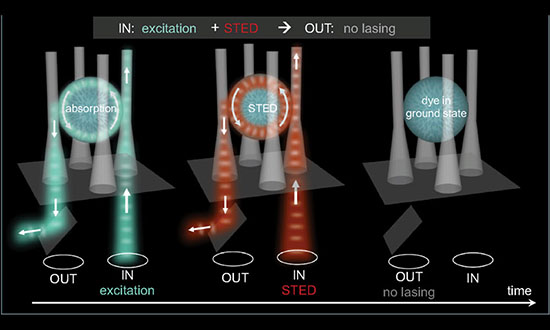 |
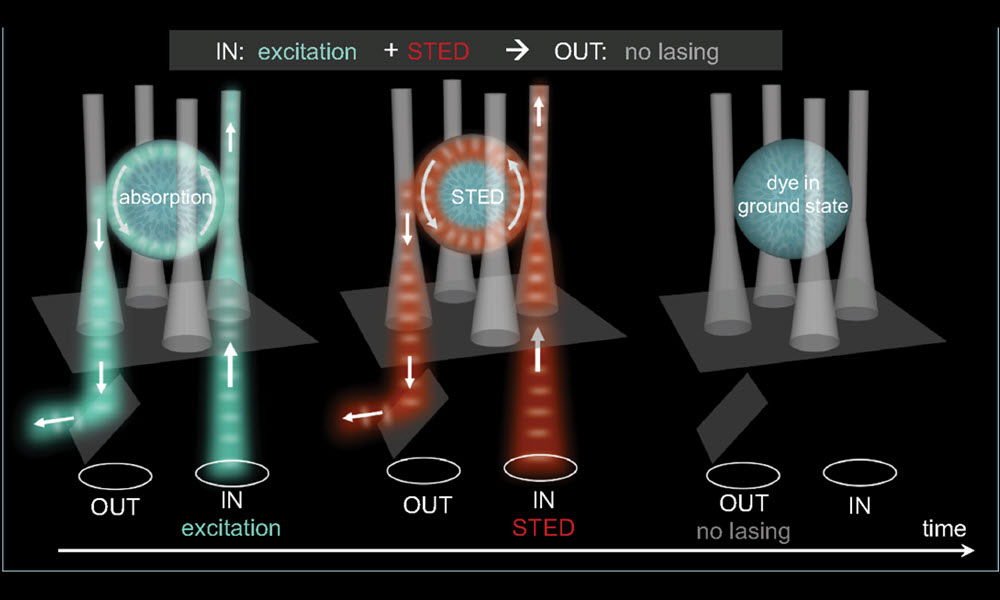
| Nanosecond all-optical switching is achieved through a soft-matter photonic platform that uses a dye-doped liquid crystal droplet to switch light with light alone. A precisely timed, red-shifted pulse redirects stored optical energy, changing the output wavelength. Such optical switching could support flexible, biocompatible technologies for next-generation optical computing and communications. (Image: Reproduced from DOI:10.1117/1.AP.8.2.026009, CC BY) (click on image to enlarge)
|
|
The switching mechanism operates in two stages. First, a laser pulse travels through one of the waveguides and excites the dye molecules, causing the droplet to lase and emit its own light. If, however, a second pulse at a longer wavelength arrives through the same waveguide before lasing begins, it triggers stimulated emission and depletes the excited dye molecules. Instead of producing whispering gallery mode laser emission, the system redirects the stored energy to amplify this second pulse. The result is a shift in the dominant output wavelength, achieved entirely through light-by-light control with no electrical input.
|
|
A central innovation of the platform involves the physical interface between the solid waveguide and the liquid droplet. In rigid materials, a spherical cavity and a cylindrical waveguide share too little contact area for efficient light transfer. Because the droplet is liquid, however, surface tension and interfacial forces cause it to deform slightly upon contact with the waveguides. This deformation creates a stable, efficient optical connection that the researchers say would be extremely difficult to achieve using solid materials alone, underscoring a distinct advantage of soft matter for photonic interconnections.
|
|
The system also delivers exceptional energy efficiency. In standard stimulated-emission depletion applications such as super-resolution microscopy, the depletion pulse must typically overpower the excitation pulse by orders of magnitude because it encounters the sample only once. Inside the resonant cavity, by contrast, the depletion light circulates repeatedly, interacting with the excited molecules on each pass. This multipass amplification effect slashes the energy needed for depletion by more than a hundredfold relative to nonresonant configurations.
|
|
Beyond the nanosecond switching demonstration itself, the platform offers practical benefits over established photonic technologies. The spherical cavities form through rapid self-assembly rather than the multi-step fabrication processes that hard materials demand. This opens possibilities for biocompatible and flexible photonic devices, where engineers could potentially replicate complex circuits using soft imprint lithography, manufacture them at low temperatures, and construct them from less toxic materials.
|
|
The researchers describe this work as a foundational advance toward a new generation of soft, bio-inspired optical technologies. "We presented a self-assembled soft-matter microphotonic element, a soft-matter photonic switch that uses the concept of light-by-light manipulation at very low light intensity. As such, this is a rare example of a photonic device based on self-organizing properties of soft matter that could be a building block of a futuristic, bio-inspired soft photonic platform," states corresponding author Professor Igor Muševič of the University of Ljubljana and Jožef Stefan Institute in Slovenia.
|