Pulsar
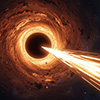
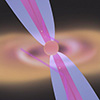
A pulsar (from pulsating radio source) is a highly magnetized rotating compact star (usually neutron stars but also white dwarfs) that emits beams of electromagnetic radiation out of its magnetic poles.
This radiation can be observed only when a beam of emission is pointing toward Earth (similar to the way a lighthouse can be seen only when the light is pointed in the direction of an observer), and is responsible for the pulsed appearance of emission.
Neutron stars are very dense and have short, regular rotational periods. This produces a very precise interval between pulses that ranges from milliseconds to seconds for an individual pulsar. Pulsars are one of the candidates for the source of ultra-high-energy cosmic rays.
The periods of pulsars make them very useful tools for astronomers. Observations of a pulsar in a binary neutron star system were used to indirectly confirm the existence of gravitational radiation. The first extrasolar planets were discovered around a pulsar, PSR B1257+12. In 1983, certain types of pulsars were detected that, at that time, exceeded the accuracy of atomic clocks in keeping time.
Signals from the first discovered pulsar were initially observed by Jocelyn Bell while analyzing data recorded on August 6, 1967 from a newly commissioned radio telescope that she helped build. Initially dismissed as radio interference by her supervisor, Antony Hewish, developer of the telescope, the fact that the signals always appeared at the same declination and right ascension soon ruled out a terrestrial source.
On November 28, 1967, Bell and Hewish using a fast recorder resolved the signals as a series of pulses, evenly spaced every 1.33 seconds. No astronomical object of this nature had ever been observed before. On December 21, Bell discovered a second pulsar, quashing speculation that these might be signals beamed at earth from an extraterrestrial intelligence.
Check out these latest Nanowerk Astronomy & Space News: