Reference terms from Wikipedia, the free encyclopedia
 

Spaceflight

Spaceflight (or space flight) is an application of astronautics to fly spacecraft into or through outer space, either with or without humans on board. Most spaceflight is uncrewed and conducted mainly with spacecraft such as satellites in orbit around Earth, but also includes space probes for flights beyond Earth orbit. Such spaceflight operates either by telerobotic or autonomous control. The more complex human spaceflight has been pursued soon after the first orbital satellites and has reached the Moon and permanent human presence in space around Earth, particularly with the use of space stations. Human spaceflight programs include the Soyuz, Shenzhou, the past Apollo Moon landing and the Space Shuttle programs, with currently the International Space Station as the main destination of human spaceflight missions while China's Tiangong Space Station is under construction.

Spaceflight is used for placing in Earth's orbit communications satellites, reconnaissance satellites, Earth observation satellites, but also for space exploration such as space observatories and space probes, or even for space tourism.

Spaceflight can be achieved with different types of launch systems, conventionally by rocket launching, which provide the initial thrust to overcome the force of gravity and propel a spacecraft from the surface of the Earth. Once in space, the motion of a spacecraft – both when unpropelled and when under propulsion – is covered by the area of study called astrodynamics.

Some spacecraft remain in space practically indefinitely, which has created the issue of space pollution in the form of light pollution and space junk, which is a hazard to spaceflight. Otherwise spacecraft are terminated by atmospheric reentry, in which they disintegrate, or if they do not, their reentry is mostly controlled to safely reach a surface by landing or impacting, often being dumped in the oceanic spacecraft cemetery. As such spacecraft have been the subject of some space traffic management.

 
Note:   The above text is excerpted from the Wikipedia article Spaceflight, which has been released under the GNU Free Documentation License.
 

Check out these latest Nanowerk Astronomy & Space News:
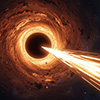
 

Researchers use counterjet to reveal clumpy gas near a black hole

Counterjet observations reveal clumpy, dense ionized gas around a supermassive black hole, offering a new probe of AGN jet–gas interactions.

Cosmic dawn fuel discovery unlocks early galaxy growth secrets

NSF VLA and ALMA observations detect enormous cold molecular gas reserves in a distant galaxy seen 13 billion years ago.

Big Bang inside a star: How a gravastar forms

A new relativity model suggests gravastars could form when dark energy creates an expanding mini-universe inside a collapsing star, preventing a black hole.

Webb finds strongest evidence yet for 'black hole stars'

Many of the scattered pieces of the little red dot puzzle are coming together.

Galaxy-killing wind discovered in the early universe

Galaxy-killing winds from early galaxy collisions may blow away star-forming gas, explaining why massive galaxies lived fast and died young.

Study reveals growth spurt of massive stars in extreme galactic center

Massive stars can form via accretion disks even in the Milky Way’s harsh center, showing disk-driven growth works across extreme environments.

Astronomers discover the earliest known flickering quasar

When the universe was just 850 million years old, this voracious black hole was already surprisingly mature, a new study finds.

Understanding neutron star mergers with artificial intelligence

Machine learning models energy release during heavy-element formation, enabling faster simulations of neutron star mergers and kilonova signals.

X-ray telescopes on a satellite can map the Moon's surface chemistry in a few years

Simulations show a compact orbital instrument could chart lunar elements in 1–2 years, offering new insight into the Moon's evolution.

Magnetic field helps binary star systems form

Simulations show magnetic fields can remove angular momentum from forming protostars, helping binary star systems form within realistic timescales.

Check out more of the latest Astronomy & Space News here.