

Gene Silencing: How RNAi and Epigenetic Mechanisms Switch Genes Off
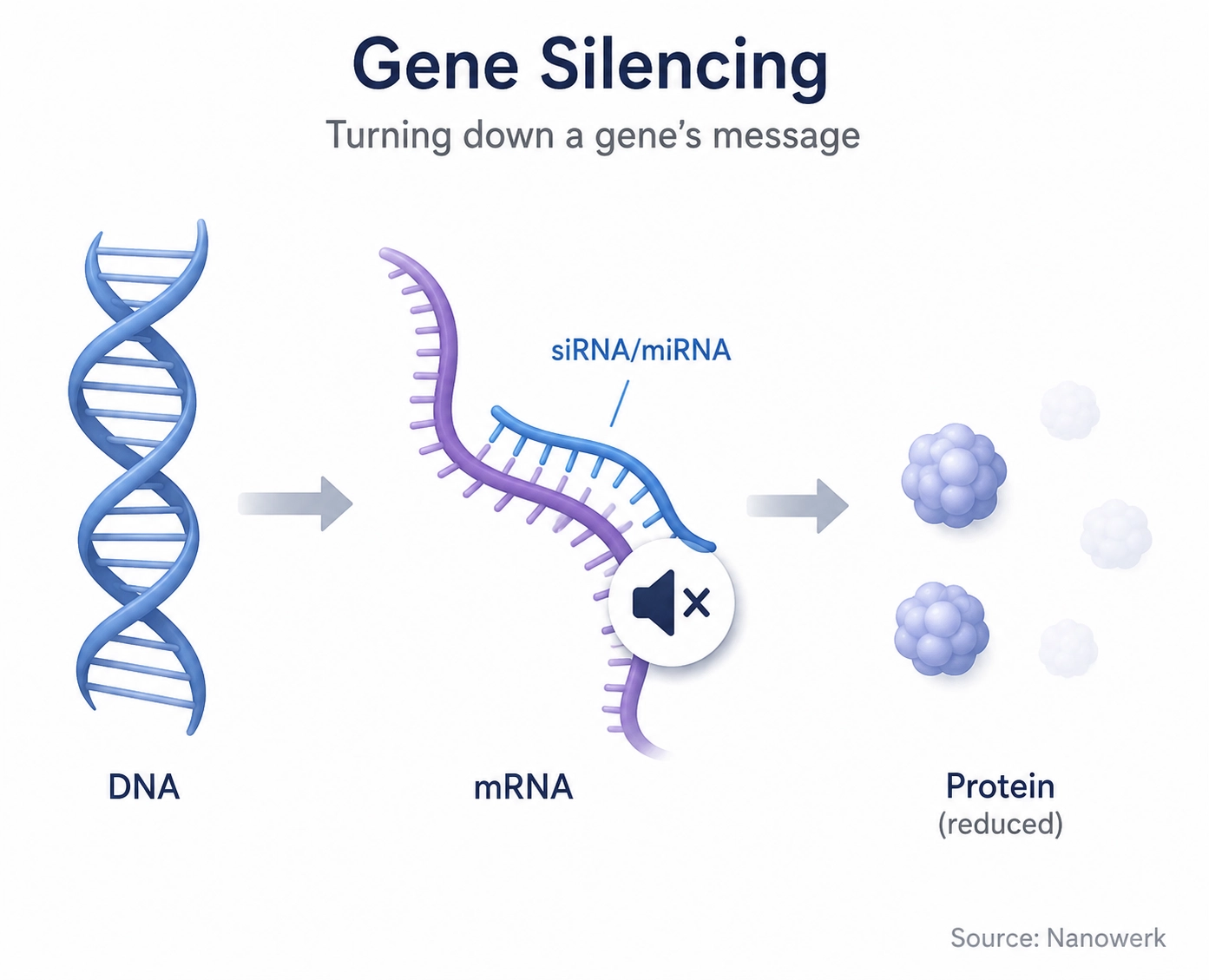
Definition: Gene silencing is the natural or engineered reduction or shutdown of a gene's activity without altering the underlying DNA sequence. Put simply, it turns down the volume of a gene rather than rewriting the gene itself. Silencing can work after a gene has been copied into messenger RNA, by destroying or blocking that RNA, or before copying begins, by switching the gene off through epigenetic marks on DNA or chromatin.
What Is Gene Silencing?
Gene silencing refers to any mechanism that turns down or switches off the expression of a specific gene so that less of its protein, or none at all, is produced. Crucially, the gene's DNA is left intact: silencing acts on the steps that read the gene out, not on the genetic code itself. This makes it fundamentally different from gene editing, which physically rewrites the sequence. Because the change is to activity rather than to the code, silencing is often reversible and can be tuned by dose.
Silencing is not only a laboratory technique. It is a natural part of how cells manage their genomes, used to keep viral sequences and mobile genetic elements in check, to switch developmental programs on and off, and to fine-tune how much of each protein a cell makes. Researchers learned to harness these same pathways deliberately, first to probe what individual genes do and, more recently, to build a class of medicines that lower the production of disease-causing proteins. The human genome contains roughly 20,000 protein-coding genes, and the ability to design a silencing trigger from sequence information alone is what makes the approach so powerful in both molecular biology and medicine. In practice, a target must be expressed, accessible, and reachable in the relevant tissue.
At a glance:
- Core idea: reduce or stop a gene's output without changing its DNA sequence
- Two main levels: post-transcriptional (destroy or block the mRNA) and transcriptional (switch the gene off via epigenetic marks)
- Signature pathway: RNA interference, in which a short double-stranded RNA guides cleavage of a matching mRNA
- Key tools and molecules: siRNA, microRNA, antisense oligonucleotides, shRNA, and CRISPR interference using dCas9
- Reversibility: usually reversible and dose-dependent, unlike permanent gene editing
- Clinical status: multiple RNA interference drugs approved by the US FDA since 2018, mostly for liver-expressed targets
The Two Levels of Gene Silencing
A gene becomes a protein in two broad stages: it is first copied into messenger RNA during transcription, and that messenger RNA is then read by a ribosome to build the protein during translation. Gene silencing can intervene at either stage, and the two strategies have different properties.
Post-transcriptional gene silencing lets the gene be transcribed but then destroys or blocks the messenger RNA so it never produces protein. RNA interference is the best-known example, but antisense oligonucleotides that trigger RNA degradation work on the same principle. Transcriptional gene silencing acts earlier, preventing the gene from being copied into RNA in the first place, typically by depositing repressive chemical marks on the DNA or its packaging proteins. This second route is the realm of epigenetics, and its effects can be inherited through cell divisions.
How Does RNA Interference Work?
RNA interference, or RNAi, is a central mechanism of post-transcriptional silencing and the basis of approved siRNA medicines. It is triggered by double-stranded RNA. In natural RNAi, an enzyme called Dicer chops long double-stranded RNA into short fragments about 21 to 23 nucleotides long, known as small interfering RNAs or siRNAs. One strand of each fragment, the guide strand, is loaded into a protein assembly called the RNA-induced silencing complex, or RISC, while the other strand is discarded.
The loaded RISC complex now carries a short RNA address. It scans the messenger RNA molecules in the cell and binds wherever it finds a sequence that exactly complements its guide. At the heart of RISC is a protein called Argonaute, which acts as a molecular blade: when the match is precise, Argonaute cuts the target messenger RNA, and the cell's machinery then degrades the broken pieces. With its messenger RNA destroyed, the gene can no longer be made into protein, even though the gene itself is untouched. Because RISC is released intact after each cut and can act again, a small amount of siRNA can silence a large pool of transcripts.
Cells run a closely related pathway using their own genome-encoded microRNAs. These are a class of non-coding RNA that match their targets only partially and therefore tune the output of many genes at once, usually by blocking translation and promoting messenger RNA decay rather than making a single clean cut. Synthetic siRNA, by contrast, is designed for near-perfect complementarity to a chosen transcript, making cleavage of that transcript the intended outcome. The discovery of this pathway by Andrew Fire and Craig Mello, working in the roundworm Caenorhabditis elegans, was recognized with the 2006 Nobel Prize in Physiology or Medicine.
Transcriptional Silencing and the Epigenome
The second route to a silent gene acts before any RNA is made. In transcriptional gene silencing, the cell marks a gene as off-limits by chemically modifying either the DNA or the histone proteins around which DNA is wound inside chromosomes. The most studied mark is DNA methylation, the addition of a methyl group to cytosine bases clustered at gene promoters. Dense methylation of a promoter generally recruits proteins that compact the local chromatin and exclude the transcription machinery, keeping the gene quiet.
These changes are part of the epigenome, the layer of heritable information that sits on top of the DNA sequence without changing it. Transcriptional silencing helps cells maintain specialized identities, supports X-chromosome inactivation in cells with two X chromosomes, and helps the genome suppress transposable elements. Unlike RNA interference, which fades when the trigger is removed, epigenetic silencing can be copied to daughter cells and persist for the life of a cell lineage, although it does not alter the genetic code and remains, in principle, reversible. This stability has made the engineered manipulation of these marks an active area of gene regulation research and a route toward durable gene silencing therapies.
How Gene Silencing Is Achieved in Practice
Several distinct technologies can silence a gene, and they differ in where they act, how they are delivered, and how durable the effect is. Synthetic siRNA exploits the RNAi pathway directly. Antisense oligonucleotides are short single-stranded DNA-like molecules that pair with a target messenger RNA and recruit an enzyme, RNase H, to degrade it, or simply block translation by physically obstructing the ribosome. Short hairpin RNAs are siRNA precursors encoded on a vector so cells make their own silencing trigger continuously. And CRISPR interference repurposes a catalytically dead version of the Cas9 protein, called dCas9, which retains the targeting ability of CRISPR-Cas9 but, instead of cutting, sits on a gene's promoter and blocks transcription.
The table below summarizes how these approaches compare. The non-obvious trade-off is that the most precise and potent method on paper is rarely the best choice in practice; the deciding factor is almost always whether the silencing molecule can be delivered to the right cells at an adequate dose and how long the effect needs to last.
| Approach | Where it acts | Mechanism | Durability | Typical use |
|---|---|---|---|---|
| siRNA (RNAi) | Cytoplasm, mRNA | RISC-guided cleavage of a near-perfectly matched mRNA | Transient; repeat dosing needed | Approved drugs, target validation |
| Antisense oligonucleotide | Nucleus or cytoplasm, RNA | RNase H degradation, steric block of translation, or splicing modulation | Usually reversible; duration depends on chemistry and tissue | Approved drugs, splicing modulation |
| Short hairpin RNA (shRNA) | Expressed from DNA; acts through RNAi on mRNA | Vector-expressed RNA hairpin processed into an RNAi trigger | Long-lasting while vector is expressed | Stable knockdown in research |
| CRISPR interference (dCas9) | DNA, promoter | dCas9 physically blocks transcription | Long-lasting while dCas9 is present | Functional genomics, screens |
| Epigenetic silencing | DNA or histones | Repressive methylation or chromatin marks | Potentially durable and heritable | Research, emerging durable therapies |
In research, RNAi and CRISPR interference are workhorses for figuring out what a gene does. By knocking down one gene at a time and observing the consequences, scientists infer its function, a strategy known as loss-of-function analysis. Pooled libraries of thousands of siRNAs or guide RNAs allow genome-wide screens that ask, in a single experiment, which genes a cell needs to survive, to resist a drug, or to become cancerous. These screens have become a standard part of the toolkit across biotechnology and drug discovery.
Gene Silencing as Medicine
The therapeutic appeal of gene silencing is straightforward: many diseases are driven by too much of a particular protein, and a silencing drug can be designed against that protein's gene from sequence information alone. This sidesteps the long search for a small molecule that fits a protein's surface and, in principle, makes targets that were considered undruggable accessible. Translating that promise into medicines took two decades of work, mostly on the problem of delivery, since naked RNA is rapidly degraded in the body and does not cross cell membranes on its own.
Two delivery strategies made the first wave of siRNA drugs practical, especially for liver targets. The first, used by patisiran, packages siRNA inside a lipid nanoparticle that carries it to liver cells. The second and now dominant approach chemically attaches the siRNA to a sugar called N-acetylgalactosamine, or GalNAc, which is recognized by a receptor on liver cells and ferries the cargo inside; this allows simple subcutaneous injection, sometimes only twice a year. As of May 2026, FDA-approved siRNA-based RNA therapy drugs include patisiran (the first, in 2018), givosiran, lumasiran, inclisiran, vutrisiran, nedosiran, fitusiran, and plozasiran. They treat hereditary transthyretin amyloidosis, acute hepatic porphyria, primary hyperoxaluria type 1, elevated LDL cholesterol, hemophilia A or B, and familial chylomicronemia syndrome. Most use GalNAc conjugation to reach liver cells, and several act by silencing genes such as PCSK9, antithrombin, or apolipoprotein C-III. Antisense oligonucleotide drugs that act by related RNA-silencing mechanisms have also reached the clinic, and the broader field overlaps with gene therapy.
Limitations and Safety Considerations
The dominant constraint is delivery. The reason almost every approved RNAi drug targets the liver is that the liver is, so far, the organ that can be reached reliably; extending silencing to the brain, lungs, kidneys, muscle, and tumors is the central problem the field is working on, and it depends on new targeting ligands and nanoparticle formulations. A silencing molecule that cannot reach its tissue is inert no matter how well designed.
Specificity is the second concern. A guide sequence can partially match unintended messenger RNAs and lower the wrong genes, an off-target effect that careful sequence design and chemical modification reduce but do not entirely eliminate. Double-stranded RNA can also be sensed by the innate immune system as a viral signature, provoking an inflammatory response; modern chemical modifications dampen this reaction substantially. Finally, because most silencing is transient, durable control of a chronic disease requires repeated dosing, which is one reason long-lasting epigenetic and vector-based strategies are being pursued. These are major engineering challenges, but the steady expansion of approved RNAi drugs shows that several are tractable, especially for liver-expressed targets.
Frequently Asked Questions
What is the difference between gene silencing and gene editing? Gene silencing reduces or shuts off the activity of a gene without changing the underlying DNA sequence, usually by destroying its messenger RNA or blocking its transcription. Gene editing permanently rewrites the DNA itself, for example by cutting and repairing it with CRISPR-Cas9. Silencing is typically reversible and dose-dependent, while editing is intended to be permanent.
Is gene silencing permanent? Usually not. RNA interference and antisense approaches lower a protein only as long as the silencing molecule is present, so repeat dosing is needed. Epigenetic silencing through DNA methylation or histone changes can persist through cell divisions and is sometimes effectively long-lasting, but it does not alter the genetic code and can in principle be reversed.
What are the FDA-approved gene silencing drugs? FDA-approved small interfering RNA drugs include patisiran, givosiran, lumasiran, inclisiran, vutrisiran, nedosiran, fitusiran, and plozasiran. Patisiran was the first, approved in 2018. These medicines treat conditions such as hereditary transthyretin amyloidosis, acute hepatic porphyria, primary hyperoxaluria type 1, high LDL cholesterol, hemophilia A or B, and familial chylomicronemia syndrome. Because approvals change, any fixed list should be checked before publication.
What is the difference between siRNA and miRNA in gene silencing? In research and medicine, small interfering RNA is usually supplied or expressed as a designed trigger and is chosen to match one target messenger RNA almost perfectly, leading to cleavage of that transcript as the intended outcome. MicroRNA is encoded by the genome, matches its targets only partially, and can dampen many different messenger RNAs at once. Both feed into the same RNA-induced silencing complex machinery.
Can gene silencing turn off any gene? In principle, a silencing molecule can be designed against many expressed genes once the target RNA sequence is known. In practice, success depends on whether the target transcript is accessible, whether the molecule avoids off-target effects, and whether it can be delivered to the relevant tissue at a sufficient dose. Most approved RNA interference drugs target the liver, where delivery is most efficient.
What is knockdown in gene silencing? Knockdown means reducing the expression of a gene rather than eliminating it completely. Many RNAi and antisense experiments produce partial knockdown, which can still reveal what a gene does or lower a harmful protein enough to treat disease.
Further Reading
Nature Reviews Drug Discovery, The Current State and Future Directions of RNAi-Based Therapeutics
Signal Transduction and Targeted Therapy, Therapeutic siRNA: State of the Art
Experimental & Molecular Medicine, Where Should siRNAs Go: Applicable Organs for siRNA Drugs
