

Cleantech and Environmental News – Latest Headlines
 Subscribe to our Cleantech News feed
Renewable - and continuous - electricity from solar energy
With EU funding of the project 'Thermochemical energy storage for concentrated solar power plants' (TCSPOWER), scientists are developing ways to store the Sun's thermal energy for electricity production during the night.
October 4, 2013 Read more
Multidimensional maps to improve energy efficiency
Researchers are developing a multidimensional mapping tool to identify areas of similar climate, building practices, technologies and economics. This will aid efforts to improve the energy and resource efficiency of the built environment.
October 4, 2013 Read more
Biochar in soils cuts greenhouse gas emissions
University of Tuebingen microbiologists show soil microbe communities can be influenced to decrease nitrous oxide emissions.
October 4, 2013 Read more
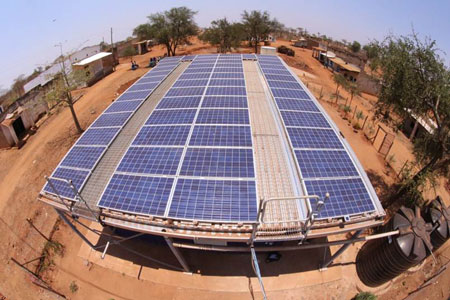
Bringing sustainable electricity to rural African communities
The aim of the project is to establish and implement replicable, off-grid electricity generation, based on a solar photovoltaic storage system, which promotes development in sub-Saharan Africa.
October 4, 2013 Read more

3D printing: The greener choice
New research shows that making stuff on a 3D printer uses less energy - and therefore releases less carbon dioxide - than producing it en masse in a factory and shipping it to a warehouse.
October 3, 2013 Read more
Energy Department to award $100 million for Energy Frontier Research Centers
U.S. Energy Secretary Ernest Moniz announced a proposed $100 million in FY2014 funding for Energy Frontier Research Centers to accelerate the scientific breakthroughs needed to build a new 21st-century energy economy. Research supported by this initiative will enable fundamental advances in energy production and use.
October 2, 2013 Read more
Carbon capture plant turns emissions into baking soda
The term 'carbon capture and storage' seems only to appear when shortly followed by 'not commercially proven' or 'in development'. But construction has now begun on what will be the world's first commercial carbon dioxide mineralisation plant, in which carbon dioxide greenhouse gas is transformed into baking soda.
October 2, 2013 Read more
Solving ethanol's corrosion problem may help speed the biofuel to market
To meet a goal set by the US Environmental Protection Agency's Renewable Fuels Standard to use 36 billion gallons of biofuels each year - mostly ethanol - the nation must expand its infrastructure for transporting and storing ethanol. Ethanol, however, is known for triggering stress corrosion cracking of steel. Researchers investigated the mechanism of how ethanol triggers stress corrosion cracking along with ways to circumvent this issue to prevent ethanol-related corrosion issues.
October 1, 2013 Read more
NREL releases new roadmap to reducing solar PV 'soft costs' by 2020
The National Renewable Energy Laboratory recently issued a new report, 'Non-Hardware ('Soft') Cost-Reduction Roadmap for Residential and Small Commercial Solar Photovoltaics, 2013'. The report builds off NREL's ongoing soft-cost benchmarking analysis and charts a path to achieve SunShot soft-cost targets of $0.65/W for residential systems and $0.44/W for commercial systems by 2020.
October 1, 2013 Read more

Predicting the life expectancy of solar modules
Solar modules are exposed to many environmental influences that cause material to fatigue over the years. Researchers have developed a procedure to calculate effects of these influences over the long term. This allows reliable lifespan predictions.
October 1, 2013 Read more
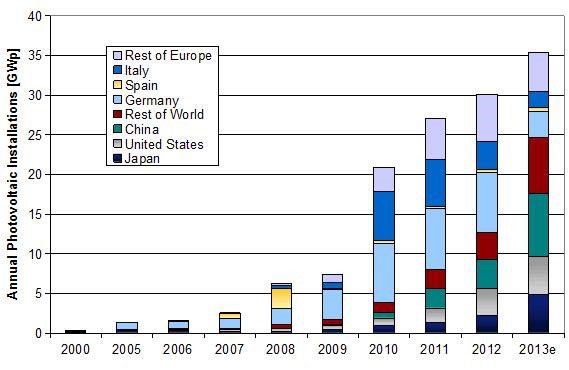
Solar cell production grows despite a crisis-driven decline in investment
Global production of photovoltaic cells grew by 10% in 2012 in comparison to 2011 despite a 9% decline in solar energy investments according to the annual 'PV Status Report' released by the European Commission's Joint Research Centre.
September 30, 2013 Read more

Precise remote sounding for better climate models
The water budget of the troposphere, the bottom layer of the Earth's atmosphere, determines the weather and plays a central role in climate change. The isotope composition of water vapor, i.e. the ratio of light and heavy water molecules, provides insight into underlying mechanisms. Climate researchers gather the data required by in-situ measurements as well as by using remote sounding instruments, e.g. on board of satellites. In a recent campaign, they combined both methods and proved the precision of remote sounding measurements for the first time.
September 30, 2013 Read more
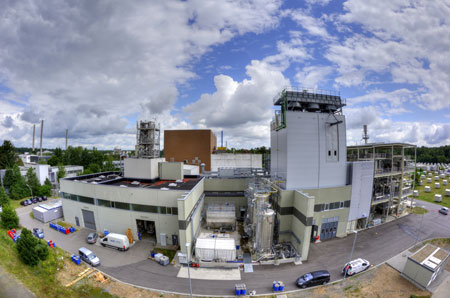
First gasoline produced by the bioliq biomass pilot plant
The synthesis stage of the bioliq pilot plant successfully started operation. Now, all stages of the bioliq process, i.e. flash pyrolysis, high-pressure entrained-flow gasification, and synthesis, have been realized. The project will now be completed by testing the entire process chain and optimizing it for the large industrial scale.
September 30, 2013 Read more
A novel technology to produce gasoline by a metabolically-engineered microorganism
A major scientific breakthrough in the development of renewable energy sources and other important chemicals; The research team succeeded in producing 580 mg of gasoline per liter of cultured broth by converting in vivo generated fatty acids.
September 29, 2013 Read more
Human influence on climate clear, new IPCC report says
Human influence on the climate system is clear. This is evident in most regions of the globe, a new assessment by the Intergovernmental Panel on Climate Change (IPCC) concludes.
September 27, 2013 Read more
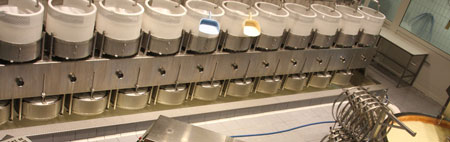
Hydrogen recovery and electricity production from recycled dairy wastewater
An innovative new way of treating dairy wastewater and whey could cut water and energy consumption dramatically, saving the food industry millions of euros.
September 26, 2013 Read more
Solar growth outpaces wind in 2013, for first time
New figures show contrast this year between strong growth in photovoltaic installations and sharp fall in new wind capacity added.
September 26, 2013 Read more

Can bacteria combat oil spill disasters?
Teams of international scientists have decrypted the effectiveness of two types of bacteria, which could be used in the future to help combat oil spill disasters.
September 26, 2013 Read more