

Cleantech and Environmental News – Latest Headlines
 Subscribe to our Cleantech News feed
Diamond catalyst shows promise in breaching age-old barrier
In the world, there are a lot of small molecules people would like to get rid of, or at least convert to something useful, according to University of Wisconsin-Madison chemist Robert J. Hamers.
June 30, 2013 Read more
Ultrasound to improve algae harvest
Scientists from the National Physical Laboratory (NPL) are using ultrasound to reduce the amount of energy needed to harvest microalgae.
June 28, 2013 Read more
Exotic alloys for potential energy applications
The search for thermoelectrics, exotic materials that convert heat directly into electricity, has received a boost from researchers at the California Institute of Technology and the University of Tokyo, who have found the best way to identify them.
June 27, 2013 Read more
First World Conference on Climate Impacts: Painting the big picture
For the first time ever, scientists and stakeholders from all over the world come together this week to have a look at the big impacts picture. They assemble at the 'Impacts World 2013' conference in Potsdam, Germany, aiming at developing a new scientific agenda to systematically address knowledge gaps and to start bridging them.
June 27, 2013 Read more
Power for seaports may be the next job for hydrogen fuel cells (w/video)
Providing auxiliary hydrogen power to docked or anchored ships may soon be added to the list of ways in which hydrogen fuel cells can provide efficient, emissions-free energy.
June 27, 2013 Read more
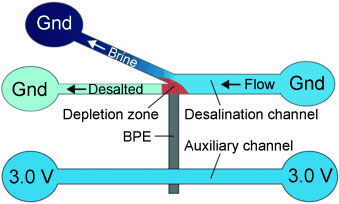
Membraneless seawater desalination in microfluidic systems
A new method for the desalination of sea water has been reported. In contrast to conventional methods, this technique consumes little energy and is very simple. This electrochemically mediated seawater desalination is based on a system of microchannels and a bipolar electrode.
June 27, 2013 Read more
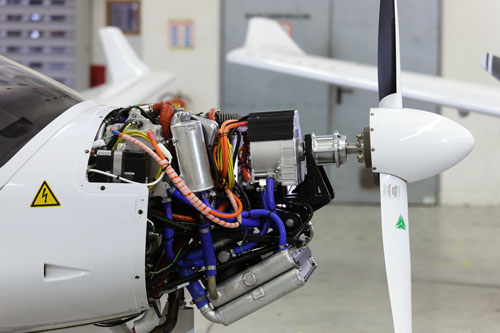
Electric hybrid drives for aircraft
The two-seat DA36 E-Star 2 plane recently made its one-hour maiden flight and was then presented to aeronautics experts at the Paris Air Show.
June 27, 2013 Read more
Big environmental footprints: 21 percent of homes account for 50 percent of greenhouse gas emissions
Energy conservation in a small number of households could go a long way to reducing greenhouse gas emissions, scientists are reporting.
June 27, 2013 Read more
Renewables to surpass gas by 2016 in the global power mix
IEA report sees renewable power increasingly cost-competitive with new fossil-fuel generation, but agency warns against complacency.
June 26, 2013 Read more
Major rethink needed if chemical industry is to meet greenhouse gas targets
The UK chemical industry requires 'an urgent and radical rethink' into how it produces chemicals if it is to play its part in meeting Government's stringent greenhouse gas emission reduction targets of 80% plus by 2050.
June 26, 2013 Read more
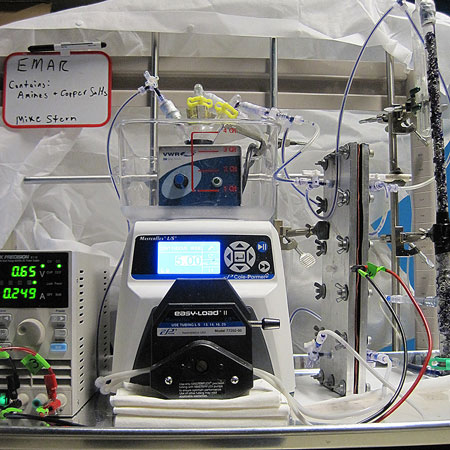
Getting the carbon out of emissions
Proposed method could be more efficient than previous systems and easier to retrofit in existing power plants.
June 25, 2013 Read more
Engineered E. coli mass-produce key precursor to potent biofuel
New lines of engineered bacteria can tailor-make key precursors of high-octane biofuels that could one day replace gasoline.
June 25, 2013 Read more

Policy issues plague hydropower as wind power backup
Theoretically, hydropower can step in when wind turbines go still, but barriers to this non-polluting resource serving as a backup are largely policy- and regulation-based, according to Penn State researchers.
June 25, 2013 Read more
NREL reports 31.1 percent efficiency for III-V solar cell
Conversion-efficiency mark is a world record for a 2-junction solar cell measured under 1-sun illumination.
June 25, 2013 Read more
Using crowdsourced supercomputer, Harvard rates solar energy potential of 2.3 million new compounds
The search for more versatile and less expensive materials for solar energy received a boost today as Harvard launched a free database that catalogues the suitability of 2.3 million organic, carbon compounds for converting sunlight into electricity.
June 24, 2013 Read more
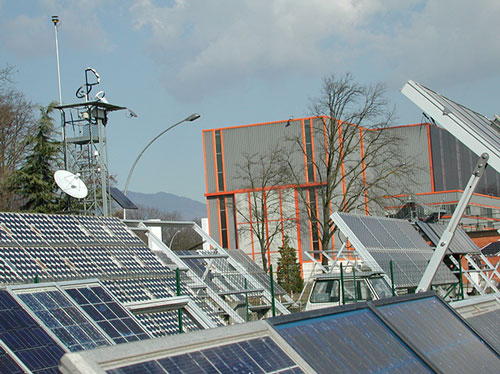
New research facilities to support solar technologies in the EU
A EUR 3 million investment in new state-of-the art technologies will allow the European Solar Test Installation to keep pace with the rapidly evolving photovoltaics market and be able to address forthcoming standardisation issues.
June 24, 2013 Read more
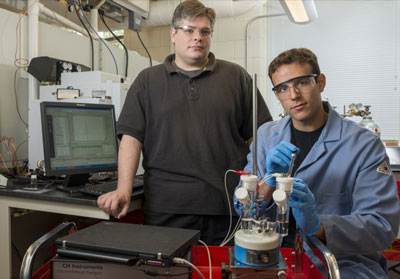
A cheaper drive to 'cool' fuels
Researchers have developed an inexpensive catalyst that uses the electricity generated from solar energy to convert carbon dioxide into synthetic fuels.
June 21, 2013 Read more

Uncovering quantum secret in photosynthesis
Scientists have been able to show for the first time at ambient conditions that the quantum mechanisms of energy transfer make phyotosynthesis more robust in the face of environmental influences. The quantum phenomenon responsible, known as coherence, is manifested in so-called photosynthetic antenna proteins that are responsible for absorption of sunlight and energy transport to the photochemical reaction centers of photosynthesis.
June 20, 2013 Read more