

Nanotechnology News – Latest Headlines
Researchers apply NMR/MRI to microfluidic chromatography
By pairing an award-winning remote-detection version of NMR/MRI technology with a unique version of chromatography specifically designed for microfluidic chips, researchers with the U.S. Department of Energy's Lawrence Berkeley National Laboratory have opened the door to a portable system for highly sensitive multi-dimensional chemical analysis that would be impractical if not impossible with conventional technologies.
July 6, 2011 Read more
Cooler than ever: Mechanical micro-drum chilled to quantum ground state
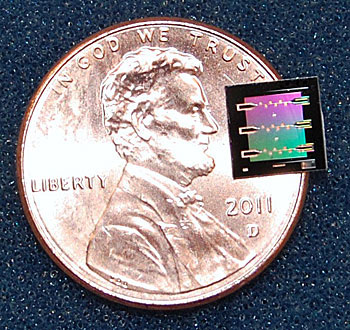
Showcasing new tools for widespread development of quantum circuits made of mechanical parts, scientists from the National Institute of Standards and Technology (NIST) have demonstrated a flexible, broadly usable technique for steadily calming the vibrations of an engineered mechanical object down to the quantum 'ground state', the lowest possible energy level.
July 6, 2011 Read more
Nanotechnology detector for deadly anthrax
An automatic and portable detector that takes just fifteen minutes to analyze a sample suspected of contamination with anthrax is being developed by US researchers. The technology amplifies any anthrax DNA present in the sample and can reveal the presence of just 40 microscopic cells of the deadly bacteria Bacillus anthracis.
July 6, 2011 Read more
Unique gel capsule structure enables co-delivery of different types of drugs
Researchers at the Georgia Institute of Technology have designed a multiple-compartment gel capsule that could be used to simultaneously deliver drugs of different types. The researchers used a simple "one-pot" method to prepare the hydrogel capsules, which measure less than one micron.
July 6, 2011 Read more
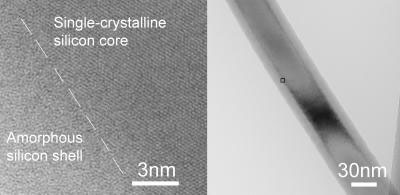
With a simple coating, nanowires show a dramatic increase in efficiency and sensitivity
Development holds promise for photodetectors and energy harvesting applications like solar cells.
July 6, 2011 Read more
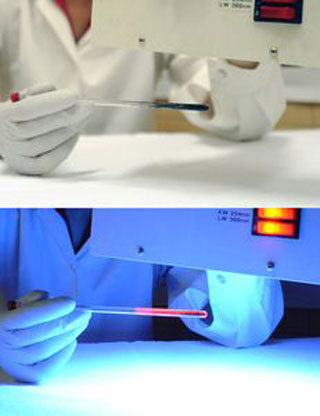
Red light from carbon nanotubes
To the human eye, carbon nanotubes usually appear as a black powder. They can hardly be forced to emit light, as they are excellent electrical conductors and capture the energy from other luminescent chemical species placed nearby. The researchers from the Institute of Physical Chemistry of the Polish Academy of Sciences in Warsaw contributed recently to the development of a relatively simple method allowing the nanotubes exposed to UV to emit red light.
July 6, 2011 Read more
Just add water to these nanoparticles and treat brain cancer
Freeze-dried gene therapy system avoids virus, potential complications.
July 6, 2011 Read more
The forces of attraction - how cells change direction
Many cell types in higher organisms are capable of implementing directed motion in response to the presence of certain chemical attractants in their vicinity. A team at the Center for NanoScience (CeNS) at Ludwig-Maximilians-Universitaet (LMU) Muenchen has developed a novel technique to expose an ensemble of living cells to rapidly varying concentrations of chemoattractants.
July 6, 2011 Read more
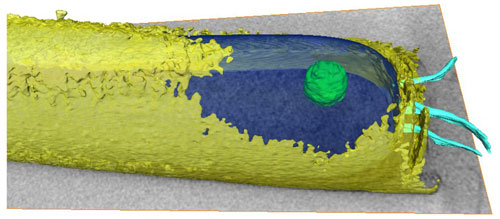
Old life capable of revealing new tricks after all
Energy-storage capacity of ancient microorganism could lead to power source for synthetic cells.
July 6, 2011 Read more
Funding opportunity: Research and demonstration of innovative drinking water treatment technologies in small systems
The U.S. Environmental Protection Agency (EPA), as part of its Science to Achieve Results (STAR) program, is seeking applications proposing to conduct research necessary to identify, develop and demonstrate novel and innovative treatment technologies and approaches for small public drinking water systems.
July 6, 2011 Read more
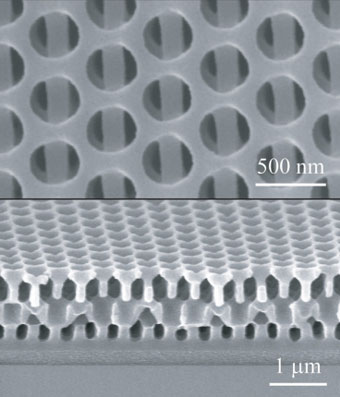
A new way to build nanostructures
The making of three-dimensional nanostructured materials - ones that have distinctive shapes and structures at scales of a few billionths of a meter - has become a fertile area of research, producing materials that are useful for electronics, photonics, phononics and biomedical devices. But the methods of making such materials have been limited in the 3-D complexity they can produce. Now, an MIT team has found a way to produce more complicated structures by using a blend of current "top-down" and "bottom-up" approaches.
July 6, 2011 Read more

The 2011 Koerber European Science Prize goes to Stefan Hell
Prof. Dr. Dr. h. c. Stefan Hell of the Max Planck Institute for Biophysical Chemistry in Goettingen is to receive the 2011 Koerber European Science Prize endowed with 750,000 euros for his pioneering discoveries in the field of optics.
July 6, 2011 Read more
New microsystem for better drug-testing
A University of Southampton nanoscientist is working on a new microsystem for more efficient testing of pharmaceutical drugs to treat diseases such as cystic fibrosis, MG (myasthenia gravis) and epilepsy.
July 6, 2011 Read more
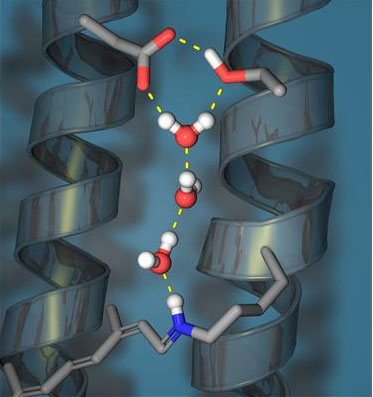
Extremely rapid water: Scientists decipher a protein-bound water chain
Researchers from the Ruhr-Universitaet-Bochum (RUB) Department of Biophysics of Prof. Dr. Klaus Gerwert have succeeded in providing evidence that a protein is capable of creating a water molecule chain for a few milliseconds for the directed proton transfer. The combination of vibrational spectroscopy and biomolecular simulations enabled the elucidation of the proton pump mechanism of a cell-membrane protein in atomic detail. The researchers demonstrated that protein-bound water molecules play a decisive role in the function.
July 6, 2011 Read more
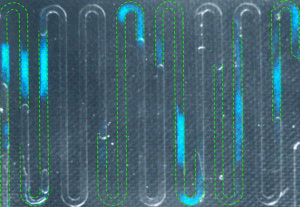
Microfluidics: Bubble chemistry
The intense energy released by collapsing bubbles in a microfluidic chip could help speed up chemical reactions.
July 6, 2011 Read more
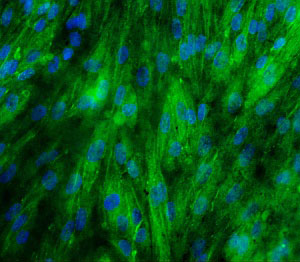
Suitable materials for making bioreactors inside a bioartificial kidney
A research team led by Daniele Zink and Jackie Y. Ying at the A*STAR Institute of Bioengineering and Nanotechnology has now developed membrane materials and coatings that are suitable for human proximal tubule cells growth and differentiation by modifying the surface of established materials and synthesizing novel materials.
July 6, 2011 Read more
 Subscribe to our Nanotechnology News feed