

Nanotechnology News – Latest Headlines
Different approaches to increase the storage capacity of flash memories
There is a big demand for flash memories that can store even more data. However, it is now necessary to use new materials and technologies to improve flash memories and researchers worldwide are trying different approaches to achieve this aim. The project REALISE has developed a material and a processing technique now ready for industrial application.
March 24, 2011 Read more
Electro-osmotic pump simplifies home diagnostics
Researchers in Sweden have invented an improved pump, called an electroosmotic pump, which can be placed in a "microfluidic chip". Such chips, sometimes called "lab-on-a-chip" devices, contain miniaturized versions of the beakers and test tubes found in chemistry laboratories interconnected by tiny pipes. Rather than using moving parts, the new pump moves fluids in these pipes via an electric current. The fluids to be pumped can be biological samples such as blood, urine or saliva for medical devices.
March 24, 2011 Read more
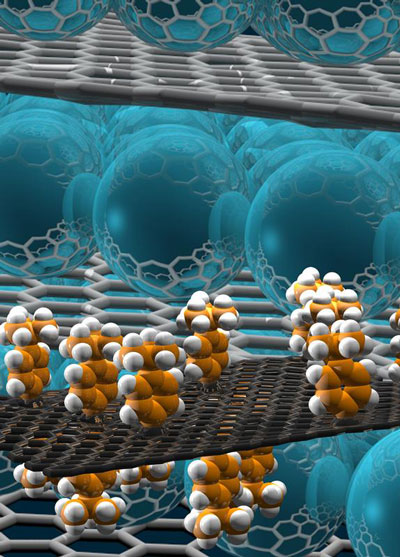
Neues Verfahren erlaubt Graphen-Produktion in grossen Mengen
Forschern ist es gelungen, ohne mechanische Einwirkung isolierte Graphenschichten herzustellen und diese in nur einem weiteren Schritt mit massgeschneiderten Eigenschaften auszustatten.
March 24, 2011 Read more
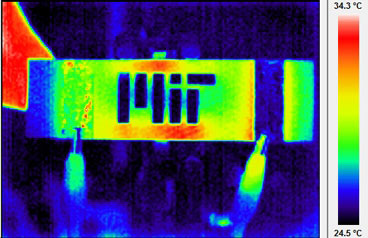
Seeing below the surface
Engineers devise a new way to inspect advanced materials used to build airplanes.
March 24, 2011 Read more
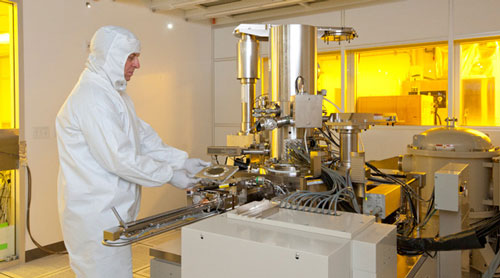
New Stanford Nano Center provides state-of-the-art equipment
Stanford has significantly upgraded its nanotechnology research with a new Nano Center, providing faculty with some of the world's best nanoscale research facilities.
March 24, 2011 Read more
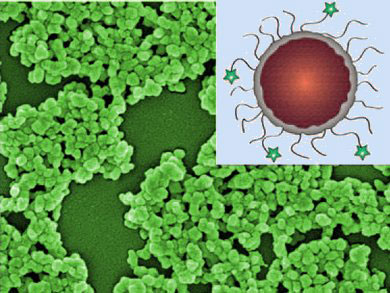
Contrast agent for tumor diagnostics
Scientists have introduced a novel contrast agent that marks tumor cells in vitro. The dye is a phosphorescent ruthenium complex incorporated into nanoparticles of a metal-organic coordination polymer, which allows an extraordinarily high level of dye loading.
March 23, 2011 Read more
Novel, highly sensitive sensor spots three modes of selectivity
A highly sensitive sensor that combines a variety of testing means (electrochemistry, spectroscopy and selective partitioning) into one device has been developed at the University of Cincinnati. It's already been tested in a variety of settings - including testing for components in nuclear waste.
March 23, 2011 Read more
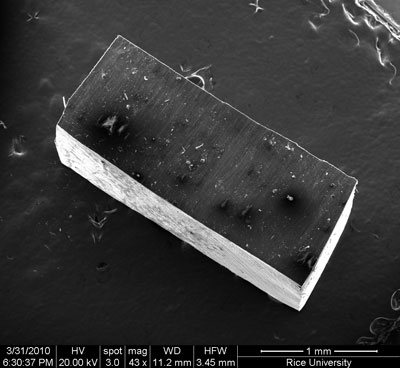
Self-strengthening nanocomposite gets stronger from repeated stress
Researchers at Rice University have created a synthetic material that gets stronger from repeated stress much like the body strengthens bones and muscles after repeated workouts.
March 23, 2011 Read more
Chemist develops technique to use light to predict molecular crystal structures
A Syracuse University chemist has developed a way to use very low frequency light waves to study the weak forces (London dispersion forces) that hold molecules together in a crystal. This fundamental research could be applied to solve critical problems in drug research, manufacturing and quality control.
March 23, 2011 Read more
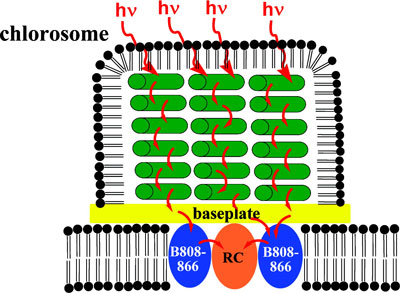
Neutron analysis yields insight into bacteria for solar energy
Structural studies of some of nature's most efficient light-harvesting systems are lighting the way for new generations of biologically inspired solar cell devices. Researchers from Washington University in St. Louis and the Department of Energy's Oak Ridge National Laboratory used small-angle neutron scattering to analyze the structure of chlorosomes in green photosynthetic bacteria.
March 23, 2011 Read more
Forum to promote creating jobs through nanotechnology innovation
Building on the success of the past two years, the N.C. Office of Science and Technology will host the 2011 N.C. Nanotechnology Commercialization Conference at the UNC Charlotte Barnhardt Student Center on March 29-30. The third annual conference brings together entrepreneurs, business leaders, researchers, and investors to accelerate the commercialization of nanotechnology and drive economic development.
March 23, 2011 Read more
Sticking power: new adhesive earns patent, could find place in space
A recently patented adhesive made by Kansas State University researchers could become a staple in every astronaut's toolbox. The patent, "pH dependent adhesive peptides", covers an adhesive made from peptides -- a compound containing two or more amino acids that link together -- that increases in strength as moisture is removed.
March 23, 2011 Read more
Genes mimic Facebook workings
Scientists at the European Molecular Biology Laboratory (EMBL) and the German Cancer Research Centre (DKFZ) in Heidelberg in Germany have developed a method to uncover the combined effects of genes. The method should help scientists understand how different genes can amplify, cancel out or mask the effects of each other.
March 23, 2011 Read more
Singularity University looks at impact of technology on the future of health and biomedicine
FutureMed, an executive program for physicians, healthcare executives, innovators and investors focused on exploring the impact of rapidly developing technologies on the future of health and biomedicine, is being held May 10-15 at Singularity University on the NASA-Ames Research Park in Silicon Valley.
March 22, 2011 Read more
National Biophotonic Sensors and Systems Center announced
The new Center for Biophotonic Sensors and Systems (CBSS) is one of 50 such cooperative research center awards across the country and the only center focused on biophotonic sensors.
March 22, 2011 Read more
Team adds more give for stronger self-healing nanogel materials
A Pitt and Carnegie Mellon team developed a new model of how self-repairing materials function and show that materials with a certain number of easily breakable bonds can absorb more stress, a natural trick found in the resilient abalone shell.
March 22, 2011 Read more
 Subscribe to our Nanotechnology News feed