

Nanotechnology News – Latest Headlines
Erster Aalener Photoniktag
Hochschuluebergreifender Photonik-Verbund erschliesst neue Anwendungsfelder.
April 9, 2009 Read more
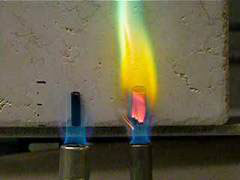
Nanotechnology experiments could lead to more spectacular firework displays
Recent experiments to create a fast-reacting explosive by concocting it at the nanoscopic level could result in more spectacular firework displays. But more impressively, the method used to mix chemicals at that tiny scale could lead to new strong porous materials for high temperature applications, from thermal insulation in jet engines to industrial chemical reactors.
April 8, 2009 Read more
$6 million funding towards developing self-healing circuits
One novel way around the problem of failing computer chips is a so-called 'self-healing' circuit - one that can detect, isolate, and fix its own flaws, both by working around the defective transistors by modifying the properties of the rest of the system and introducing additional transistors into the system in a seamless fashion.
April 8, 2009 Read more
DNA origami seeds to direct bottom-up fabrication processes
Researchers at Caltech describe the development of an information-containing DNA 'seed' that can direct the self-assembled bottom-up growth of tiles of DNA in a precisely controlled fashion
April 8, 2009 Read more
Nanotechnology seen boosting recovery factors in oil and gas exploration
Nanotechnology might someday boost the average global recovery factor of oil and gas by 10 percentage points, said an oil company executive at the RMI Oilfield Breakfast Forum in Houston.
April 8, 2009 Read more
Ancient life form leads to one of newest technologies for solar energy
Engineers at Oregon State University have discovered a way to use an ancient life form to create one of the newest technologies for solar energy, in systems that may be surprisingly simple to build compared to existing silicon-based solar cells.
April 8, 2009 Read more
Carbon nanotube polymer nanocomposites for field emission cathodes
A collaboration between researchers at the University of Surrey's Advanced Technology Institute (ATI) and the School of Physics at Trinity College Dublin have discovered that you can produce a composite of carbon nanotubes embedded in a polymer that gives outstanding performance as an electron emitter material.
April 8, 2009 Read more
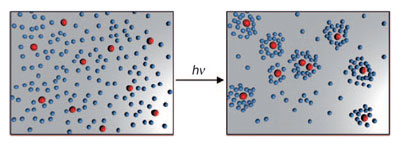
Silver chloride microparticles act as light-driven micromotors that organize into swarms
Researchers led by Ayusman Sen at Pennsylvania State University have introduced silver chloride microparticles that can 'swarm' together, almost like living single-celled organisms.
April 8, 2009 Read more
Bionanotechnology leads to revolution of cell biology at single molecule level
Progress in bionanotechnology is essential for our understanding of cells and for the development of new therapeutics, which nowadays increasingly function at the molecular level. This was one of the statements made by Prof. Nynke Dekker on Wednesday 8 April during her inaugural address at TU Delft, the Netherlands.
April 8, 2009 Read more

Quantum computers will require complex software to manage errors
Highlighting another challenge to the development of quantum computers, theorists at the National Institute of Standards and Technology (NIST) have shown that a type of software operation, proposed as a solution to fundamental problems with the computers? hardware, will not function as some designers had hoped.
April 8, 2009 Read more
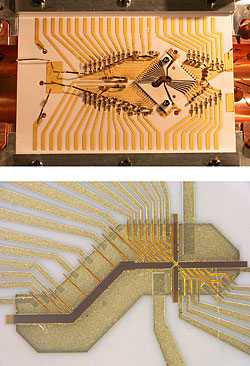
X marks the spot: ions coldly go through trap junction
Physicists at the National Institute of Standards and Technology (NIST) have demonstrated a new ion trap that enables ions to go through an intersection while keeping their cool.
April 8, 2009 Read more
Nanoscale changes rise to macro importance in a key electronics material
By combining the results of a number of powerful techniques for studying material structure at the nanoscale, a team of researchers from the National Institute of Standards and Technology (NIST), working with colleagues in other federal labs and abroad, believe they have settled a long-standing debate over the source of the unique electronic properties of a material with potentially great importance for wireless communications.
April 8, 2009 Read more
Low-cost nanotechnology for disposable blood tests
Nanotechnology is being used by academics at the University of Southampton to develop low-cost, disposable blood-testing kits that can be made available in GPs' surgeries.
April 8, 2009 Read more
Pittcon 2009 reports increased attendance
Pittcon 2009 reported today that 19,018 attendees from 90 countries participated in the annual Conference and Exposition, which was held in Chicago, Illinois, from March 8 to March 13. The scientific event was marked by a 6% increase in conferees over Pittcon 2008.
April 8, 2009 Read more
Nanotechnology research points way toward chameleon-like camouflage
Certain fish species blend with their environment by changing color like chameleons. In two recent papers, Sandia researchers have demonstrated that, in theory, they could produce a similar color change to enable synthetic or hybrid materials to change color like fish do.
April 8, 2009 Read more
Nanoscale magnetic vortex switch leads to electric pulse
Researchers at the University of Arkansas have shown that changing the chirality, or direction of spin, of a nanoscale magnetic vortex creates an electric pulse, suggesting that such a pulse might be of use in creating computer memory and writing information.
April 8, 2009 Read more
 Subscribe to our Nanotechnology News feed