

Space Exploration News – Latest Headlines
 Subscribe to our Space Exploration News feed
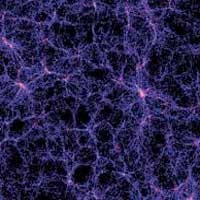
Placing another piece in the dark matter puzzle
PRISMA+ and HIM scientists report the latest findings of the CASPEr research program.
October 29, 2019 Read more
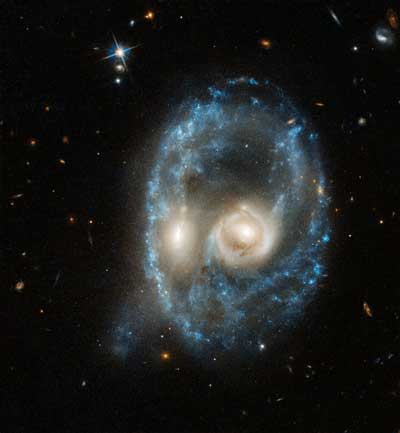
In celebration of Halloween, Hubble captures ghostly cosmic face
In celebration of Halloween, this new image from the NASA/ESA Hubble Space Telescope captures two galaxies of equal size in a collision that appears to resemble a ghostly face.
October 28, 2019 Read more
A flash and a shudder
New findings detail a method for investigating the inner workings of stars in a rare phase.
October 28, 2019 Read more
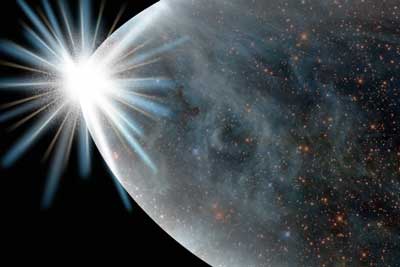
Putting the 'bang' in the Big Bang
Physicists simulate critical 'reheating' period that kickstarted the Big Bang in the universe's first fractions of a second.
October 25, 2019 Read more
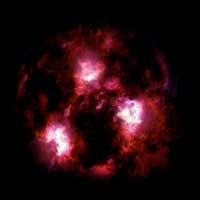
Cosmic Yeti from the dawn of the universe found lurking in dust
Astronomers accidentally discovered a monstrous galaxy from the dawn of the universe; hidden in dust, the 'cosmic Yeti' may be the missing link to a population of galaxies waiting to be discovered.
October 22, 2019 Read more

Gravity crystals: A new method for exploring the physics of white dwarf stars
Scientists study how charged particles arrange themselves into crystalline patterns and apply what they learn to explore the interiors of white dwarf stars.
October 21, 2019 Read more
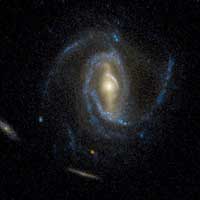
Super spirals spin super fast
Dark matter tugs the most massive spiral galaxies to breakneck speeds.
October 17, 2019 Read more

Tracing interstellar dust back to the solar system's formation
Interplanetary particles from Earth's upper atmosphere contain dust from the initial formation of the solar system. The exotic grains may represent the building blocks of planets from 4.6 billion years ago. Analysis of these materials makes it possible to gain deeper insights into the processes that formed and altered our solar system.
October 16, 2019 Read more
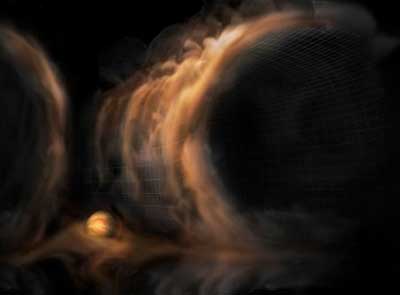
Gas 'waterfalls' reveal infant planets around young star
The birthplaces of planets are disks made out of gas and dust. Astronomers study these so-called protoplanetary disks to understand the processes of planet formation. Beautiful images of these disks show distinct gaps and ring features in dust, which may be caused by infant planets.
October 16, 2019 Read more
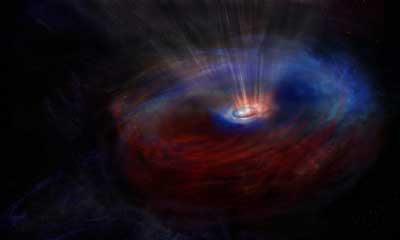
Going against the flow around a supermassive black hole
Astronomers made an unexpected discovery that could explain why supermassive black holes grew so rapidly in the early Universe.
October 15, 2019 Read more
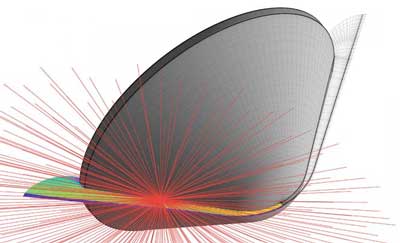
Analysis of Galileo's Jupiter entry probe reveals gaps in heat shield modeling
Data from the probe's 1995 fireball has continued to confound those studying the mission. New simulations and faster computers point to bettering atmospheric entry vehicles.
October 15, 2019 Read more
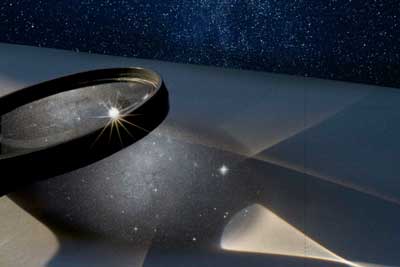
Astronomers use giant galaxy cluster as X-ray magnifying lens
New lens technique spots tiny dwarf galaxy in the first, super-energetic stages of star formation.
October 14, 2019 Read more
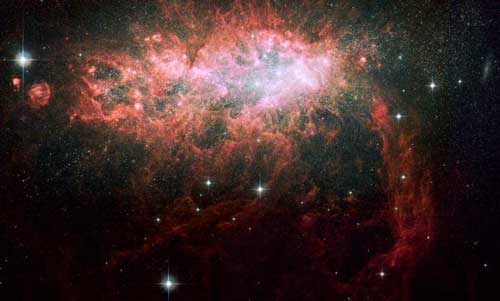
Black holes stunt growth of dwarf galaxies
Astronomers find large-scale winds associated with active black holes in small galaxies suppress star formation.
October 14, 2019 Read more
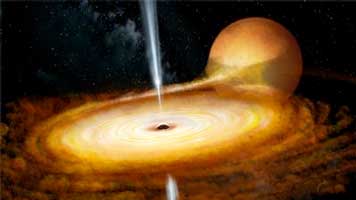
Violent flaring revealed at the heart of a black hole system
An international team of astronomers have used state-of-the-art cameras to create a high frame-rate movie of a growing black hole system at a level of detail never seen before. In the process they uncovered new clues to understanding the immediate surroundings of these enigmatic objects.
October 11, 2019 Read more
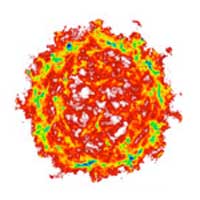
Clumpy structure in remnant probably formed in supernova explosion itself
Application of a new statistic to x-ray images of a supernova remnant suggests that clumps were formed during the explosion.
October 11, 2019 Read more
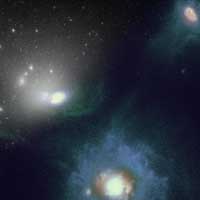
The Milky Way kidnapped several tiny galaxies from its neighbor
Research shows our galaxy is undergoing a massive merger with its largest satellite galaxy, the Large Magellanic Cloud.
October 10, 2019 Read more
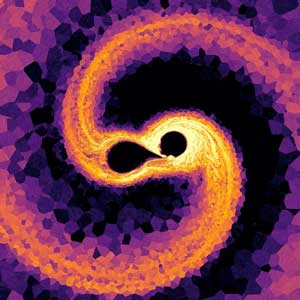
How do the strongest magnets in the universe form?
A team of astrophysicists has found a possible answer to the question of how magnetars form.
October 9, 2019 Read more
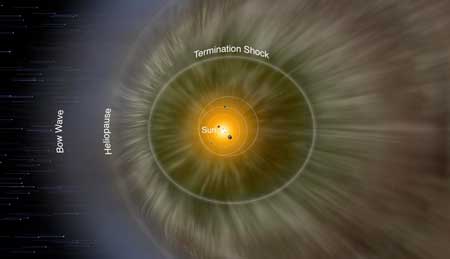
Pressure runs high at edge of solar system
Out at the boundary of our solar system, pressure runs high. This pressure, the force plasma, magnetic fields and particles like ions, cosmic rays and electrons exert on one another when they flow and collide, was recently measured by scientists in totality for the first time - and it was found to be greater than expected.
October 8, 2019 Read more