Nanobiotechnology: Definition, Methods, and Applications
What is Nanobiotechnology?
Nanobiotechnology is the interdisciplinary field that applies tools, materials, and methods from nanotechnology to study, mimic, and engineer biological systems, ranging from single biomolecules to whole organisms.
In simple terms, nanobiotechnology uses very small engineered structures to measure, carry, build, or control biological molecules and cells.
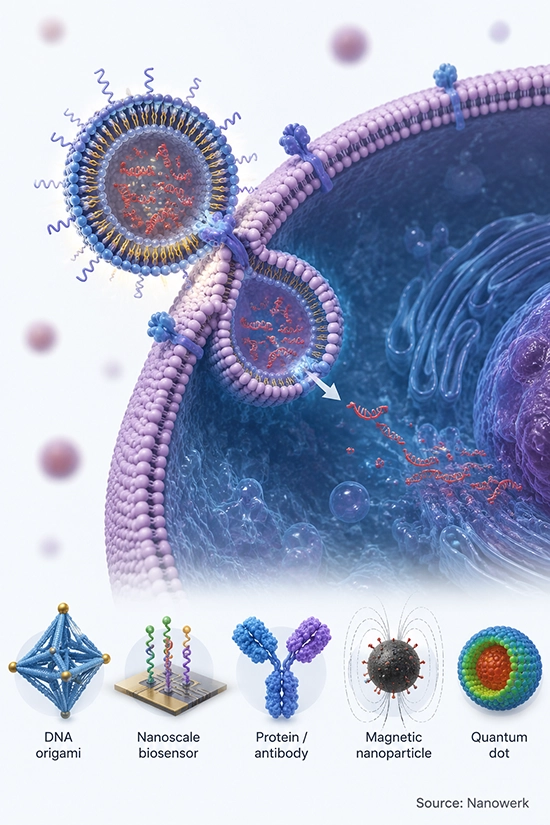
In practice, nanobiotechnology operates in two directions. The first uses engineered nanomaterials – nanoparticles, nanofibers, nano-patterned surfaces, and nanoscale devices – to deliver drugs, detect biomolecules, image tissues, or interface with cells. The second uses biological building blocks such as DNA, proteins, peptides, and lipids to assemble functional nanostructures. Both directions are usually grouped under the same umbrella, and many projects now combine them. A deeper, applications-focused overview is available on the main Nanowerk page on nanobiotechnology.
Biology is naturally nanoscale. A DNA double helix is about 2 nanometers wide, a typical globular protein measures 3–10 nm, an antibody is roughly 10 nm across, a ribosome is about 25 nm, and a small enveloped virus such as influenza is around 100 nm. Because nanomaterials share these dimensions, they can interact with biological structures in ways that micrometer- or millimeter-scale tools cannot. The clearest demonstration of impact came during the COVID-19 pandemic, when lipid nanoparticles were used to deliver billions of doses of mRNA vaccines worldwide, one of the largest and most visible clinical deployments of engineered nanomaterials to date.
Key takeaways:
- Nanobiotechnology applies nanoscale materials and devices to biological and medical problems, and also uses biological molecules to build new nanostructures.
- It overlaps with but is broader than nanomedicine, which focuses on clinical applications.
- Core building blocks include liposomes, lipid and polymeric nanoparticles, dendrimers, gold and magnetic nanoparticles, quantum dots, and DNA and protein nanostructures.
- Major application areas include drug delivery, vaccines, diagnostics, biosensing, in vivo imaging, gene and cell therapy, and tissue engineering.
- Translation depends on controlling biodistribution, immune response, manufacturing reproducibility, and long-term safety.
Bionanotechnology and Nanobiotechnology: A Working Distinction
The terms nanobiotechnology and bionanotechnology are often used interchangeably, but many authors draw a useful working distinction. Nanobiotechnology usually emphasizes the application of engineered nanomaterials and nanofabrication to biological or medical problems, for example a polymer nanoparticle that carries a chemotherapy drug. Bionanotechnology emphasizes the use of biological molecules – nucleic acids, peptides, lipids, motor proteins – as building blocks for nanoscale structures and devices. DNA origami, which folds a long single strand of DNA into custom shapes through base-pairing, is a canonical example of the second direction.
In practice the boundary is blurred, since engineered carriers almost always combine synthetic and biological components, and most working scientists do not police the terminology strictly. The distinction is useful mainly when reading the literature: a paper titled with one term is often signaling which side of the field it sits on.
Nanobiotechnology does not mean that every biological molecule is a nanotechnology product. The term is usually reserved for cases where nanoscale engineering, characterization, or design is central to the function, such as a nanoparticle carrier, a DNA origami structure, a nanostructured biosensor, or a nano-patterned surface that controls cell behavior.
Core Nanomaterials Used in Nanobiotechnology
Most nanobiotechnology applications rely on a relatively small set of nanomaterial families. Each has a distinct set of properties that determine which problems it can address, and most clinical and commercial products are based on one of these.
| Material class | Typical role in nanobiotechnology |
|---|---|
| Liposomes and lipid nanoparticles | Drug, RNA, and vaccine delivery |
| Polymeric nanoparticles and dendrimers | Controlled release, tunable carriers, imaging-agent loading |
| Gold nanoparticles | Colorimetric diagnostics, labeling, and photothermal concepts |
| Magnetic nanoparticles | MRI contrast, magnetic separation, hyperthermia, and iron replacement |
| Quantum dots | Fluorescent imaging and multiplexed labeling |
| DNA, protein, and biologically derived nanostructures | Programmable assembly, scaffolding, cargo organization, and biomimetic delivery |
Liposomes and lipid nanoparticles
Liposomes are small vesicles made of one or more phospholipid bilayers enclosing an aqueous core. They have been used clinically since the mid-1990s, most famously in the liposomal doxorubicin product Doxil. Lipid nanoparticles are a more recent and structurally distinct class. They typically contain an ionizable lipid that becomes positively charged in the acidic environment of an endosome, helping to release nucleic acid cargo into the cytoplasm. Lipid nanoparticles are now the dominant carrier for mRNA vaccines and for the small interfering RNA therapeutic patisiran (Onpattro), the first approved siRNA drug.
Polymeric and dendritic nanoparticles
Polymeric nanoparticles, often based on poly(lactic-co-glycolic acid) (PLGA), polycaprolactone, or polyethylene glycol copolymers, give designers fine control over size, surface chemistry, drug-release rate, and biodegradation. Dendrimers are branched, tree-like polymers with a precise number of terminal groups, which makes them useful as carriers when stoichiometric loading of a drug or imaging agent matters.
Gold, magnetic, and inorganic nanoparticles
Gold nanoparticles have a strong surface plasmon resonance that produces an intense color change on aggregation, the basis of the red line in many lateral-flow diagnostic strips, including home pregnancy and rapid antigen tests. Magnetic nanoparticles, usually iron oxides, are used as MRI contrast agents, in magnetic cell separation, in localized hyperthermia, and as iron-replacement therapeutics. Silica, calcium phosphate, and metal oxide nanoparticles are widely studied for vaccine adjuvants, controlled release, and bone regeneration.
Quantum dots and fluorescent nanostructures
Quantum dots are semiconductor nanocrystals whose emission color is tuned by particle size through quantum confinement. They are far brighter and more photostable than conventional organic dyes, which makes them attractive for multiplexed labeling, live-cell tracking, and deep-tissue imaging when their toxicity can be managed.
DNA and protein nanostructures
Structural DNA nanotechnology uses the predictable base-pairing of nucleic acids to fold strands into defined two- and three-dimensional shapes. DNA origami and related techniques produce nanoscale boxes, tubes, and lattices that can be loaded with cargo or decorated with proteins, dyes, and nanoparticles at exact positions. Peptide nanotubes, nanozymes (nanomaterials with enzyme-like activity), engineered protein cages such as ferritin and virus-like particles, and biologically derived nanoscale carriers such as extracellular vesicles and engineered exosomes round out the toolkit.
Major Application Areas
Drug delivery and nanomedicine
The largest and most clinically advanced area of nanobiotechnology is nanoparticle-enabled drug delivery. Some systems are designed for targeted drug delivery, while others mainly improve solubility, circulation time, stability, or toxicity profiles. A nanoparticle drug carrier can protect a payload from degradation, change where it accumulates in the body, and release its cargo in response to local pH, enzymes, light, or magnetic fields. Surface functionalization with antibodies, peptides, or aptamers can direct binding to specific cell-surface receptors, although receptor targeting is only one route to clinical utility. Several dozen nanoparticle-based drug products are approved, and many more are in clinical trials.
Vaccines and nucleic acid therapeutics
Lipid nanoparticles helped solve a long-standing problem in mRNA delivery by protecting the mRNA from nucleases, carrying it into cells, and helping it escape the endosome before it reaches the cytoplasm. The same general platform is now being applied to therapeutic cancer vaccines, vaccines for other infectious diseases, and protein-replacement therapies that supply transient instructions for the body to make a missing protein. Virus-like particles and self-assembling protein nanocages are parallel approaches under active development for next-generation vaccines.
Diagnostics and biosensors
Nanobiosensors use nanomaterials as the signal-transducing element in biological assays. Gold-nanoparticle lateral-flow strips, silicon-nanowire field-effect transistors, surface-plasmon-resonance chips, electrochemical aptamer sensors, and carbon-nanotube electrodes can detect proteins, nucleic acids, small molecules, and even single cells at very low concentrations. These platforms underpin point-of-care diagnostics and integrate naturally with microfluidics and lab-on-a-chip devices.
In vivo imaging
Nanoparticle contrast agents can sharpen images obtained with magnetic resonance imaging, computed tomography, ultrasound, photoacoustic imaging, fluorescence imaging, and positron emission tomography. Targeted nanoparticle probes can also act as theranostic agents, combining imaging and therapy in the same construct so that treatment can be guided by where the agent accumulates.
Tissue engineering and regenerative medicine
Cells respond to the size, stiffness, and topography of their surroundings at the nanoscale. Tissue engineering scaffolds made from electrospun nanofibers, nanoporous hydrogels, or nano-patterned surfaces can guide stem-cell differentiation, accelerate wound healing, and support the regrowth of nerves, bone, and cartilage. Engineered nanobiomaterials are central to this work.
Nano-bio interfaces and bioelectronics
Arrays of nanoneedles, nanowires, and nanopillars can record electrical activity inside neurons, deliver molecules across the cell membrane, or read out the mechanical and biochemical state of single cells. These nano-bio interfaces are central to next-generation neural probes, cardiac and brain organoid monitoring, and the broader effort to instrument biology at the cellular level.
Safety, Manufacturing, and Translation Challenges
Most nanobiotechnology products that reach clinical trials never reach the market, for reasons that are now well documented. Biodistribution is hard to predict: a nanoparticle's size, shape, and surface chemistry strongly influence whether it accumulates in the target tissue or in the liver, spleen, and kidneys. The protein corona that forms when a particle enters blood can mask targeting ligands and change uptake by immune cells. Manufacturing nanoparticles reproducibly at clinical scale, with consistent size, composition, and drug loading, remains demanding and expensive.
Nanotoxicology studies how the same physical features that make nanomaterials useful – high surface area, small size, surface reactivity – can also drive oxidative stress, inflammation, or accumulation in unintended organs. Long-term safety data are still limited for many newer carrier types, and regulatory agencies evaluate each product individually. These constraints are now among the main bottlenecks between laboratory demonstrations and approved therapies.
Future Directions
Several directions are likely to define the next decade of nanobiotechnology. Programmable nucleic acid nanostructures, including DNA origami carriers and RNA-based therapeutics beyond mRNA, will continue to expand. Cell- and exosome-derived nanocarriers are being developed as biologically camouflaged alternatives to fully synthetic particles. Combinations of nanobiotechnology with gene editing, particularly the delivery of CRISPR machinery in lipid nanoparticles, are moving from preclinical work into early clinical trials. Machine-learning-guided design of nanocarriers and high-throughput screening of nano-bio interactions are starting to compress development cycles. The clinical translation gap may narrow as standardized characterization, better predictive models of biodistribution, and scalable manufacturing mature alongside these advances.
FAQ: Nanobiotechnology
What is nanobiotechnology in simple terms?
Nanobiotechnology is the use of nanoscale tools, particles, and devices to study, mimic, or interact with biological systems. It sits where nanotechnology, biology, chemistry, and medicine overlap, and includes applications such as nanoparticle drug delivery, biosensors, and engineered nano-bio interfaces.
What is the difference between nanobiotechnology and bionanotechnology?
The terms are often used interchangeably, but many authors draw a working distinction. Nanobiotechnology typically describes the use of engineered nanomaterials and nanoscale devices to address biological or medical problems. Bionanotechnology more often refers to the reverse direction, using biological molecules such as DNA, proteins, and lipids to build functional nanoscale structures.
How is nanobiotechnology different from nanomedicine?
Nanomedicine is the clinical and biomedical subset of nanobiotechnology focused on diagnosing, treating, and preventing disease. Nanobiotechnology is broader and also covers basic biological research, agricultural and food applications, environmental biosensing, and tools for understanding cells and biomolecules.
What are real examples of nanobiotechnology in use today?
Widely used examples include lipid-nanoparticle-delivered mRNA vaccines, the small interfering RNA therapy patisiran, liposomal chemotherapy drugs such as Doxil, iron-oxide formulations used as MRI contrast agents or as iron-replacement medicines, and gold-nanoparticle lateral-flow tests like home pregnancy and rapid antigen tests.
Is nanobiotechnology safe?
Approved nanomedicines undergo the same safety review as conventional drugs and biologics. The broader safety question depends on the material, dose, route, and lifecycle. Nanotoxicology studies how size, shape, surface chemistry, and persistence influence biological responses, and regulators evaluate these factors for each product individually.
What disciplines does nanobiotechnology combine?
Nanobiotechnology draws on chemistry, materials science, physics, molecular and cell biology, pharmacology, immunology, bioengineering, and clinical medicine. Researchers in the field often work across these boundaries on a single problem, such as designing a nanoparticle that is both chemically stable and biologically targeted.
Further Reading
Nature Biotechnology, The 'right' size in nanobiotechnology
Nature Reviews Materials, DNA nanotechnology
Nature Reviews Materials, Lipid nanoparticles for mRNA delivery
Chemical Reviews, Polymeric nanoparticles for drug delivery
Nature Reviews Bioengineering, Nano-bio interfaces for electrical and biochemical signal transduction