What is Nanomedicine? Nanoparticles in Drug Delivery, Imaging and Therapy
What is Nanomedicine?
Nanomedicine is the application of nanotechnology to medicine. It uses materials, particles, devices, and molecular assemblies engineered at the nanometer scale to diagnose, treat, monitor, or prevent disease.
In practice, many clinical nanomedicines are nanoscale particles or particle-like assemblies that carry a drug, nucleic acid, protein, vaccine component, or imaging agent. The carrier can protect a fragile payload from degradation, change how long it circulates in blood, alter which tissues it reaches, and control when or where the active ingredient is released. This makes it possible to use therapies that would otherwise be too toxic, too unstable, too insoluble, or too poorly absorbed to work well as conventional formulations.
The main carrier classes include liposomes, lipid nanoparticles, polymeric nanoparticles, polymer micelles, dendrimers, protein-based particles, nanoemulsions, nanocrystals, and inorganic nanoparticles such as gold and iron oxide. Some products sit at the boundary between nanomedicine, complex drug formulation, and non-biological complex drugs, which is why counts of approved nanomedicines vary depending on the definition used.
The field has a long experimental history but a comparatively recent clinical one. The first liposomes were described in the 1960s. Doxil, a pegylated liposomal formulation of doxorubicin, became the first FDA-approved nanoparticle-based cancer drug in 1995. Albumin-bound paclitaxel (Abraxane) followed in 2005, showing that a nanoparticle-like protein formulation could avoid the toxic solvent system used with conventional paclitaxel, although its behavior in the body is more complex than a simple stable carrier model. Patisiran (Onpattro), approved in 2018, showed that lipid nanoparticles could deliver short interfering RNA to patients. The largest public milestone came during the COVID-19 vaccination campaign, when lipid-nanoparticle mRNA vaccines were administered in billions of doses worldwide.
Key takeaways:
- Nanomedicine uses nanoscale carriers and materials to improve diagnosis, drug delivery, imaging, vaccination, and therapy.
- The formulation often determines circulation time, biodistribution, cellular uptake, and release as much as the active ingredient itself.
- Lipid, polymeric, protein-based, inorganic, and nucleic-acid-based platforms each solve different delivery problems.
- Medical nanorobotics includes programmable molecular systems such as DNA origami and other nucleic-acid nanomachines, but these remain mostly experimental.
- Approved examples include Doxil, Abraxane, Onpattro, AmBisome, and lipid-nanoparticle mRNA vaccines.
- The central challenge, especially in cancer, is that only a small fraction of an injected nanoparticle dose usually reaches the intended diseased tissue.
Why the Nanoscale Matters in Medicine
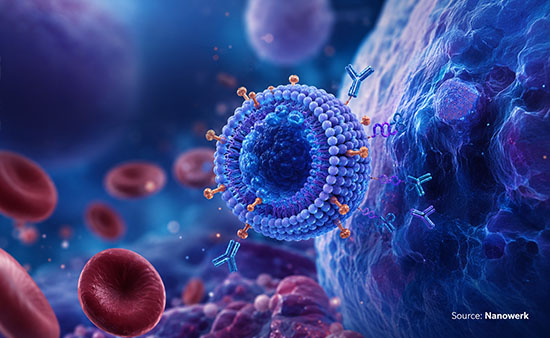
A particle 100 nanometers across is larger than a typical small-molecule drug but smaller than a bacterium and far smaller than a red blood cell. This intermediate scale gives nanomedicines unusual biological behavior. They can circulate through capillaries, interact with cell membranes, carry many drug molecules at once, and display multiple copies of a targeting ligand on the same surface. At the same time, they are large enough for the immune system, liver, spleen, kidneys, and blood proteins to recognize them as structured objects rather than individual molecules.
As a rough rule, particles with hydrodynamic diameters below about 5–6 nanometers can be rapidly filtered by the kidneys, while particles well above roughly 200 nanometers are more likely to be sequestered by the liver and spleen. These are not hard cutoffs. Renal filtration and immune clearance also depend on shape, charge, flexibility, surface chemistry, protein binding, and whether the particle breaks down into smaller components. Much of nanomedicine design therefore takes place in the intermediate size range where circulation, tissue penetration, and clearance can be tuned.
Surface chemistry is just as important as size. Bare nanoparticles are quickly coated by blood proteins, forming a protein corona that can change their identity in the body and promote clearance by the mononuclear phagocyte system. Coating particles with polyethylene glycol (PEG) or related hydrophilic polymers can reduce protein adsorption and prolong circulation, an effect often described as stealth behavior. PEGylation is useful but not universal: anti-PEG antibodies, accelerated blood clearance, and hypersensitivity reactions can limit the benefit for some products and patient groups.
The high surface-to-volume ratio at the nanoscale also allows particles to display many ligands at once. Antibodies, antibody fragments, peptides, aptamers, sugars, or small molecules such as folate can be attached to the surface to increase binding to cells that express the matching receptor. This multivalent presentation can produce stronger binding than a single ligand molecule, but it does not automatically guarantee that more particles will reach the target tissue.
Common Classes of Nanomedicine Platforms
No single platform is best for every disease or cargo. The right carrier depends on whether the payload is a small-molecule drug, peptide, protein, vaccine antigen, RNA, DNA, gene-editing machinery, or imaging agent. It also depends on the target tissue, route of administration, required release profile, tolerability, stability, cost, and manufacturing method.
| Platform | Composition | Typical size | Representative products and uses | Strengths and trade-offs |
|---|---|---|---|---|
| Liposomes | Phospholipid bilayer enclosing an aqueous core | 50–200 nm | Doxil (doxorubicin), AmBisome (amphotericin B) | Long clinical history and good biocompatibility; drug loading and leakage can be formulation-dependent |
| Lipid nanoparticles (LNPs) | Ionizable lipid, helper lipid, cholesterol, and PEG-lipid arranged around nucleic acid cargo | 60–120 nm | Onpattro (siRNA); Comirnaty and Spikevax mRNA vaccines | Leading platform for RNA delivery; many current formulations naturally favor liver delivery |
| Polymeric nanoparticles and micelles | Biodegradable polymers such as PLGA, PLA, polycaprolactone, or amphiphilic block copolymers | 20–200 nm | Depot formulations, micellar drugs, and many investigational carriers | Tunable degradation and release; batch reproducibility and residual solvent control can matter |
| Protein-based nanoparticles | Albumin or other protein scaffolds associated with hydrophobic drugs | About 100–150 nm | Abraxane (albumin-bound paclitaxel) | Can avoid toxic solubilizers; mechanism and in vivo structure may be more complex than a stable-particle model |
| Dendrimers | Highly branched, synthetic polymer architectures | 2–10 nm | SPL7013-containing products in some topical indications; investigational drug carriers | Precise architecture and high ligand density; cationic surfaces can raise toxicity concerns |
| Inorganic nanoparticles | Gold, iron oxide, silica, mesoporous silica, and related materials | 2–200 nm | Iron oxide agents used or approved for imaging in some settings; gold nanoshells and magnetic hyperthermia systems in specialized or investigational use | Useful optical, magnetic, or thermal properties; persistence, long-term clearance, and tissue accumulation require careful evaluation |
| Nucleic-acid nanostructures | DNA origami, RNA assemblies, and other programmable nucleic-acid structures | 10–100 nm | Largely preclinical | Programmable shape and ligand placement; nuclease stability, immune recognition, cost, and manufacturing remain difficult |
Several formats sit between these categories, including nanoemulsions, nanocapsules, nanogels, drug nanocrystals, polymer-drug conjugates, and core-shell architectures. Many advanced designs are hybrid systems, such as an inorganic imaging core inside a polymer shell or a polymeric core wrapped in a lipid membrane. The broader trend is toward modular formulations in which each component has a defined role: circulation, targeting, endosomal escape, controlled release, imaging, or biodegradation.
Medical Nanorobots and DNA Origami
Nanomedicine also overlaps with nanorobotics, especially where researchers design programmable molecular systems rather than conventional drug carriers. In this medical context, a nanorobot is usually not a tiny mechanical submarine moving through the bloodstream. It is more often a nanoscale molecular or supramolecular structure that can be programmed to assemble into a defined shape, recognize molecular cues, change conformation, expose or hide binding sites, carry cargo, or release a therapeutic payload under specified conditions.
One of the most actively researched areas of medical nanorobotics is DNA nanotechnology. Because nucleic-acid base pairing is predictable, DNA and RNA can be used as programmable construction materials for rationally designed nanoshapes and nanomachines. DNA origami is the best-known example: a long DNA scaffold strand is folded into a chosen nanoscale geometry by many shorter staple strands. Related approaches create cages, boxes, switches, walkers, tubes, lattices, and dynamic devices that respond to pH, enzymes, strand-displacement reactions, aptamer binding, or other biological signals.
For nanomedicine, DNA origami and related nucleic-acid assemblies are being explored as programmable carriers for small-molecule drugs, proteins, imaging labels, immune modulators, and gene-regulating payloads. Their appeal is precision: binding sites, drug molecules, antigens, or ligands can be positioned with nanometer-scale control. In principle, such systems could open only in the presence of disease-associated markers, cluster receptors on selected cells, combine sensing and delivery, or organize therapeutic molecules in ways that ordinary nanoparticles cannot. The main barriers are stability in biological fluids, nuclease degradation, immune recognition, scalable manufacturing, cost, biodistribution, clearance, and regulatory validation. For this reason, DNA-based nanorobots are an important research frontier within nanomedicine, but not yet a routine clinical technology.
Passive and Active Targeting
A useful distinction is that passive targeting mainly affects where particles accumulate at the tissue level, whereas active targeting mainly affects which cells bind or internalize particles after they arrive. Confusing these two ideas is one reason targeted nanomedicine is often overhyped.
The EPR effect and passive targeting
The classical rationale for cancer nanomedicine is the enhanced permeability and retention effect, or EPR effect. Some solid tumors develop abnormal, leaky blood vessels and poor lymphatic drainage. Nanoparticles in a suitable size range can leak from these vessels into the tumor interstitium and remain there longer than freely diffusing small molecules. This tissue-level accumulation helped justify the first generation of cancer nanomedicines, including liposomal doxorubicin.
The EPR effect is real, but it is not a reliable universal targeting mechanism. Human tumors differ widely in vascular leakiness, stromal density, blood flow, lymphatic drainage, and interstitial pressure. A widely cited 2016 analysis of preclinical studies reported that, on average, only about 0.7 percent of the injected nanoparticle dose reached solid tumors. Delivery in humans is generally more heterogeneous than in mouse tumor models. For this reason, modern cancer nanomedicine increasingly combines passive accumulation with strategies such as vascular transport, tumor-penetrating ligands, microenvironment-responsive release, local administration, image-guided dosing, or patient selection based on measurable tumor uptake.
Active targeting
Active targeting adds a recognition element to the nanoparticle surface. Common ligands include antibodies or antibody fragments against tumor markers such as HER2, EGFR, or PSMA; peptides such as RGD; aptamers; transferrin; sugars; and small molecules such as folate. These ligands can increase binding to receptor-expressing cells and may improve internalization once the particle is near the target cell.
Active targeting does not necessarily increase the total amount of nanoparticle that reaches a tumor or organ. Before a ligand can bind a cancer cell, the particle still has to survive circulation, avoid rapid immune clearance, cross or interact with vascular barriers, and move through dense tissue. Ligand density, orientation, PEG shielding, receptor expression, endocytosis rate, and protein-corona formation all influence performance. Most approved cancer nanomedicines still rely primarily on passive accumulation or altered pharmacokinetics rather than ligand-directed active targeting.
Stimuli-Responsive and Controlled-Release Designs
Stimuli-responsive nanoparticles are designed to release their cargo when they encounter a particular chemical or physical trigger. Internal triggers include acidic pH in endosomes or tumor microenvironments, high glutathione levels inside cells, reactive oxygen species, and disease-associated enzymes such as matrix metalloproteinases. External triggers include light, ultrasound, alternating magnetic fields, heat, and radiation.
Ionizable lipids in modern lipid nanoparticles are an important example of pH-responsive design. They are relatively neutral at physiological pH, which helps reduce toxicity during circulation, but become positively charged in the acidic endosome. That charge shift promotes interaction with endosomal membranes and helps release RNA cargo into the cytoplasm. Similar design principles are used in polymers that swell, degrade, or change charge in response to pH, redox state, or enzymes.
Diagnostic and Theranostic Nanomedicine
Nanoparticles are not limited to drug delivery. They can also act as imaging contrast agents because many nanoscale materials have optical, magnetic, acoustic, or radioactive properties that small molecules do not. Iron oxide nanoparticles can generate strong magnetic-resonance contrast and have been used clinically in some settings. Gold nanoparticles can enhance computed-tomography and photoacoustic signals. Upconversion nanoparticles convert near-infrared excitation into visible emission for deep-tissue optical imaging. Nanodiamonds with nitrogen-vacancy defects are being explored as biocompatible quantum sensors.
Theranostic nanomedicine combines therapy and diagnostics in the same platform. A theranostic particle might carry a drug and an imaging label, allowing clinicians to see whether the formulation reaches a tumor before or during treatment. This approach is especially attractive for diseases where delivery varies strongly between patients. In principle, imaging can help select patients, adjust dose, or switch therapies when a nanoparticle does not accumulate where expected.
Nanoparticles can also enable physical therapies. In photothermal therapy, gold nanoshells or nanorods are tuned through localized surface plasmon resonance to absorb near-infrared light and convert it into heat. In magnetic hyperthermia, iron oxide nanoparticles exposed to an alternating magnetic field produce localized heating that can damage tumor tissue. Related approaches use high-atomic-number nanoparticles as radiosensitizers to increase the effect of radiotherapy in tumor tissue. These methods remain more specialized than mainstream drug-delivery nanomedicine, but they show why nanoscale materials are useful beyond acting as passive carriers.
Approved Nanomedicines and Clinical Milestones
Depending on how broadly the term is defined, dozens of nanomedicine products have reached approval across the United States, Europe, and other major regulatory regions. The list includes liposomal drugs, lipid-nanoparticle RNA medicines, albumin-bound drug formulations, iron carbohydrate complexes, nanoemulsions, nanocrystals, polymeric depots, and imaging agents. Because regulatory agencies do not always use the same terminology, it is better to think of nanomedicine as a family of complex nanoscale products rather than a single regulatory category.
Several products anchor the field. Doxil demonstrated that liposomal encapsulation could alter the distribution and toxicity profile of doxorubicin, particularly by reducing exposure of healthy tissues to high peak concentrations of free drug. AmBisome improved the therapeutic index of amphotericin B by packaging it in liposomes. Abraxane replaced paclitaxel’s solvent-based formulation with an albumin-bound form, improving administration and avoiding Cremophor EL. Onpattro validated lipid nanoparticles as a clinical system for RNA interference in the liver. The Pfizer–BioNTech and Moderna COVID-19 vaccines showed that lipid nanoparticles could protect and deliver mRNA at unprecedented global scale.
Other examples require more careful wording. Some iron oxide magnetic-resonance agents have been approved or used clinically, but availability has changed by region and over time. Ferric carboxymaltose and related intravenous iron products are often discussed as nanomedicine-like iron colloids or non-biological complex drugs rather than classic targeted nanoparticles. Magnetic hyperthermia systems based on iron oxide nanoparticles have received European regulatory clearance for specialized cancer applications, but clinical use remains limited compared with chemotherapy, radiotherapy, immunotherapy, and surgery.
Challenges and Limitations
The biggest challenge is delivery. Nanoparticles can dramatically change pharmacokinetics, but they do not automatically solve the biological barriers that prevent drugs from reaching diseased cells. In solid tumors, particles must avoid clearance in blood, pass through abnormal but uneven vasculature, move through dense extracellular matrix, overcome high interstitial pressure, and then enter the right cells. The protein corona that forms in human blood can also mask targeting ligands or redirect particles to immune cells.
Translation from animals to humans is difficult because mouse tumors, especially rapidly growing xenografts, often show stronger EPR effects than human tumors. A formulation that accumulates in a mouse tumor may fail in patients because of differences in tumor architecture, immune recognition, blood flow, disease stage, prior therapy, and scale. Patient-to-patient variability is one reason image-guided nanomedicine and companion diagnostics are active areas of research.
Manufacturing is another major barrier. Nanomedicines are complex, multicomponent products whose clinical behavior can change with small differences in particle size distribution, surface charge, lipid ratio, polymer molecular weight, residual solvent, mixing speed, temperature, storage condition, or sterilization method. Lipid-nanoparticle vaccines rely on controlled mixing processes that must reproducibly assemble particles at large scale. For regulators, critical quality attributes include not only chemical identity but also particle size, polydispersity, encapsulation efficiency, release profile, stability, impurities, and biological performance.
Safety is platform-specific. Biodegradable lipid and polymer carriers are often cleared within days to weeks, but persistent inorganic nanoparticles may remain in the liver, spleen, lymph nodes, or other tissues for much longer. Acute infusion reactions, complement activation-related pseudoallergy, PEG-related hypersensitivity, anti-PEG antibodies, oxidative stress, membrane damage, and unexpected immune stimulation are all relevant for some formulations. Nanotoxicology studies how size, shape, surface chemistry, dose, dissolution, and degradation determine these risks.
Future Perspectives
The next phase of nanomedicine is focused on programmable delivery. Lipid nanoparticles are being adapted for protein replacement, cancer vaccines, gene editing, and in vivo cell engineering, but reliable delivery beyond the liver remains a central challenge. DNA origami and other molecular nanorobotic systems add a second kind of programmability: nanoscale control over shape, logic, ligand placement, and stimulus-responsive behavior. Other active areas include bioinspired coatings that mimic cell membranes, catalytic nanozymes, microfluidic manufacturing, and computational design of lipid and polymer libraries. The field is moving from empirical formulation toward modular platforms whose delivery, immune interaction, release behavior, safety, and manufacturability are engineered together.
FAQ: Nanomedicine
What is nanomedicine in simple terms?
Nanomedicine is the use of nanoscale materials, devices, or assemblies to diagnose, treat, monitor, or prevent disease. Many clinical nanomedicines are particles or particle-like structures that carry a drug, nucleic acid, or imaging agent through the body and help control where it goes, how long it circulates, and when it is released.
Are mRNA vaccines a form of nanomedicine?
Yes. The Pfizer–BioNTech and Moderna COVID-19 vaccines are lipid-nanoparticle formulations that encapsulate messenger RNA. The lipid nanoparticle protects the mRNA from rapid enzymatic degradation, helps it enter cells, and promotes release into the cytoplasm, where ribosomes can translate it. Without a protective carrier, naked mRNA is rapidly degraded by nucleases and enters cells inefficiently.
How do nanoparticles target tumors?
Tumor targeting is usually discussed in two layers. Passive targeting is tissue-level accumulation caused by leaky tumor blood vessels and poor lymphatic drainage, known as the EPR effect. Active targeting adds ligands such as antibodies, peptides, aptamers, or folate to increase binding or uptake by receptor-expressing cells after particles have reached the tissue. Most approved cancer nanomedicines still rely mainly on passive accumulation or altered pharmacokinetics, not precise ligand-directed homing.
What is the EPR effect and why does it matter?
The enhanced permeability and retention effect, or EPR effect, is the tendency of nanoscale particles to leave the abnormal blood vessels of some solid tumors and remain there because lymphatic drainage is impaired. It matters because it explains why many cancer nanomedicines can accumulate in tumor tissue, but the effect is highly variable in humans and often weaker than in mouse models.
How is nanomedicine different from a conventional drug?
A conventional small-molecule drug is usually a single chemical entity whose distribution depends mainly on its own physicochemical properties. A nanomedicine is a multicomponent formulation, often a carrier plus a payload, in which the carrier strongly influences biodistribution, cellular uptake, release, safety, manufacturing, and regulation.
Are nanorobots part of nanomedicine?
Yes. In a medical context, nanorobots often means programmable nanoscale molecular systems rather than tiny mechanical robots. DNA origami, nucleic-acid nanomachines, molecular switches, and responsive nanoscale assemblies are active areas of nanorobotics research. They are being explored for targeted drug delivery, biosensing, imaging, immunotherapy, and controlled release, but most remain experimental rather than clinically established.
Are nanomedicines safe?
Approved nanomedicines have undergone regulatory review and many have favorable safety profiles compared with the corresponding free drugs, but safety is platform-specific. Biodegradable lipid and polymer carriers raise different questions from persistent inorganic particles, and immune reactions such as complement activation or anti-PEG responses can matter for some formulations. New nanomedicines therefore need case-by-case toxicology, pharmacokinetic, and manufacturing assessment.
Further Reading
Nature Reviews Materials, Analysis of nanoparticle delivery to tumours
Nature Reviews Cancer, Cancer nanomedicine: progress, challenges and opportunities
Nature Reviews Drug Discovery, Engineering precision nanoparticles for drug delivery
Nature Reviews Materials, Lipid nanoparticles for mRNA delivery
Nature Nanotechnology, A translational framework to DELIVER nanomedicines to the clinic