Surface-to-Volume Ratio: Formula, Examples, and Nanotechnology Effects
What is Surface-to-Volume Ratio?
Surface-to-volume ratio is a fundamental concept in nanotechnology that describes how much surface area an object exposes per unit of its internal volume. Geometry guarantees that as an object gets smaller, this ratio grows, because surface area scales with the square of size while volume scales with the cube. The same chunk of material, broken into ever-smaller pieces, exposes more and more of its atoms to the outside world.
When the size of a piece of matter shrinks to the nanoscale, this ratio becomes extreme enough to change how the material behaves. Surface atoms have fewer neighbors and dangling bonds that bulk atoms do not, so they are more reactive, contribute disproportionately to total energy, and dominate properties such as catalysis, adsorption, melting, and stability. Many of the unusual behaviors associated with nanomaterials trace back, directly or indirectly, to this single geometric fact.
In one sentence: as a material is divided into smaller pieces, the fraction of its atoms that sit at the surface rises sharply, and surface atoms behave differently from atoms buried in the bulk.
In simple terms, surface-to-volume ratio tells you how much outside surface an object has compared with the amount of material inside it. Nanoparticles have a high surface area to volume ratio because shrinking an object reduces its volume faster than its surface area.
Key takeaways:
- Surface-to-volume ratio is surface area divided by volume.
- For a cube, S/V = 6/L; for a sphere, S/V = 3/r or 6/D.
- As objects get smaller, their surface-to-volume ratio increases.
- Nanoparticles are often more reactive because a larger fraction of their atoms are at the surface.
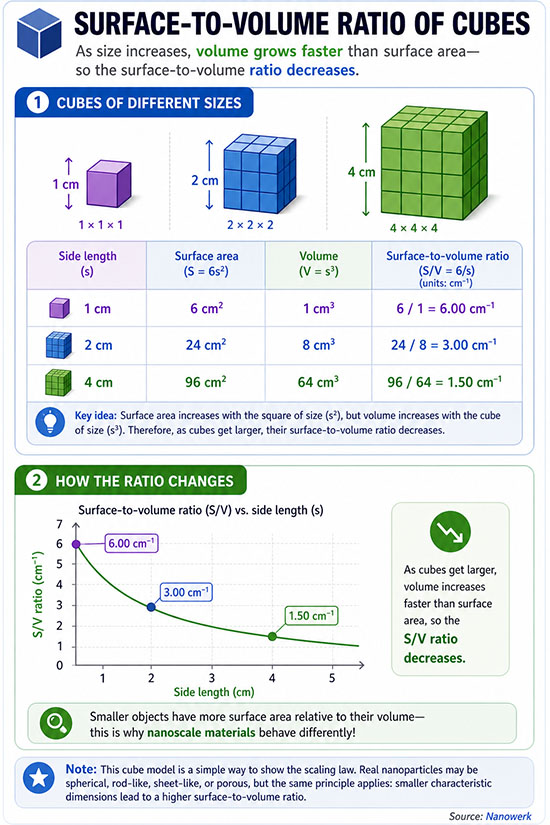
Note: The cube model is a simple way to show the scaling law. Real nanoparticles may be spherical, rod-like, sheet-like, branched, or porous, but the same principle applies: smaller characteristic dimensions increase surface area relative to volume.
The mathematics of size and shape
The surface-to-volume ratio is defined as surface area divided by volume:
Surface-to-Volume Ratio = Surface Area / Volume
Key formula: For a cube, S/V = 6/L. For a sphere, S/V = 3/r, which is the same as 6/D when D is diameter. The units are inverse length, such as cm-1 or nm-1.
Check out our Surface-to-Volume Ratio Calculator
For a cube of side length L the surface area is 6L2 and the volume is L3, so the ratio is 6/L. For a sphere of radius r the surface area is 4πr2 and the volume is (4/3)πr3, giving a ratio of 3/r, or 6/D when D is the sphere diameter. In both cases the ratio is inversely proportional to a characteristic length, so reducing that length by a factor of ten raises the surface-to-volume ratio by the same factor of ten.
A familiar analogy is sugar dissolving in water: a sugar cube dissolves slowly, but powdered sugar dissolves much faster because crushing it exposes far more surface area. Nanoparticles behave similarly: more exposed surface means more contact with the surrounding environment.
Shape matters as well as size. For a fixed volume, a sphere has the smallest possible surface area, while elongated rods, flat sheets, and porous structures have larger surfaces. This is why anisotropic nanoparticles such as nanorods, nanoplates, and branched nanostars are often more reactive than spheres of the same volume, and why the most extreme surface-to-volume ratios are found in two-dimensional sheets and porous frameworks rather than in compact spheres.
Why surface-to-volume ratio matters at the nanoscale
For an everyday object, the surface contributes a negligible fraction of the total atom count. A 1 cm cube of metal has only a tiny fraction of its atoms at the surface, typically on the order of tens to hundreds of parts per billion depending on the atomic spacing and crystal structure. Even a 1 μm particle has roughly one atom in a thousand at the surface. Below about 100 nm, however, the surface fraction starts to climb noticeably, and below about 10 nm it can become large enough to control the material's properties.
A useful rough scaling estimate is that the surface-atom fraction varies approximately as 1/D, where D is particle diameter. The exact value depends on crystal structure, particle shape, and how "surface atom" is defined, and simple shell models become unreliable for particles only a few atoms across. For metal nanoparticles, the surface fraction can rise from around 1% at 100 nm to tens of percent below 10 nm, and it can exceed half of all atoms for particles only about 1–2 nm across. This is one reason the nanoscale is commonly associated with dimensions below about 100 nm, although the exact onset of nano-like behavior depends on the material, shape, and property being measured.
The same scaling explains why subdividing a fixed mass of material massively expands its accessible surface. Grinding a 1 cm3 cube into 10 nm cubes raises the total surface area by a factor of one million, from a few cm2 to several hundred m2, without changing the chemical composition. This is the basic geometric trick that nanotechnology exploits.
Specific surface area: from ratio to a practical metric
In practice, scientists and engineers usually express surface-to-volume in mass-normalized form as the specific surface area, with units of square meters per gram (m2/g). For a non-porous spherical particle, specific surface area equals 6/(ρD), where ρ is the density and D the diameter. The standard experimental method to measure it is Brunauer-Emmett-Teller (BET) analysis, in which gas adsorption isotherms are fitted to recover the area accessible to small probe molecules.
Specific surface area is the metric that translates abstract geometry into a number engineers can compare across materials. Bulk metals and ceramics measure well below 1 m2/g. Nanoparticles, porous oxides, and framework materials reach values that are thousands of times larger, with consequences for storage, separation, and reactivity.
| Material class | Typical specific surface area (m2/g) | Structural origin | Common uses |
|---|---|---|---|
| Bulk metal or polished ceramic | < 1 | Macroscopic external surface only | Structural parts, wiring, optical components |
| Activated carbon | 500–1500 | Disordered micro- and mesopores in a carbon matrix | Water and air filtration, gas masks, adsorbents |
| Mesoporous silica (e.g., SBA-15, MCM-41) | 800–1000 | Ordered pores 2–50 nm in an oxide framework | Catalyst supports, drug delivery, separations |
| Carbon nanotubes | 200–1000 | Hollow one-dimensional cylinders | Composites, electrodes, sensors |
| Graphene (theoretical, single layer) | ~ 2630 | Atom-thick two-dimensional sheet | Sensors, supercapacitors, transparent conductors |
| Metal-organic frameworks (MOFs) | 3000–7000+ | Crystalline open lattice of metal nodes and organic linkers | Gas storage, gas separation, catalysis |
Reported surface-area values depend on activation conditions and measurement method. For example, graphene is often cited at a theoretical 2630 m2/g, while MOF values are usually reported from BET gas adsorption measurements and can vary substantially by framework and preparation method.
The non-obvious trade-off in this comparison is that ultra-high specific surface area is rarely free. metal-organic frameworks and aerogels reach extreme values only in carefully activated, often fragile, structures that can collapse on heating, exposure to humidity, or mechanical handling. Activated carbon offers a more modest but very robust surface area at low cost. The right material for an application depends not just on how much surface area is available, but on how durably it survives in the operating environment.
Physical and chemical consequences
A high surface-to-volume ratio reshapes the energetics of a material. Surface atoms cost more energy than bulk atoms because they have fewer neighbors, so the surface contribution to total energy grows as particles shrink. Several distinct phenomena follow from this single fact.
Reactivity and catalysis
Heterogeneous chemical reactions happen at surfaces, so the rate at which a material can convert reactants depends on how much surface area it offers. Nanoparticles of platinum, palladium, and gold are widely used as catalysts because they put a much larger fraction of their atoms in contact with the reaction mixture than larger particles of the same metals. The corner and edge atoms exposed at the surface of small particles also have lower coordination numbers than terrace atoms, which often makes them more catalytically active site for site.
This combination of more surface atoms and more reactive surface atoms is what underlies the use of nanostructured catalysts in fuel cells, exhaust treatment, and the production of fine chemicals. The deliberate control of which surface facets are exposed has become a central theme in modern nanochemistry.
Adsorption and storage
High surface area also means a large amount of binding sites for molecules from a surrounding fluid. Activated carbons, mesoporous silicas, zeolites, and MOFs use this directly to capture water contaminants, store hydrogen and methane, separate gas mixtures, and concentrate trace pollutants for analysis. The same principle is used in supercapacitor electrodes, where charge is stored in a thin double layer at the electrode-electrolyte interface, so increasing electrode surface area increases the energy that can be stored at a given voltage.
Surface energy and thermodynamic effects
Because surface atoms cost extra energy, very small particles are thermodynamically less stable than larger ones of the same material. Two important consequences follow. First, the melting point drops as size decreases: gold nanoparticles melt several hundred degrees below the bulk melting point of 1064 °C, an effect known as melting-point depression. Second, smaller particles are more soluble than larger ones, which drives Ostwald ripening, in which small particles slowly dissolve and redeposit on larger ones until the size distribution coarsens. The same thermodynamic pressure causes nanoparticles to sinter and aggregate, which is why most practical nanomaterials need stabilizing ligands, polymer coatings, or rigid supports to keep their high surface area intact during use.
Optical and electronic properties
Common misconception: A high surface-to-volume ratio does not cause quantum confinement. Both effects become important at small sizes, but they have different physical origins.
A high surface-to-volume ratio is often associated with strikingly different optical and electronic behavior at the nanoscale, but the underlying physics needs care. The size-dependent colors and tunable band gaps of quantum dots arise from quantum confinement, which is caused by spatial confinement of electrons and excitons rather than by the surface-to-volume ratio itself. The two effects appear together because both scale with size, but they have different physical origins. What the surface-to-volume ratio does control directly is the importance of surface states, surface trap-induced quenching, and ligand-mediated electronic effects, which can dominate the optical response of small particles even when quantum confinement sets the band gap.
Mechanical behavior
At the nanoscale, mechanical properties are also size-dependent, although the connection to surface-to-volume ratio is more indirect than for the effects above. Smaller volumes contain fewer defects, surface atoms accommodate strain differently from bulk atoms, and grain boundaries play a larger role as grain size shrinks. As a result, nanoscale wires, films, and nanocrystalline metals often display higher hardness or strength than their bulk counterparts. The size scaling is not universal, and at very small grain sizes the trend can reverse, so claims that "smaller is always stronger" should be treated with caution.
Surface-to-volume ratio in nature
Living systems exploit high surface-to-volume ratios long before nanotechnology made the idea explicit. The lungs maximize gas exchange by branching into about 300 million alveoli, packing roughly 70 m2 of respiratory surface into a few liters of chest volume. The intestinal wall is folded into villi and microvilli that expand its absorptive area by orders of magnitude, and plant root hairs increase soil contact for nutrient uptake. The intuition is general: whenever a process is rate-limited by exchange across an interface, evolution and engineering converge on the same answer of pushing the surface-to-volume ratio higher.
High-surface-area nanomaterials in technology
The classes of materials in the table above are not interchangeable. Compact gold nanoparticles, silver nanoparticles, and other inorganic nanoparticles expose a moderate amount of surface but are easy to handle and functionalize, which is why they dominate in catalysis, sensing, and biomedicine. Magnetic nanoparticles add a separable handle for bioseparation and imaging. One-dimensional nanostructures such as nanowires and nanotubes provide elongated reactive surfaces well suited to sensing and electrochemistry, while two-dimensional materials in the graphene family approach the geometric limit of one-atom-thick layers. Porous frameworks such as metal-organic frameworks (MOFs) and aerogels reach the largest accessible surface areas of any synthetic materials, at the cost of greater fragility.
Limitations and challenges
A high surface-to-volume ratio is not free. The same surface energy that drives reactivity also drives instability. Small particles aggregate, sinter, and undergo Ostwald ripening to reduce their total surface area, and reactive surfaces oxidize, hydrolyze, or pick up adventitious adsorbates that mask their intended chemistry. Practical nanomaterials almost always include some form of stabilization, whether by capping ligands, polymer coatings, encapsulation in silica or other shells, or anchoring to a high-area support. Surface functionalization is therefore a near-universal step in synthesizing nanomaterials for real applications.
The same factors raise legitimate questions about safety. Compared with bulk powders of the same composition, nanoparticles present more reactive surface per unit mass, can interact more strongly with biological tissue, and may translocate across membranes that larger particles cannot cross. This has prompted ongoing debate over whether dose for nanomaterials should be measured in mass, surface area, or particle number. As a result, surface area is increasingly considered a primary descriptor in toxicology, regulatory testing, and the design of safer nanomaterials.
Future perspectives
Surface-to-volume engineering is moving in two complementary directions. At the small end, single-atom catalysts push the ratio to its physical limit by dispersing isolated metal atoms on a support so that essentially every metal atom is exposed. At the architectural end, hierarchical materials combine micro-, meso-, and macropores so that high specific surface area is also accessible to bulky molecules and to fluid flow. Advances in atomically precise synthesis, in situ characterization, and computational screening are making it increasingly possible to specify a target surface area and surface chemistry and to obtain a material that delivers them. As nanocarbon materials, MOFs, covalent organic frameworks, and engineered porous solids continue to mature, the simple geometric idea behind surface-to-volume ratio will remain central to how researchers think about reactivity, storage, separation, and energy conversion at the nanoscale.
FAQ: Surface-to-volume ratio
How do you calculate surface-to-volume ratio?
Divide the surface area by the volume in consistent units. For a cube of side L the ratio is 6/L; for a sphere of radius r the ratio is 3/r, or 6/D when D is diameter. Both expressions show that the ratio is inversely proportional to a characteristic length, so smaller objects have larger surface-to-volume ratios.
Why is a high surface-to-volume ratio important in nanotechnology?
Surface atoms behave differently from bulk atoms because they have fewer neighbors and dangling bonds. When a large fraction of the atoms in a material sit at the surface, surface chemistry and surface energetics dominate properties such as catalysis, adsorption, melting point, and stability. This is why nanoscale matter often behaves so differently from bulk matter of the same composition.
What is the difference between surface-to-volume ratio and specific surface area?
Surface-to-volume ratio is a geometric quantity with units of inverse length. Specific surface area is the same idea expressed per unit mass, in m2/g. The two are related by the material's density, and specific surface area is the metric most often reported in catalysis, adsorption, and porous-materials research because it can be measured directly by gas adsorption.
Does shape change the surface-to-volume ratio?
Yes. For a fixed volume, a sphere has the smallest possible surface area, so any non-spherical shape has a higher surface-to-volume ratio. Rods, plates, branched structures, and porous networks all exceed a sphere of the same volume, which is why shape control is a major strategy in designing nanomaterials for catalysis and sensing.
Can the surface-to-volume ratio be too high?
In a thermodynamic sense, yes. A very high ratio means a high surface energy and a strong driving force toward aggregation, sintering, dissolution, or Ostwald ripening. Practical nanomaterials almost always need stabilization through surface functionalization, capping ligands, or attachment to a support. Toxicological and environmental considerations also become more important as surface area per unit mass increases.
Further Reading
Journal of Chemical Education, Using nanoparticles to teach surface area, volume, and atom fractions
Scientific Reports, Theoretical specific surface area of graphene and graphene-based materials
Chemical Reviews, Surface and interface control in nanoparticle catalysis
ACS Central Science, Surface-area-to-volume ratio determines surface tensions in microscopic, surfactant-containing droplets
Nanoscale Advances, Size-dependent melting point depression of nickel nanoparticles
Nanotechnology Reviews, Mechanical properties of nanomaterials: a review
Journal of Nanoparticle Research, Structural parameters of nanoparticles affecting their toxicity for biomedical applications: a review