Quantum Size Effect: Why Nanomaterials Behave Differently
What is the Quantum Size Effect?
The quantum size effect (QSE) is the change in a material's electronic, optical, magnetic, or thermal behavior when one or more of its dimensions become small enough to confine charge carriers such as electrons and holes. At this scale, the material no longer behaves like a continuous bulk solid. Instead, its allowed energy states become more discrete, and properties such as band gap, emission color, conductivity, and heat transport can become size-dependent.
QSE is especially important in quantum dots, quantum wells, quantum wires, ultrathin films, semiconductor nanocrystals, and very small metal clusters. It is one of the key reasons nanomaterials can behave differently from the same substance in bulk form.
In nanoparticles, the quantum size effect is most prominent when particle diameter approaches the exciton Bohr radius or another relevant quantum length scale, causing properties to vary with particle size rather than only with chemical composition.
In one sentence: the quantum size effect occurs when nanoscale dimensions force electrons and holes into confined quantum states, making material properties depend on size.
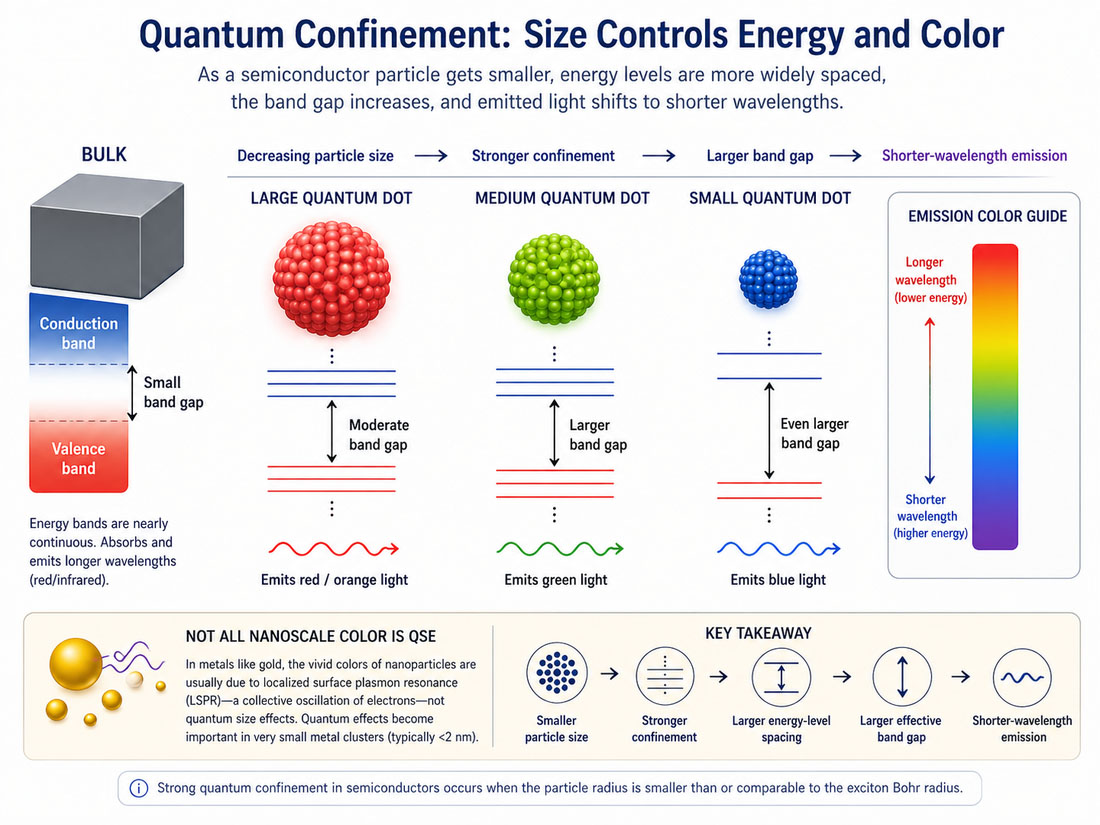
Quantum size effect in semiconductor nanoparticles: as particle size decreases, stronger quantum confinement widens the band gap, shifting emitted light toward shorter, bluer wavelengths. (Image: Nanowerk) (click on image to enlarge)
Why the Quantum Size Effect Happens
In a bulk material, electrons can occupy energy bands that are so closely spaced they appear almost continuous. When a material is reduced to the nanoscale, the motion of electrons and holes can be restricted in one, two, or three dimensions. This restriction is known as quantum confinement.
Confinement becomes important when a nanostructure is comparable in size to the relevant quantum-mechanical length scale of the charge carriers. This is often described using the de Broglie wavelength. In semiconductor nanocrystals, a common practical benchmark is the exciton Bohr radius, which describes the typical separation of a bound electron-hole pair. When a particle is similar in size to, or smaller than, this radius, its band gap and optical behavior can change strongly with size.
As a confined particle gets smaller, the spacing between allowed energy levels generally increases. In many semiconductor quantum dots, this produces a larger effective band gap: smaller dots absorb and emit shorter-wavelength, bluer light, while larger dots emit longer-wavelength, redder light.
Quantum Size Effect vs. Quantum Confinement
Quantum confinement is the physical restriction of charge carriers in one or more dimensions. The quantum size effect is the resulting change in measurable material properties, such as band gap, color, conductivity, or density of states. In simple terms, confinement is the cause; quantum size effect is the observed consequence.
Quantum Size Effect vs. Other Nanoscale Effects
Not every unusual property of a nanoparticle is caused by QSE. Nanomaterials often show several effects at the same time, and separating them is important for understanding their behavior.
| Effect | Main cause | Example |
|---|---|---|
| Quantum size effect | Quantum confinement and discrete energy levels | Size-tunable fluorescence in semiconductor quantum dots |
| Surface effects | High surface-to-volume ratio and surface atoms | Enhanced catalytic activity or chemical reactivity |
| Plasmonic effects | Collective oscillation of conduction electrons | Red or purple color of many colloidal gold nanoparticles |
| Finite-size magnetic effects | Small particle volume, magnetic anisotropy, and thermal fluctuations | Superparamagnetism in magnetic nanoparticles |
For example, gold nanoparticles can appear red, purple, or blue, but this color is usually dominated by localized surface plasmon resonance rather than ordinary semiconductor-like QSE. In very small metal clusters, however, quantum size effects can become significant because the electronic states become more discrete.
How the Quantum Size Effect Changes Nanomaterial Properties
Optical Properties
The most familiar example of QSE is the size-dependent color of semiconductor quantum dots. Changing the dot diameter changes the band gap, which changes the wavelengths of light the material absorbs or emits. This tunability is used in displays, light-emitting devices, photodetectors, biological imaging, and optical labels.
Electronic Properties
QSE modifies band structure, density of states, and charge-carrier behavior. In semiconductor nanocrystals, it can shift the band gap and alter exciton energies. In ultrathin films, nanowires, and very small metallic particles, it can influence conductance, tunneling, and electron transport.
These changes do not automatically improve electronic performance. Charge mobility and recombination depend strongly on surface passivation, defects, particle coupling, ligands, grain boundaries, and device architecture. Poorly passivated nanocrystals, for example, can have many surface traps that reduce emission efficiency or increase recombination losses.
Magnetic Properties
At the nanoscale, magnetic behavior can differ sharply from bulk behavior. Magnetic nanoparticles may become single-domain particles, and sufficiently small particles can exhibit superparamagnetism when thermal energy overcomes their magnetic anisotropy barrier. These effects are primarily finite-size magnetic effects, although quantum size effects can also influence magnetism in some low-dimensional or very small systems.
Thermal Properties
QSE and related nanoscale size effects can also influence heat transport. In nanowires, thin films, superlattices, and other low-dimensional structures, changes in electron and phonon behavior can alter thermal conductivity and thermoelectric performance. This has made nanostructuring an important strategy in thermoelectric materials, where researchers try to control both electrical transport and heat flow.
Examples of Quantum Size Effect in Nanotechnology
Quantum Dots
Quantum dots are among the clearest examples of QSE. Because their dimensions are small enough to confine electrons and holes in all three spatial directions, their band gap can be tuned by changing their size, composition, and surface chemistry.
Quantum Wells and Quantum Wires
In quantum wells, carriers are confined mainly in one dimension; in quantum wires, they are confined in two. These structures are used to tailor electronic and optical behavior in lasers, detectors, sensors, and nanoscale electronic devices.
Metal Nanoparticles and Nanoclusters
In larger metal nanoparticles, optical behavior is often dominated by plasmonic effects. As metal particles become extremely small, approaching the cluster regime, the electronic density of states becomes more discrete, and quantum size effects become increasingly important.
Applications of the Quantum Size Effect
Displays and Light-Emitting Devices
Quantum dots can produce narrow, tunable emission colors. This makes them valuable for high-color-purity displays, LEDs, and other optoelectronic devices.
Photovoltaics and Photodetectors
In solar cells and photodetectors, quantum-confined nanomaterials are studied because their band gaps can be tuned to absorb selected parts of the solar spectrum or detect specific wavelengths. Practical performance depends not only on QSE but also on stability, charge extraction, interface quality, toxicity, and scalable manufacturing.
Bioimaging and Sensing
Quantum dots and related fluorescent nanomaterials can be engineered for bright, size-tunable optical signals. In biomedical applications, their usefulness depends on biocompatibility, surface functionalization, brightness, photostability, and safe clearance from the body.
Thermoelectrics and Energy Materials
Low-dimensional and nanostructured thermoelectric materials use size effects to influence electronic states and scatter heat-carrying phonons. The goal is to improve conversion between heat and electricity, although real-world performance depends on the balance between electrical conductivity, thermal conductivity, and the Seebeck coefficient.
Nanoscale Electronics
As electronic components shrink, quantum confinement, tunneling, and discrete charge effects become increasingly important. These effects can create challenges for conventional device scaling but also enable new device concepts based on quantum dots, nanowires, single-electron devices, and low-dimensional materials.
Challenges in Using the Quantum Size Effect
Harnessing QSE requires precise control over nanomaterial size, shape, composition, crystal structure, and surface chemistry. Even small variations in particle diameter can broaden emission spectra or reduce device performance. For many applications, researchers must also address surface traps, oxidation, aggregation, toxicity, long-term stability, and reproducible large-scale synthesis.
Another challenge is interpretation. In real nanomaterials, QSE often appears together with surface effects, strain, defects, dielectric confinement, plasmonic behavior, and finite-size effects. Careful experiments and modeling are needed to determine which mechanism is responsible for a measured property.
Future Perspectives
Future work on QSE is likely to focus on more precise synthesis, safer and less toxic materials, improved surface passivation, better integration into devices, and stronger links between computational prediction and experimental design. As characterization methods improve, researchers will be able to distinguish quantum confinement from other nanoscale effects more accurately and design nanomaterials with more predictable properties.
Further Reading
Reviews of Modern Physics, Quantum size effects in metal particles
Annual Review of Physical Chemistry, Colloidal quantum dots: synthesis, properties and applications
Chemical Reviews, Semiconductor Quantum Dots in the Cluster Regime
npj Quantum Materials, Size effect in thermoelectric materials