| Jun 24, 2025 |
Nanoparticles rival traditional phosphates in plant growth
Researchers tested citrate-capped FePO4 nanofertilizer vs. triple superphosphate, assessing plant growth, nutrient uptake, and soil-microbe interactions.
(Nanowerk News) Phosphorus deficiency is a major limitation to crop productivity worldwide, as conventional fertilizers like triple superphosphate (TSP) are rapidly leached or immobilized in soils, reducing their nutrient use efficiency. With global food demands rising and environmental concerns growing, there is a pressing need to develop fertilizers that provide nutrients more efficiently while minimizing ecological impacts.
|
|
Nanofertilizers—due to their unique size and surface properties—offer slower, targeted nutrient release and reduced losses. However, their performance across soil and crop types remains insufficiently understood. Due to these challenges, deeper research into nanoscale phosphorus delivery systems like iron phosphate (FePO₄) nanofertilizers is urgently needed to evaluate their potential as next-generation fertilizers.
|
|
In a new study published in Pedosphere ("A novel nanosized FePO4 fertilizer is as effective as triple superphosphate in sustaining the growth of cucumber plants"), researchers from the University of Verona, the University of Padua, and other Italian institutions evaluated the performance of a citrate-capped FePO₄ nanofertilizer (FePNF) against conventional TSP. Using cucumber plants grown in P-deficient soil, they compared plant growth, nutrient uptake, soil enzyme activity, and microbial community changes.
|
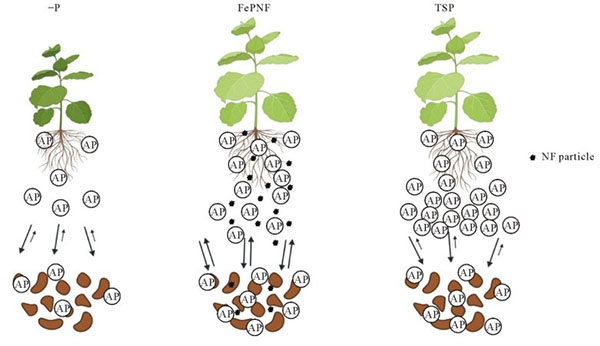 |
| Conceptual models depicting the possible mechanisms involved in P nutrition in the plant-soil systems fertilized with FePO4 nanofertilizer (NF) (FePNF) or conventional fertilizer triple superphosphate (TSP) and without P fertilizer (–P). Specifically, TSP releases a higher quantity of available P (AP, Olsen P) that can, in turn, be acquired or subjected to absorption/precipitation in soil, and FePNF can directly interact with cucumber root apoplast/exudates and release P more slowly, either in solution or after absorption. (Image: CAS)
|
|
Despite lower initial P availability from fertilizer (FePNF), the nanofertilizer matched TSP in supporting cucumber development, suggesting that its release kinetics and plant interactions provide sufficient bioavailability for effective fertilization.
|
|
In pot experiments over 28 days, cucumber plants fertilized with FePNF showed no significant differences from TSP-treated plants in key growth metrics, including shoot and root biomass, leaf area, and SPAD chlorophyll values. While Olsen-P tests indicated higher phosphorus availability in TSP soils, plant tissues accumulated comparable amounts of P in both treatments, suggesting FePNF releases P in less detectable but bioavailable forms. Soil enzyme assays revealed nuanced changes: FePNF-treated soils had higher protease activity, while alkaline phosphatase activity was more pronounced with TSP.
|
|
Interestingly, microbial DNA fingerprinting showed distinct bacterial, archaeal, and fungal community structures depending on the fertilizer used, indicating different rhizosphere dynamics. The FePNF treatment led to microbial profiles more similar to TSP than to unfertilized controls but still distinct, suggesting that the nanofertilizer may alter root exudation patterns or microbial recruitment. These findings highlight the potential of FePNF to serve as an effective and environmentally gentler alternative to conventional phosphorus fertilizers.
|
|
“Our results show that FePO₄ nanofertilizer can provide sufficient phosphorus to plants even when traditional tests suggest limited availability,” said Professor Zeno Varanini, senior author of the study. “The nutrient release appears to be mediated by root activity, which may help reduce leaching losses and improve sustainability. While further field-scale research is needed, this represents a promising step toward more efficient phosphorus use in agriculture.”
|
|
This research suggests that FePNF could reduce the environmental footprint of phosphorus fertilization by minimizing nutrient runoff and tailoring nutrient release to plant demand. Its efficacy in acidic, P-deficient soils shows potential for use in regions where conventional fertilizers are inefficient.
|
|
The study also raises important questions about how nanofertilizers interact with soil microbiota, opening new research directions in plant-microbe-soil interactions. As agriculture seeks greener inputs, nanofertilizers like FePNF offer a compelling path toward more resilient and sustainable food production systems.
|



