

| Aug 27, 2025 |
Researchers pioneer atomic-scale method to boost zirconium catalystsResearchers created a scalable method to disperse zirconium atoms, greatly improving catalyst efficiency and paving the way for cleaner, more sustainable chemistry.(Nanowerk News) Scientists at Nanjing Tech University have unveiled a new way to make zirconium catalysts more efficient by working at the atomic scale. Their approach, published in Frontiers of Chemical Science and Engineering ("Formation of atomically dispersed zirconium through the utilization of nanoconfined environments"), uses confined spaces within silica structures to precisely position zirconium atoms, dramatically boosting performance. |
| Single-atom catalysts have attracted global attention because they promise higher efficiency with less material. But producing them has been tricky—existing methods are often too complex or difficult to scale up. |
| The Nanjing team tackled this by grinding a zirconium compound into the tiny channels of a silica template, then heating it. This process fixed zirconium atoms within the structure, creating a stable, atomically dispersed catalyst. The result was striking: in making benzyl acetate, a common chemical, the catalyst achieved a 63.3% yield, far higher than the 19.8% yield without the technique. |
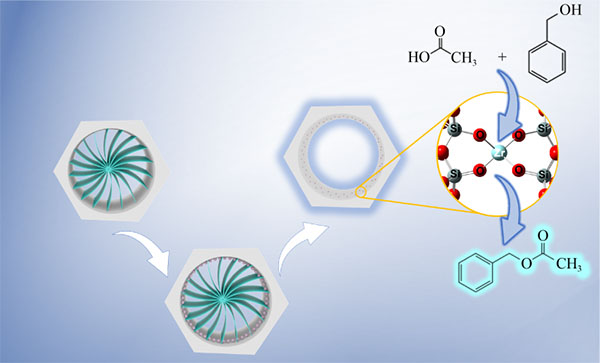 |
| Schematic of atomically dispersed zirconium catalysts formed in nanoconfined silica structures. The confined Zr–O–Si sites drive the esterification of acetic acid and benzyl alcohol to produce benzyl acetate with enhanced efficiency. (Image: Reprinted from DOI: 10.1007/s11705-025-2524-7, CC BY) |
| Computer simulations confirmed that the zirconium atoms formed strong bonds with the silica framework, a structure essential for the catalyst’s efficiency. |
| This method could help researchers and industry alike by providing a more practical path to designing powerful catalysts. Beyond boosting chemical production, the approach may also support cleaner, more sustainable processes in fields ranging from manufacturing to environmental protection. |
| Source: Frontiers Journal (Note: Content may be edited for style and length) |

