| Sep 17, 2025 |
Nanoscale optical device achieves independent electrical control of light
Engineers built a nanoscale optical device that uses voltage to control light's phase and intensity, advancing quantum communication and compact optical technologies.
(Nanowerk News) A team of engineers at UNIST has created a nanoscale optical device that can precisely control both the brightness and the phase of light using electrical signals (Science Advances, "Full complex amplitude control of second-harmonic generation via electrically tunable intersubband polaritonic metasurfaces"). The innovation marks a leap forward for quantum communication and information processing, where manipulating light with precision is essential.
|
|
The device, developed by Professor Jongwon Lee and his colleagues in the Department of Electrical Engineering, makes it possible to independently adjust the intensity and phase of second-harmonic (SH) light. This level of control has been a long-standing challenge in nonlinear optics, the field that studies how light changes as it interacts with special materials. Nonlinear optical processes are crucial for generating entangled photons and building other systems that underpin future quantum technologies.
|
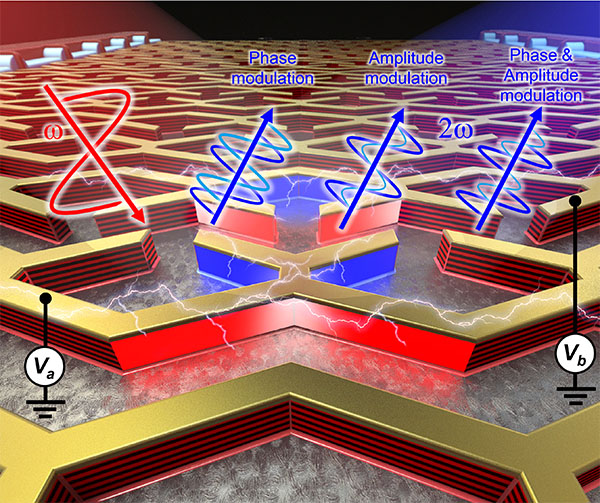 |
| Conceptual illustration of complex-amplitude-controllable nonlinear polaritonic metasurface. (Image: UNIST)
|
|
What makes the device stand out is its size and function. Measuring just one ten-thousandth the size of a fingernail, it replaces bulky materials traditionally used in optical systems. Conventional nano-optical components tend to operate passively, relying on fixed material properties. By contrast, the UNIST device responds dynamically to voltage, enabling real-time and independent tuning of both phase and amplitude. This ability to encode more complex information into light signals is critical for next-generation quantum communication.
|
|
Experimental tests showed that the device can achieve nearly 100 percent modulation of SH light intensity. It also allows the phase to be tuned across a complete 0 to 360-degree range. The nonlinear response could be adjusted within a range of about 0 to 30 nanometers per volt, proving that the device provides full electrical control over the complex amplitude of light, including both magnitude and phase.
|
|
Using these capabilities, the researchers successfully created phase and amplitude gratings, which produced dynamically adjustable diffraction patterns. Such control has immediate potential in applications such as real-time wavefront shaping, high-speed optical data encoding, and contactless optical switching. These are functions that future quantum networks and photonic devices will depend on.
|
|
The breakthrough lies in the design of the device’s surface. It features nanostructures that combine quantum wells with metal nanocavities, arranged in pairs that differ in phase by 180 degrees. This careful engineering allows highly efficient and independent tuning of nonlinear optical responses, something that previously seemed out of reach.
|
|
“This is the first time we have surpassed the physical limitations of existing nonlinear optical devices,” said Professor Lee. “Our miniaturized platform achieves high-speed, high-precision optical control using only electrical signals. This technology has the potential to become a foundation for active quantum optics systems, such as entangled photon sources and quantum interference control.”
|
|
The research points toward a future where bulky optical equipment could be replaced with compact, electrically operated devices. By making optical control smaller, faster, and more precise, the team has laid important groundwork for technologies that could drive the next stage of quantum communication and computing.
|