| Nov 26, 2025 |
Smart nanosensor wrapper preserves food and reveals freshness in real time
A stretchable antimicrobial wrapper with a built-in SERS nanosensor tracks food freshness and nutrients on the surface while preserving quality and extending shelf life.
(Nanowerk News) Ensuring food quality is vital, but traditional monitoring tools such as ribotyping and PCR are slow, destructive, and impractical for widespread use. Scientists are now turning to surface-enhanced Raman scattering, or SERS, a technology that can analyze food in real time without damaging it.
|
|
A research team led by Associate Professor Ji-Hwan Ha of Hanbat National University in South Korea has developed a two-in-one solution. Their nanostructured SERS sensor, combined with a stretchable antimicrobial wrapper, directly monitors food while also helping to keep it fresh. The work was published in the journal Small ("SERS Sensor Integrated in Stretchable and Antimicrobial Wrapper for Food Quality Monitoring and Preservation").
|
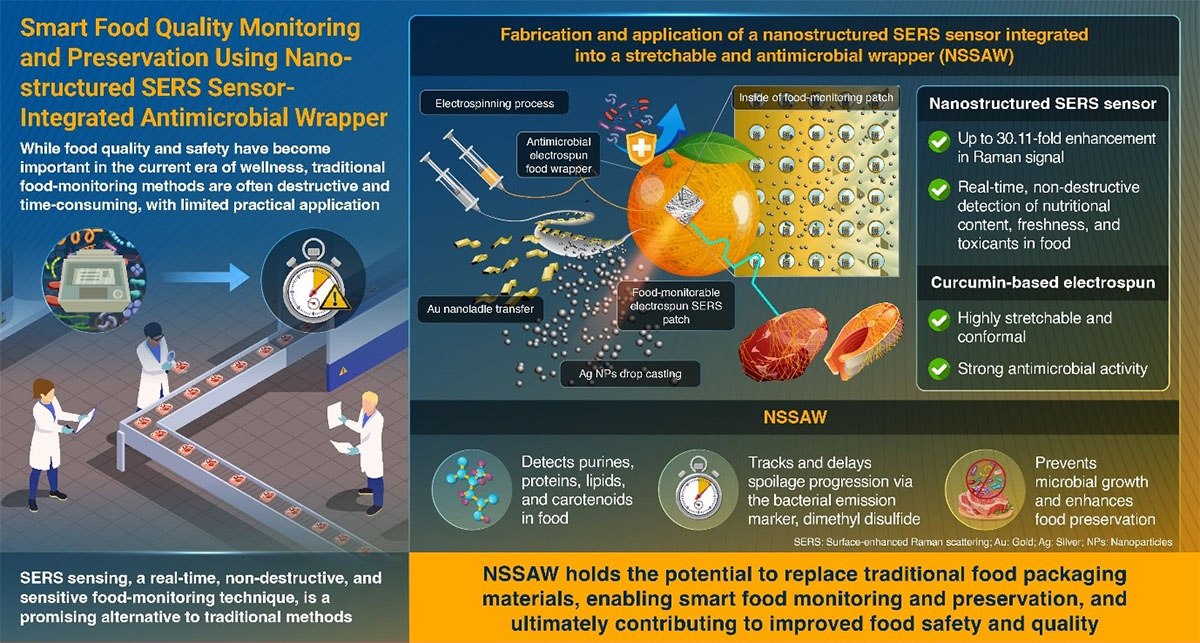 |
| A novel wrapper that facilitates real-time, non-destructive detection of nutritional components in food. (Image: Hanbat National University) (click on image to enlarge)
|
|
The wrapper integrates a nanostructured SERS layer consisting of gold nano-arrays coated with silver nanoparticles. This design delivers a Raman signal boost of up to 30.11 times, allowing rapid, non-destructive detection of nutritional components such as purines, proteins, lipids, and carotenoids, as well as the pesticide thiram on meat, fish, and fruit. The curcumin-thermoplastic polyurethane wrapper also acts as active packaging, showing 99.99 percent antimicrobial effectiveness against S. aureus and 99.9 percent against E. coli, helping to extend shelf life.
|
|
The device is durable and flexible, enduring elongation of up to 716 percent and stress of 52.3 MPa. The SERS layer becomes part of the wrapper during fabrication using nanoimprint lithography, electron-beam slanted deposition, and electrospinning with nanotransfer printing, offering a scalable approach for commercial packaging.
|
|
“In cold-chain logistics and storage, the wrapper can help distributors decide when to ship and sell food by continuously tracking freshness and spoilage chemistry. In retail smart packaging, its stretchable, conformal, and biocompatible nature enables non-destructive, on-package checks of quality and nutrition markers—without any damage to food—supporting point-of-sale quality automation and transparent date labeling. Thus, the real-world uses of our technology span the entire farm-to-fork chain,” says Prof. Ha.
|
|
The system can also monitor spoilage over time by detecting dimethyl disulfide, a key bacterial marker that links chemical signals to food freshness in a way users can easily interpret. The researchers expect this approach to reshape how food composition and freshness are monitored.
|
|
“NSSAW can act as an on-food freshness indicator during consumer storage for home use and meal-kit delivery, linking chemical changes to easy-to-interpret signals over time. In addition, for high-value seafood and meats, quantitative tracking of purines such as hypoxanthine supports premium-grade verification and shelf-life decisions. Moreover, as active packaging, the curcumin-TPU, with its antimicrobial properties, complements sensing with preservation to extend shelf life in distribution and retail,” says Prof. Ha.
|
|
Over the next decade, packaging that both preserves food and continuously verifies its quality could become commonplace. With this technology, retailers and households may rely on live freshness readings instead of rough expiration estimates, reducing waste, improving safety, and enabling smarter pricing and recalls.
|